January 6, 2012 - 12:00 am

Photo by Markrosenrosen (Wikimedia)
It looks like you made it to the weekend! I know all of you have been working very hard after a relaxing holiday, so I thought I should reward you with a Wild Fact about a cute and cuddly animal. Personally, I thought yesterday’s fact on the Anopheles Mosquito would have fallen into this category but I don’t think everyone sees it that way. So we are going to end the week with the fun and furry Blue Monkey, which is also known as the Diademed Monkey but that is tough to say so I think I will stick with the Blue Monkey. Is this monkey really blue? Find out in about 4.5 seconds…
How Blue is the Blue Monkey?
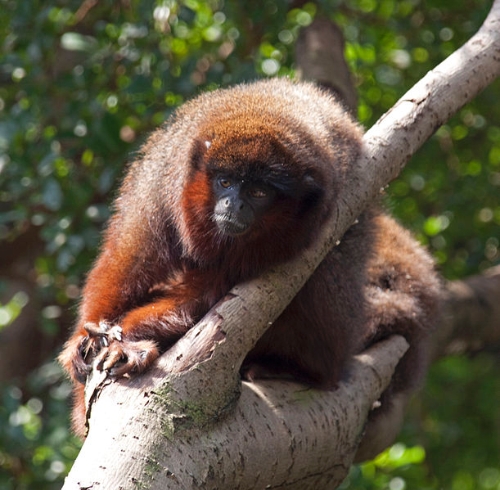
The short answer to this obvious question is “No”. The Blue Monkey is not noticeably blue, however, they have little hair on their face and this does occasionally give them a bluish appearance. For the most part the Blue Monkey is actually an olive or grey colour, except for the face which is typically dark with a yellowish patch on their forehead. Perhaps they should be called the “Yellowish, Olive/Grey Monkey”. Sure it doesn’t sound that great but at least it would be more accurate.

Photo by D. Gordon E. Robertson (Wikimedia)
A Forest Home
So where can we find our “Blue” Monkey? This particular monkey is native to Central and East Africa in the canopy of the evergreen forests or the montane bamboo forests. I have never personally been to a “bamboo forest” but it sounds absolutely incredible. If any readers have experienced this intriguing forest, could you please let me know what it was like? Thanks! Anyway, back to our monkey friend….
Life is Not Fair
Since the Blue Monkey prefers to live in trees that are capable of providing both food (fruits and leaves) and cover, they are quickly losing their habitat. For some reason, humans prefer to clear out these useful trees to create pine plantations. After this occurs, the confused monkey will begin peeling the bark off of these new, exotic trees trying to find something to eat. Naturally, this doesn’t go over well with “us” and measures are taken to ensure the Blue Monkey “Pests” no longer damage the pine plantations. Is it just me or does this not seem fair to the monkey?
That does it for the week. Enjoy your weekend and I will see you on Monday.
Posted in Blue Monkey, Mammals
Tags: Animal Facts, Blue Monkey, Blue Monkey Facts, Diademed Monkey, monkey facts, Old World Monkey, Primates
January 5, 2012 - 12:00 am

Photo from Wikimedia
While I was waiting for the bus this morning, I quickly realized that we were definitely in the middle of winter. As I was sitting there freezing, I began to actually miss blackflies, mosquitoes and all the other wonderful bugs of Spring. Yes, that is how cold I was this morning. Since I was missing these nasty little insects, I figured we would take a break from winter and learn a little more about one of the more popular mosquitoes out there, the Anopheles mosquito. What? You didn’t realize there were popular and unpopular mosquitoes? You will soon find out what makes the Anopheles mosquito so special.
A Special Vector
So does anyone know what makes the Anopheles mosquito important to humans? I will give you a hint. Out of the 460 species of Anopheles, there are a 100 species that you do not want to get bit by. Why? Well, these 100 species have been known to transmit a little disease I like to call Malaria. Have you heard of it? Of course you have and this is why the Anopheles mosquito is so special. Sure the Culex Mosquito transmits the West Nile Virus but I figure Malaria is more dangerous worldwide, which is why I chose the Anopheles for today’s Wild Fact.

Larvae Stage
A Day In The Life Of…
Other than their desire to transmit deadly diseases, the Anopheles mosquito is not much different than other mosquitoes out there. Just like their relatives, they have four life stages, which are egg, larva, pupa and imago. The first three stages occur in slow moving water (so make sure you remove those old tires and other rain traps) and will typically last between 5 and 14 days. The female adult phase (known as the imago stage) can last up to a month, however, the male adults tend to only live for a week or so. This is the stage that humans are most familiar with as we are constantly dealing with the pesky adult females during our picnics, baseball games and fishing trips. As well, it is only in this stage that the Anopheles mosquito becomes a vector of deadly diseases such as Malaria. You will notice that I keep referring to the adult “females”. Yes, it is only the women that have a taste for blood as their male counterparts prefer to feast on nectar and are actually very important pollinators. The poor males get a bad name simply because of the vampire females. Life isn’t fair sometimes, right guys?
All this talk about malaria and mosquito bites has me wishing for winter. Good thing it is January in Canada… I don’t have to worry about mosquito bites for several months. As well, I will remember not to complain so much the next time I am freezing at the bus stop. Enjoy the rest of the day.
Posted in Anopheles, Insects
Tags: Animal Facts, Anopheles, Anopheles Mosquito, Deadly Insects, Deadly Mosquitoes, Malaria, Malaria Vectors, Mosquito
January 4, 2012 - 12:00 am

Source: http://www.flickr.com/photos/arudhio/98171881/
Congratulations for making it to the middle of the week. The weekend is just around the corner and to help make the ride there a little easier, we are going on a trip to learn about a passerine bird known as the Bulbul. So where exactly are we going? Well, you get to decide since this bird can be found in a variety of locations including Africa, Middle East, tropical Asia and where I plan on going, Indonesia. What are you waiting for? Get your passport and your binoculars and let’s get going.
What’s That Noise?!?
There are about 130 species of the Bulbul but instead of going through all of them, we are just going to focus on the general characteristics of the entire family. As mentioned, the Bulbul is a passerine bird that has a long tail and short wings. Although the Bulbul is known to be quite vocal, this isn’t necessarily a good thing as one author described their nasally calls as “the most unattractive noises made by any bird”. With a description like that, you know we are going to find a call to judge for ourselves. Follow the link below to hear the “most unattractive noise”.
Brown-Eared Bulbul Call
I don’t know, I find the shrill to be quite soothing. I think it would be a great sound to fall asleep to.

Photo by Shiva shankar (Wikimedia)
Family Ties
For the most part the Bulbul is a monogamous bird species and in some cases, a very tight family. The male will typically feed the female as she incubates her eggs, which takes up to 12 days, on average. In some species, the past chicks will stick around to help raise their new brothers and sisters, which is awfully nice of them. In on species, the Bulbul is actually polygamous and as a result these tight family bonds don’t exist. It would be interesting to see which method is more successful for the Bulbul.
A Noisy Pet
If you have been reading this Wild Fact trying to figure out why you have heard of this bird before, perhaps you know someone that has a pet Bulbul. The Red-Whiskered and Red-Vented Bulbul have been captured and widely distributed in the pet trade. Hopefully these birds have a nicer song than the Brown-Eared Bulbul, otherwise I would think there would be some unhappy pet owners.
Thanks for reading today’s Wild Fact. Enjoy the rest of your day and I will see you back here tomorrow.
Posted in Birds, Bulbul
Tags: Bird Facts, Birds of Africa, Brown-Eared Bulbul, Bulbul, Bulbul Facts, passerine birds
January 3, 2012 - 12:00 am

Photo by Dawson (Wikimedia)
For many people, today is officially the end of the holidays as we all prepare to take down the decorations and head back to work. To help ease you back into your normal routine, I thought we would learn about an interesting little turtle known as the Pig Nosed Turtle. This turtle, which is native to Australia and New Guinea is also known as the Fly River Turtle and the Pitted-Shelled Turtle. So grab your morning cup of coffee and snuggle up to the computer as we prepare to learn everything we can about the Pig Nosed Turtle. Then you can scurry around the house before leaving for work.
An Important Link
As mentioned, you need to go to Australia or New Guinea if you want to catch a glimpse of the Pig Nosed Turtle, which is typically found throughout freshwater rivers, lagoons and streams. Although they are freshwater turtles, they share some qualities with their marine counterparts. In fact, researchers believe that the Pig Nosed Turtle represents an evolutionary link between freshwater and marine turtles. So what are a few of the similarities? Well, like the marine turtle, the Pig Nosed Turtle also have flippers for feet as well as movable digits. This unique freshwater feature make the Pig Nosed Turtle most adapted turtle to life in an aquatic environment, with the exception of their marine counterparts of course.

Photo by Faendalimas (Wikimedia)
A Swimming Pig
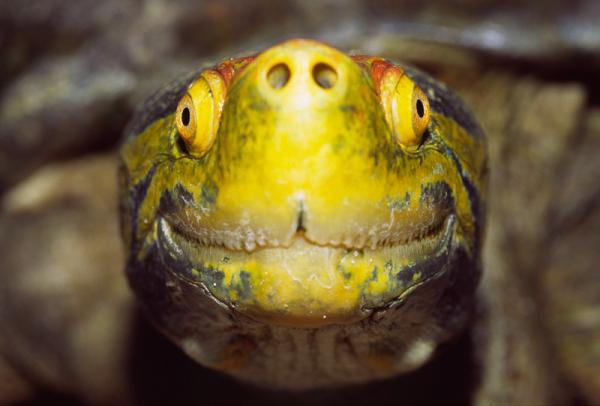
As you can tell from the picture, the Pig Nosed Turtle gets their name from their unique nose, which looks very similar to that of a pig. I am not sure what the purpose is for having a nose like this but it definitely makes the turtle interesting. Besides their fun looking nose, they also have a greyish or olive colour, leather shell and gender determining tail. Males will typically have longer tails compared to the females so it is an easy way to tell the gender of your favourite Pig Nosed Turtle.
Major Decline
The Pig Nosed Turtle is the last surviving member of its ancient family, however, their population has declined by over 50% since 1981. Reasons for the decline include harvesting – both adults and eggs – and of course habitat destruction. Hopefully this link between freshwater and marine turtles can be saved from extinction.
That does it for today’s Wild Fact. Enjoy the rest of your day and have fun going back to work.
Posted in Amphibians, Pig Nosed Turtle
Tags: Animal Facts, Fly River Turtle, Freshwater Turtles, Marine Turtles, Pig Nosed Turtle, Pig Nosed Turtle Facts, Turtles
January 2, 2012 - 12:00 am

Photo by Tino Strauss (Wikimedia)
Welcome to the first Wild Fact of 2012. I trust all of you had a great New Year’s celebration and are ready for an exciting and prosperous 2012. With New Year’s comes the infamous “New Year’s Resolutions”. I have yet to make one, however, I think today’s animal, the Fat Sand Rat, should probably take some time to craft one or two resolutions for themselves. Yes, there is a member of the Gerbil family that is commonly known as the Fat Sand Rat. In fact, their scientific name, Psammomys obesus, isn’t much better. Let’s find out why this little rodent received such a hurtful name.
The Fat Lab Rat
As you might expect the Fat Sand Rat happens to be quite bulky and as such they have been referred to as “sloths of the rodent world”, which isn’t very accurate. Granted, the male Fat Sand Rats are bulky and as such, don’t exercise too much, however, the females tend to be quite lean, fast and agile. Perhaps, the females can help their counterparts keep their resolution this year. Interestingly enough, the Fat Sand Rat has been observed to suffer from diabetes when they feed on normal rodent food. As such, these rodents have become very important in the laboratory as humans continue to study the impacts of diabetes. I guess being a fat rodent does have its benefits…..for humans.

Click for Source
Housekeeping Sand Rat
The Fat Sand Rat is known to be active throughout the day and night, which lands them back in the laboratory to study seasonal affective disorder, but we will save that story for another time. Although these rodents get pegged for being lazy, they tend to have complex burrow system. Their underground homes usually consist of chambers for food storage, nesting as well as mating. Every morning, before they go foraging, the Fat Sand Rat has been spotted at the entrance of their burrow sweeping out the dirt and excrement. A little house cleaning to start the day is probably a good habit to get into. Perhaps, I jumped to conclusions when I mentioned that this rodent needs to make a resolution. They seem to be pretty organized and could probably teach us a few things, in the laboratory as well as out of it.
That does it for the first Wild Fact of 2012. Enjoy the rest of your day and I will see you tomorrow for another animal.
Posted in Fat Sand Rat, Mammals
Tags: Animal Facts, Fat Sand Rat, Fat Sand Rat Facts, Gerbils, Rodents, Sand Rat, Sand Rat Facts
December 30, 2011 - 12:00 am

Photo by Greg Hume (Wikimedia)
Before we get today’s Wild Fact started, I wanted to wish a Happy Birthday to Jamie who is responsible for suggesting today’s fact on the Beluga Whale. I was in shock when he informed me that I had yet to complete a Wild Fact on this amazing animal. Thank you Jamie for suggesting today’s animal and I hope you have a great birthday! The Beluga Whale is also known as the White Whale as a result of their unique white colouring. This colouring makes the Beluga one of the easiest whales to identify. So let’s see if we can locate a few of these incredible animals to learn a little more, shall we?
The “Small” Whale
The Beluga Whale isn’t the largest whale out there with an average length between 4 and 6.1 metres (13 to 20 feet). Males are typically a little larger than their female counterparts and have been known to weigh up to 1900 kg (4200 lbs). It is funny how we consider a whale of this size to be “small” but I guess it is all relative. The most conspicuous feature of the White Whale is the their unique, rounded forehead, which is known as the melon. The forehead of the Beluga is incredibly bulbous and is slightly malleable. The cool thing about this melon is the fact that the whale can change the shape of it simply by blowing air into their sinuses. This would be a great party trick.

Photo by Eva Hejda (Wikimedia)
Social Whales
Beluga Whales are social animals that will typically live in small groups called pods, however, these groups have been known to get as large as 100 individuals. To communicate with each other, the Beluga uses a variety of clicks, whistles and clangs. As well, they have been known to mimic a variety of sounds. This communication is important since these pods will migrate long distances. And I am sure the trip goes a lot quicker if you can carry on a conversation with your travel buddies. The White Whale migrates south prior to the freezing of the Arctic Ocean, however, some whales won’t make it out before the ocean freezes, which typically results in death. I guess this is another important reason to be able to communicate with your pod members.
That does it for today’s Wild Fact. I hope you enjoy your day and have a great New Years. I will see you on Monday for the first Wild Fact of 2012.
Posted in Beluga Whale, Mammals
Tags: Animal Facts, Beluga Whale, Beluga Whale Facts, Whale Facts, Whales, White Whale
December 29, 2011 - 12:00 am
Welcome to the Thursday edition of Wild Facts. As the snow continues to pile up in Ontario, we are going to relax in a warmer climate today. More specifically we are going to the Andean slope in northern and central Chile to find a small cat known as the Colocolo. Hmmm… I just realized that we will be climbing to an altitude of 1800 m (5900 feet) in order to find this beautiful cat. Perhaps, this isn’t going to be a nice relaxing vacation. Nonetheless, we will carry on since the Colocolo is one interesting feline.
Fashionable and Practical
Although the Colocolo is a small cat with a length between 56 and 67 cm (22 to 26″), they are quite heavy, weighing up to 3 kg (6.6 lbs). Okay, when you say it out loud, it doesn’t sound that heavy but it really is if you think about a 2 foot cat weighing over 6 lbs. I guess that heavy-set nature comes in handy when you live in high altitudes of the world’s largest continental mountain range. The Colocolo has a beautiful grey coat decorated nicely with brown stripes and spots. This coat is not just fashionable though as the long, coarse fur offers the cat protection from the environment they inhabit.

Photograph by Cola da Web.
Conservation of the Colocolo
The conservation status for the Colocolo is listed at “Near Threatened”, however, this rating includes the related Pantanal Cat and the widespread Pampas Cat. Until recently, it was believed that the Pampas Cats and Pantanal Cats were the same species as the Colocolo. Studies have shown that these are actually three distinct cat species. If the Colocolo is rated on its own, they may be considered “Endangered”, however, this is just an assumption since an official rating for just the Colocolo has not be undertaken. Luckily, the habitat that this small cat inhabits is not incredibly useful to humans yet, so habitat destruction shouldn’t be a major issue for our furry, feline friend.
The Pampas Cat vs. The Penguin
Since the Colocolo was once considered to be the same species as the Pampas Cat, I figured we should learn a quick fact about this species as well. Did you know that the Pampas Cats were known to steal penguin eggs and chicks from their nests? I doubt the Colocolo does this since I really don’t think penguins are hanging out in the Andes Mountains.
That does it for today’s Wild Fact. Enjoy the ret of your day and I will see you tomorrow for the final fact of the week.
Posted in Colocolo, Mammals
Tags: Animal Facts, Animals of South America, Animals of the Andes Mountains, Colocolo, Colocolo Facts, Pampas Cat
December 28, 2011 - 12:00 am

Photo from WIkimedia
For some of us the holidays are ending today, so if you are heading back to a quiet workplace after a great Christmas weekend, this Wild Fact is for you. For the rest of you still on holidays……this Wild Fact is also for you
. Today we are heading to Australia to learn about the fourth largest lizard in the world, the Perentie. This particular lizard is a type of Goanna, also known as a Monitor Lizard, which is native to Australia. Other notable members of the Goanna family include the Crocodile Monitor, the Water Monitor and of course the most famous, the Komodo Dragon. Incidentally, these three species are the only lizards that are larger than the Perentie.
Big, Bad Bite
So just how big is the Perentie? Typically, this lizard can grow up to 2.5 metres (8′ 2″) long and weigh up to 20 kg (44 lbs), which is pretty impressive if you remember that this is a lizard we are talking about. Running across a large lizard like this may be intimidating but it is even worse when you realize that they also have a venomous bite. I would be careful feeding a Perentie since a bite from one of these lizards can cause swelling, blood clotting and of course an intense shooting pain that may last up to several hours. Although, the venom may not kill you, I don’t recommend sticking your fingers in the mouth of the Perentie.

Photo by Sean Mack (Wikimedia)
Escape Artists
Luckily, Perenties try their best to avoid human contact, so the chances of getting bit are pretty slim. In fact, the chances of even seeing one of these magnificent creatures is pretty slim. They will typically disappear long before you even know they are in the area. The Perentie is a surprisingly quick runner that can run on all four legs or just the hind legs. If they do stick around, there is a good chance you will just walk on by since the Perentie is known for their camouflage. As well, this large lizard is capable of digging a burrow within minutes and are excellent tree climbers, so they have many options if they decide to escape.
Well that does it for today’s “Back to Work” Wild Fact. I hope you enjoy the rest of the day and if you are still on holidays, kick back and relax! See you tomorrow for another Wild Fact.
Posted in Perentie, Reptiles
Tags: Animal Facts, Animals of Australia, Goanna, Goanna Facts, Largest Lizards in the World, Lizards of Australia, Monitor Lizard, Perentie, Perentie Facts
December 27, 2011 - 12:00 am

Photo by Laurent Lebois (Wikimedia)
I have a hunch that today’s Wild Fact is really going to stink.Yes, that is because we are going to learn about the foul-smelling Stinkpot Turtle. It is also known as the Common Musk Turtle and can typically be found in southeastern Canada and the eastern United States. More specifically, you will find these little turtles hanging out in slow moving, shallow water bodies with a nice muddy bottom. So grab your rubber boots, a pair of nose plugs and lets go learn a little more about this smelly turtle.
Too Stinky To Eat
As you may have guessed, the Stinkpot Turtle gets their name from its ability to release a foul, musky odour. Using that definition, you could probably start calling your Dad a “Stinkpot Turtle”. The purpose of this foul smell is to encourage predators to look somewhere else for dinner. Since they are only 8 to 14 cm (3 to 5 inches) in size, this is an important feature for them. Luckily this tactic works incredibly well as the Stinkpot Turtle is hardly ever preyed on. You know you smell bad when a hungry wild animal doesn’t even want to eat you.

Photo from Wikimedia
Cottage Life
As mentioned earlier, the Stinkpot Turtle spends the majority of their time in slow moving water bodies that typically have a muddy bottom. For the most part, they only venture out onto land when ti is time for the female to lay her eggs. With that said, some turtles will go out every now and again to bask in the sun. I guess even turtles can’t resist lying on the beach from time to time. Similarly, these smelly little turtles have been known to climb up large tree branches, sometimes even higher than 2 m (6 feet) into the air. As boats drive by the turtles will often fall in and go for a nice boat ride. Suntanning and boating… it sounds like a pretty good day at the pond to me.
One Smelly Pet
Although the Stinkpot Turtle smells rotten, this doesn’t stop people from owning them as pets. Recently, the Common Musk Turtle is becoming a popular pet among households. I don’t normally condone having wild animals as pets, however, owning the Common Musk Turtle is taking the pressure off of other more endangered turtles, which is bonus. In fact, the USDA bans the sale of turtles smaller than 4 inches except for the Stinkpot Turtle, so even they are on board with them being used as pets.
That does it for today’s Wild Fact. Enjoy the rest of your day and I will see you tomorrow for another animal fact.
Posted in Amphibians, Stinkpot Turtle
Tags: Animal Facts, Pet Turtles, Small Turtles, Stinkpot Turtle, Stinkpot Turtle Facts, Turtle, Turtle Facts
December 26, 2011 - 12:00 am

Photo by Pedro Gonnet (Wikimedia)
I hope Santa was good to all of you and you had a great Christmas. While you are coming down from your sugar high, I thought we would take a quick boxing day trip to eastern and southern Africa. It is probably safe to assume that there won’t be any snow there but that won’t stop us from learning about the incredibly cute Dik Dik. Even though the Dik Dik is a dwarf antelope, I think we can make a good case for them to be included with Santa’s reindeer next year. Sure, they may not be the strongest, and perhaps they can’t fly but how could you possibly say no to this cute little animal? While we ponder their inclusion into Santa’s Reindeer herd, grab another glass of egg nog, sit back and enjoy the Dik Dik facts.
A Tasty Snack
As mentioned the Dik Dik is a dwarf antelope and as such, I feel compelled to tell you just how small they really are. This tiny antelope typically stands at a height between 30 and 40 cm (12 to 16 inches) and weighs between 3 to 6 kg (7 to 16 pounds). There is a pretty good chance that you pet dog is actually larger than the Dik Dik. As you can imagine, life can be difficult for a small antelope in Africa. They have to constantly be on the lookout for the following predators:
- Monitor Lizards
- Caracals
- Lions
- Hyenas
- Wild Dogs
- Leopards
- Cheetahs
- Jackals
- Baboons
- Eagles
- Hawks
- Pythons
- Humans
If that many things wanted to eat me….I am pretty sure I would never leave the house.

Photo by D. Gordon E. Robertson (Wikimedia)
Escape the Predator
In order to live past lunch time, the Dik Dik has amazing eyesight allowing them to see the predators coming from a long distance. Once they spot the threat, this tiny antelope is able to hurriedly get out of harms way. In fact, they are capable of running up to 42 km/hr (26 mph), which is probably quick enough to escape most predators. Since they rely on their eyesight to survive, the Dik Dik can typically be found in grasslands, however, as the grass grows too tall, this antelope will move out to find a new home that doesn’t obstruct their vision. Hopefully Santa brought the Dik Dik a nice lawnmower for Christmas!
That does it for the Boxing Day Wild Fact. Feel free to head out and go shopping now…..if you are brave enough! See you tomorrow for another animal fact.
Posted in Dik Dik, Mammals
Tags: Animal Facts, Animals of Africa, Antelope, Antelope Facts, Dik Dik, Dik Dik Facts, Small Antelope