Posts Tagged ‘Cats’

Wild Fact #385 – Can You Do a Cartwheel? – Ring-Tailed Cat

January 16, 2012 - 12:00 am No Comments
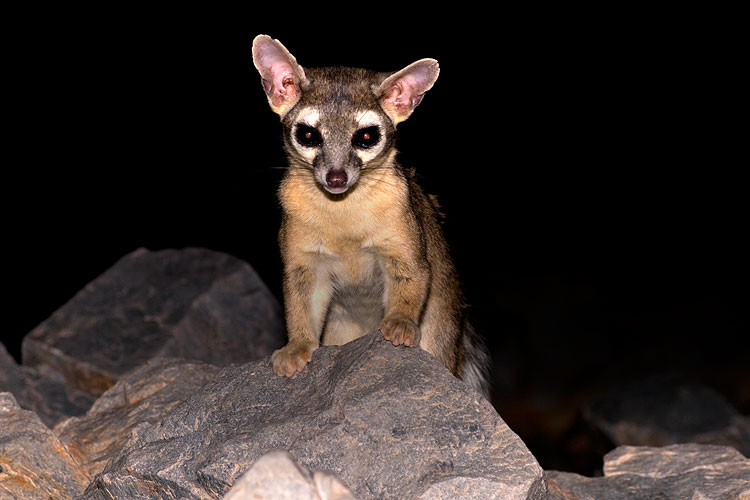
Ring-Tailed Cat

Photo by Robertbody (Wikimedia)

After ending last week with an interesting Wild Fact on the newly discovered Montane Mouse, I thought we would start this week with the typical nemesis of any mouse…..a cat! Wait! What do you mean the Ring-Tailed Cat is not actually a furry feline? That’s right, the Ring-Tailed Cat is not really a cat. So if they are not part of the feline family, what kind of animal are they? Take a minute to guess, I will give you the answer soon. To help you figure out what family this animal belongs to, you may want to take a trip to a nice desert-like area of North America such as Arizona, California or even Texas to get a closer look.

What Am I?

Okay, so did you figure out what the Ring-Tailed Cat really is? Did you guess a lemur? Perhaps the canine family? While these would have been good guesses the real answer is obvious once you hear it. The Ring-Tailed Cat is actually a member of Procyonidae family! See, I told you it was obvious once you hear it. In case you were wondering, the Procyonidae family is also known as the “Raccoon” family. This makes a lot of sense when you look at the face of this adorable desert “cat”.

The Perfect Climber

Would you believe me if I told you that this desert animal has several adaptations that make them phenomenal climbers? It’s true! For starters, they have an incredibly long tail that provides them with amazing balance. Secondly, their ankle joint is capable of rotating more than 180 degrees, which makes them a very agile climber. So why in the world would a desert animal need to be a good climber in a desert? This is a great question.

Ring-Tailed Cat

Photo by Robertbody (Wikimedia)

A Real Cliffhanger

Although, their habitat may lack trees, it does have  a lot of rocky cliffs and embankments that the Ring-Tailed Cat loves living in. The Ring-Tailed Cat may be one of the best rock climbers in the Animal Kingdom. For instance, these animals have been known to shimmy up crevices by placing their back against one wall with all four feet against the other as they climb at a 90 degree angle. If that doesn’t impress you, they have also been known to perform cartwheels using their long, balancing tail. I can’t even do a cartwheel so that amazes me.

Well, I hope you enjoyed today’s Wild Fact on the misleading Ring-Tailed Cat. Enjoy the rest of your day and I will see you tomorrow for another exciting animal fact.


Digg This
Reddit This
Stumble Now!
Buzz This
Vote on DZone
Share on Facebook
Bookmark this on Delicious
Kick It on DotNetKicks.com
Shout it
Share on LinkedIn
Bookmark this on Technorati
Post on Twitter
Google Buzz (aka. Google Reader)

Wild Fact #513 – Part of the Family – Australian Mist

July 20, 2011 - 12:00 am 3 Comments

Photo from Wikimedia

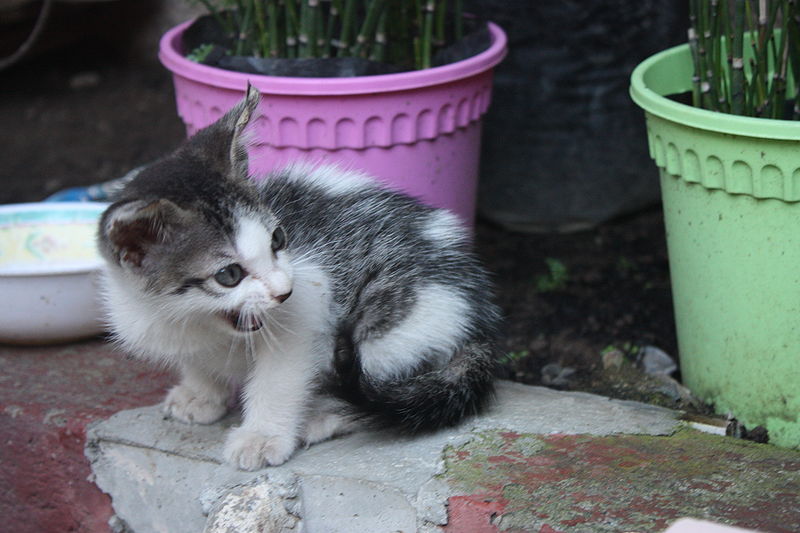
For some reason, I felt like mixing things up a little today so instead of the usual “Wild” Fact, we are going to learn about a domestic animal today. To be a little more precise, we are going to cuddle up to a cute little kitty cat called the Australian Mist. This cat, which has also been known as the Spotted Mist, has obviously be bred in Australia. Shocking, I know! They managed to create this special breed of cat by crossing Abyssinian, Burmese and Domestic Short Haired cats. Is it just me or does this sound like the same way Frankenstein was created? Luckily the Australian Mist is a lot fluffier than the scary, green monster.

By crossing these different breeds of cats, they (really, who is “they”?) managed to create a short-haired cat with spots. But the Australian Mist is much more than a spotted cat with short hair. They also make perfect pets for young children as they are friendly, don’t mind being man-handled and will hardly even think of scratching. Basically, if you are looking for a great cat that will become a part of your family then you need to get an Australian Mist. These particular cats thrive on human attention and can’t wait to crawl into your lap, invited or not. I am not a big cat person but this would definitely be the type of cat I would want.

Photo by Regis2007 (Wikimedia)

You may be thinking to yourself that you have never heard of this friendly companion. Well, don’t beat yourself up too bad, since they are a relatively new breed of cat. The first Australian Mist was created in 1976, however, most of these cats remained in Australia for quite some time. During the 20th century these friendly breeds started making appearances in the United Kingdom and the Americas. A cat that is friendly and thrives on human attention should be shared, don’t you think?

Australian Mist Fast Fact – Although they were originally named Spotted Mist, the name was changed to Australian Mist in 1998 when cats with marbled coats were considered to be part of this breed. I guess they didn’t want to offend the marbled cats by calling them “spotted”.

That does it for our Domesticated Wild Fact. We will get back to the true wild animals tomorrow so make sure you stop by to see what we are talking about.

Digg This
Reddit This
Stumble Now!
Buzz This
Vote on DZone
Share on Facebook
Bookmark this on Delicious
Kick It on DotNetKicks.com
Shout it
Share on LinkedIn
Bookmark this on Technorati
Post on Twitter
Google Buzz (aka. Google Reader)

Wild Fact #558 – The Purrrrfect Pet – Somali

May 18, 2011 - 12:00 am 2 Comments

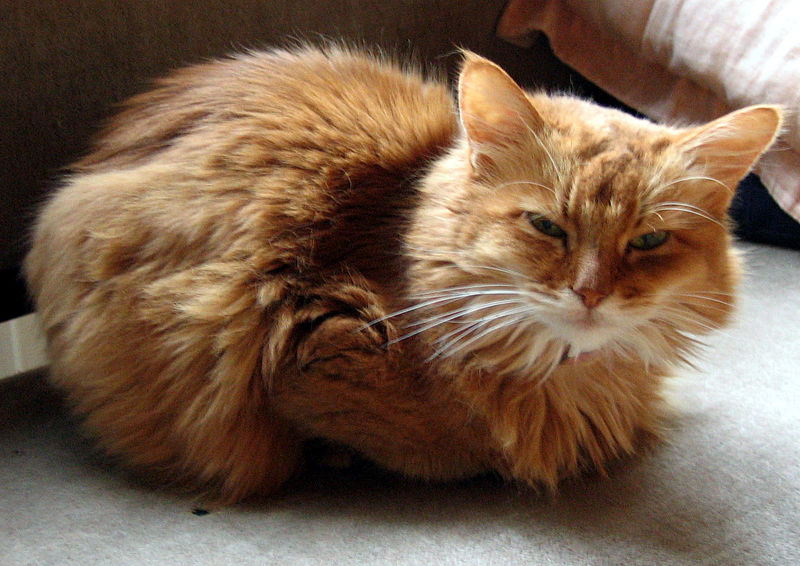
Photo by Heikki Narko (Wikimedia)

You may know by now that I am definitely more of a dog person than a cat person; however, this website is all about unbiased facts (okay so maybe there are a few biased facts) so today I am going to be writing about a domestic cat called the Somali.  I figure this is only fair since we talked about the German Shorthaired Pointer yesterday.  And you know I don’t want to leave out all of my cat loving friends.  Although the Somali originated from Northern Africa, they are quite popular throughout the United States of America.  So let’s learn more about this cute, little cat, shall we?

If you love cats but hate the shedding that comes with them then you are going to be very excited about the Somali.  Yep, you guessed it, this particular breed of cat sheds very little.  So how did this awesome, non-shedding cat come about?  Well, they sort of appeared overnight during the 1950′s.  They are actually part of an Abyssinian breeding program (in case you don’t know your cats – the Abyssinian is thought to be the oldest breed of cat in the world).  Somewhat spontaneously during this breeding initiative, little kittens were born with long fluffy coats and bottle-brush tails.  This my friends was the beginning of another intelligent and playful breed of cat.

Photo by Julia Shepeleva (Wikimedia)

As I just alluded to , the Somali isn’t your stereotypical cat that doesn’t want anything to do with you.  Nope, this breed is intelligent, active, playful and very affectionate.  Probably why they have become so popular among pet owners in the States.  Even a dog lover such as myself wouldn’t mind getting one of these playful cats (no, that is not a hint for a future birthday gift).  Even better yet is the Somali actually thrives in an environment with other animals. This makes them perfect if you have other pets or children.  It sort of sounds like I just compared your children to pets but I really didn’t mean to :) .

Somali Fast Fact – If you are going to own a Somali then you should be aware that they tend to have problems with their teeth.  As well, about 5% of all Somali’s have issues with their kidney’s.  Although, I think the benefits of this breed definitely outweighs the disadvantages.

I guess that does it for another Domesticated Wild Fact. I promise we will be back to the Wild tomorrow.

Digg This
Reddit This
Stumble Now!
Buzz This
Vote on DZone
Share on Facebook
Bookmark this on Delicious
Kick It on DotNetKicks.com
Shout it
Share on LinkedIn
Bookmark this on Technorati
Post on Twitter
Google Buzz (aka. Google Reader)

Wild Fact #848 – No Place to Hide – Leopards

March 24, 2010 - 12:00 am 8 Comments

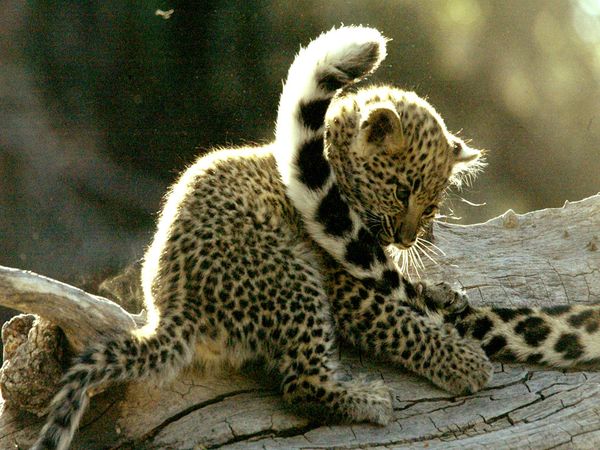
Photograph by Beverly Joubert

I can’t really explain it but I have been absolutely fascinated with large cats lately.  The more I research and study them the more I respect and appreciate the natural beauty, power and grace of these animals.  Today, we are going to look at some interesting feeding strategies of the Leopard. For the record, I figured I would put the cute baby leopard at the beginning of the fact since nobody would be able to resist reading the post after seeing the playful kitten. Enough of my sneaky ploys to get readers! Let’s learn about the leopard!

The leopard’s habitat is in Africa, India, China, and Central Asia, but the leopard population is dwindling outside the African continent. The leopard may be closely related to lions, tigers, and jaguars, but their unique feeding habits puts them at the top of my “Favorite Large Cat List.”  The leopard is capable of dominating all aspects of their environment.  These cats are incredibly comfortable in the trees and will actually hunt from above their prey.  The spots on the leopard allow this cat to blend in with the leaves until it decides to pounce. Once they ambush their prey the leopard has been known to drag their dinner back up into the trees and have a nice quiet meal all to themselves without those pesky hyenas trying to steal their kill.  It absolutely amazes me that the leopard is capable of hauling large prey such as antelope into the tree tops.  Just think about how strong and agile you would have to be.  Heck, my muscles are aching just thinking about this heavy lifting.  If the leopard gets tired of hunting from the trees then it is fully capable of stalking their prey on the ground and pouncing like other large cats.  If they are not in the mood for either of these hunting methods then they will take to the water where they will feast on fish and crabs.  The leopard is a strong swimmer and provides one more example to the inaccuracies of the myth that cats don’t like water.  You can see why I am amazed with the diverse hunting strategies of the leopard.  They can dominate the land, air and water.  Where can you possibly go to escape these large cats? I think I would just go and hide under my bed!

Since I was so sneaky and put the cute, cuddly, wuddly, baby picture at the beginning of the post, I will include the adult below.  Enjoy!

Digg This
Reddit This
Stumble Now!
Buzz This
Vote on DZone
Share on Facebook
Bookmark this on Delicious
Kick It on DotNetKicks.com
Shout it
Share on LinkedIn
Bookmark this on Technorati
Post on Twitter
Google Buzz (aka. Google Reader)

Wild Fact #852 – The Water Cat – Flat-Headed Cat

March 18, 2010 - 12:00 am 8 Comments

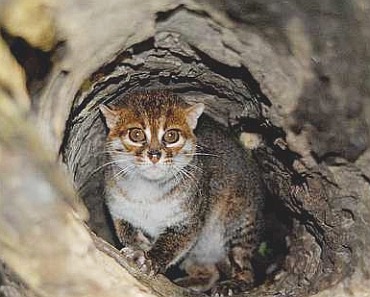
Today we are going to continue with the apparent theme of the week which is “Cats and Dogs”.  We are going to head to Southeast Asia where we will discover that cats really do like water.  I don’t know where this myth that cats don’t like water comes from but I can tell you that the Flat-Headed Cat loves the wonderful, wet stuff.

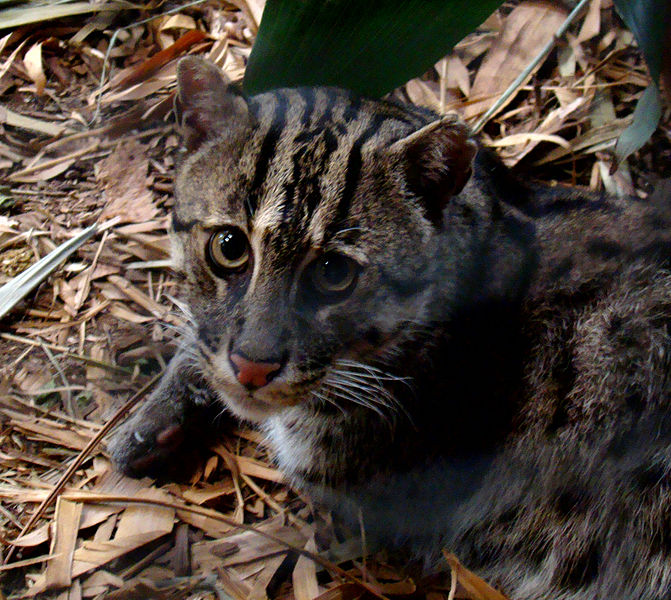
So what the heck is a flat-headed cat. Well, it is a rare, little cat that is about 60 cm (2′) long and only weighs 2.2 kg (4.8 lbs).  The diet of the flat-headed cat includes fish, frogs, crustaceans and rodents.  You will notice that the majority of their diet lives around water.  This is why you will always find our furry, flat-headed friends around lakes and streams. The appearance of this cat would make you question whether it truly is a cat since it has short legs, a long head with tiny ears and a short tail. They have often been compared to muskrats and otters instead of other cats.  The differences continue to pile up for the flat-headed cat since their toes tend to be webbed and they are one of the few cat species with non-retractile claws.  Well, I guess that isn’t entirely true since their claws do retract, however, the sheath covering is so short that two-thirds of the nail remain exposed.

Unfortunately, the population of the flat-headed cat is decreasing with under ten-thousand cats remaining in the wild. As you can imagine water pollution and habitat destruction is causing a major concern for these cute little kitties.  Just imagine what would happen to us if we didn’t have a place to live and all of our food was poisoned.  Currently, the status for this particular cat is listed as Vulnerable.

I hate ending Wild Facts with the negative feelings of extinction.  I know, I tend to do this from time to time but I do want everyone to be aware that certain animals are in jeopardy.  To make up for the sad ending, I am going to include a cute picture at the end of the post.  ENJOY!

Digg This
Reddit This
Stumble Now!
Buzz This
Vote on DZone
Share on Facebook
Bookmark this on Delicious
Kick It on DotNetKicks.com
Shout it
Share on LinkedIn
Bookmark this on Technorati
Post on Twitter
Google Buzz (aka. Google Reader)

Wild Fact #862 – Beware the Black Ear! – Caracal

March 4, 2010 - 12:00 am 4 Comments

I had so much fun yesterday writing about an animal that looks like a cat, which is named after a cat but is not a cat that I thought it would great to actually write about a cat! No, the Caracal isn’t your friendly, fluffy, neighbourhood cat but it is pretty interesting nonetheless.  Why don’t you hop on the Wild Facts Train and find out more about this medium-sized cat from Africa and the Middle-East.

Please ensure that your seats and tray tables are locked in the upright position because here we go.  Wait! I don’t think you have to worry about your seats and trays on a train, do you??  Oh well, moving on! The caracal has often been compared to the Eurasian Lynx and at one time was thought to be a close member to the lynxes. This is not the case as the caracal is more closely related to the serval (keep your eyes peeled for a Wild Fact on the Serval in the coming days).

Have you ever wondered where people come up with these weird names for animals? Who thought of the name “Caracal”?  Apparently, the term “Caracal” is turkish for black ear! Pretty original, eh?  If you are observant you may say to yourself that their ears are not that black so why are they named after it.  Then I will tell you that the young caracal cats ears are black on the outside but this colour disappears as they become adults.  Imagine what those awkward teenage years are like for the young caracal’s.  One black ear and one normal coloured ear!  The other cats laughing and pushing at poor Carl the Caracal just because he matured faster than the others.  Awww, that poor cat! Oh, before I forget I wanted to mention that the ears of the caracal are actually controlled by 20 different muscles. If I remember my human anatomy correctly, the human ear only has 2 muscles.  These ear muscles are significant for the caracal since it relies heavily on hearing to capture its prey.

For the record, they will prey on rodents, gazelles, antelopes and birds.  In my opinion the caracal is like most house cats that I am familiar with.  They are fussy and spoiled.  In fact, the caracal is such a fussy eater that it will actually use its claws to peel off the fur of the larger prey species.  The fur bothers them but apparently feathers are fine for them to eat.  I guess I am just a dog person since I have never understood cats.

This is the last stop for the Wild Facts Train.  I will be sure to pick you up the same time tomorrow.  Maybe we should just start car pooling?

Digg This
Reddit This
Stumble Now!
Buzz This
Vote on DZone
Share on Facebook
Bookmark this on Delicious
Kick It on DotNetKicks.com
Shout it
Share on LinkedIn
Bookmark this on Technorati
Post on Twitter
Google Buzz (aka. Google Reader)

Wild Fact #977 – The Purrrrfect Plan – Cats

September 23, 2009 - 12:00 am 8 Comments

cute_kitten_purr-11247594084

Maybe I should label today’s fact “Domestic Fact #977″ since I have a tough time considering the common house cat to be wild.  Although, they tend to be independent and slightly rebellious so that is how I am justifying them as a Wild Fact!

I have often thought of cats as being a conniving and manipulative pet.  Now, I have scientific evidence to prove just how manipulative cats can be.  A new study has shown that cats have evolved a special purr called “solicitation purring”.  They have developed this special purr in order to get what they want from humans! This purr has a similar pitch and frequency to a baby crying.  We all know that we can’t ignore a baby crying, especially when you are trying to sleep on a late night flight.  I am sure many cat owners have witnessed this type of manipulative purring.  You know that awesome time in the morning when you just wake up and it is cold outside so you just want to lie all snuggled up in your warm, comfy bed? Yeah, that is a great time yet the minute you start to stir, in comes Midnight purring like a crazy cat.  Because of the high pitch and frequency which makes the purr sound urgent, you feel inclined to get out of your warm sanctuary and plop some food into her bowl. If this has ever happened to you then your faithful, furry, feline friend just pulled a fast one over you. When cats communicate with other cats they tend to use a lower pitched purr.  They only save this high-pitched, annoying, baby like sound for their owners!  And you wonder why they say a dog is man’s best friend?

Have you ever witnessed the high-pitched frequency of a whining cat? Did you know they evolved this pitch to get what they want from humans?

Digg This
Reddit This
Stumble Now!
Buzz This
Vote on DZone
Share on Facebook
Bookmark this on Delicious
Kick It on DotNetKicks.com
Shout it
Share on LinkedIn
Bookmark this on Technorati
Post on Twitter
Google Buzz (aka. Google Reader)