Posts Tagged ‘Chameleon’

Wild Fact #490 – A Colourful Wild Fact – Panther Chameleon

August 22, 2011 - 12:00 am No Comments
Panther Chameleon

Photo by Marc Staub (Wikimedia)

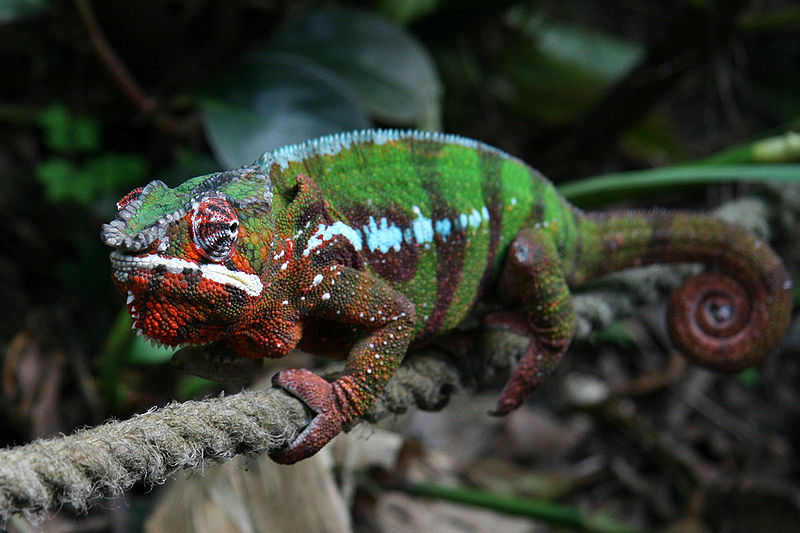
Welcome back to the start of another thrilling week of Wild Facts. We are going to learn about some pretty amazing animals this week and to kick it all off, we are heading to Madagascar to study the Panther Chameleon. I am sure you noticed from the picture that they have a pretty impressive colour display. As you might expect with Chameleons, their colour is a big part of their life so we will have to talk more about this in a few moments. Okay, so grab your field gear and lets head out to the amazing forests of Madagascar.

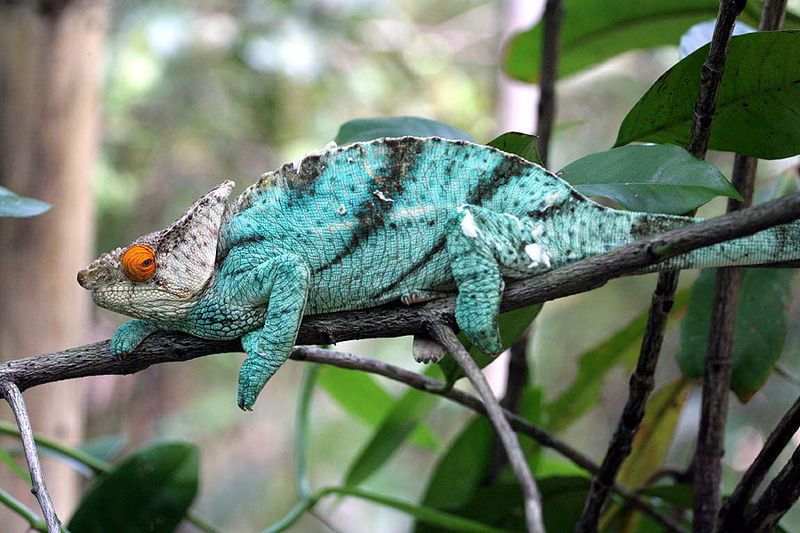
The Panther Chameleon is a fairly large reptile with males measuring up to 50 cm (20″) in length while the females are about half this size. This size discrepancy is not the only difference between male and female Panther Chameleons. As we have seen time and time again with animals, the males are also much more brightly coloured than their female counterparts. Typically the colour of the male will vary depending on their location, however, they will usually be a vibrant mix of blue, red, green, yellow and orange. The females on the other hand will be a boring old tan and brown colour with a little bit of pink or orange thrown in for good measure. Interestingly enough, the colour of the females doesn’t change based on location.

Panther Chameleon

Photo by Tom Junek (Wikimedia)

During mating season, the Panther Chameleon never has to worry about taking a pregnancy test since once the female begins carrying eggs she will turn to a dark brown colour with a nice orange stripe. This pretty much tells all the other males in the area to “leave her alone”, which is a pretty neat trick. It seems being left alone is a natural feeling for the Panther Chameleon since other than mating season they all lead very isolated lives. Like other Chameleons, the Panther variety is also very territorial and will always defend their home range. This makes sense since it is always a good idea to protect your investments and a home is one of the biggest investments a Chameleon will have.

Panther Chameleon Fast Fact – If you are stunned by the beautiful colours of the Panther Chameleon then you may be happy to hear that they have become quite popular in the pet trade. Before rushing out and buying one though, you need to realize that they can be difficult to keep since they need to have very specific living conditions.

Well that does it for the first Wild Fact of the week. I can’t wait to see you tomorrow for a brand new animal. Enjoy the rest of your day and I will talk with you again, real soon.

Digg This
Reddit This
Stumble Now!
Buzz This
Vote on DZone
Share on Facebook
Bookmark this on Delicious
Kick It on DotNetKicks.com
Shout it
Share on LinkedIn
Bookmark this on Technorati
Post on Twitter
Google Buzz (aka. Google Reader)

Wild Fact #597 – The Jousting Reptiles – Jackson’s Chameleon

March 24, 2011 - 12:00 am No Comments

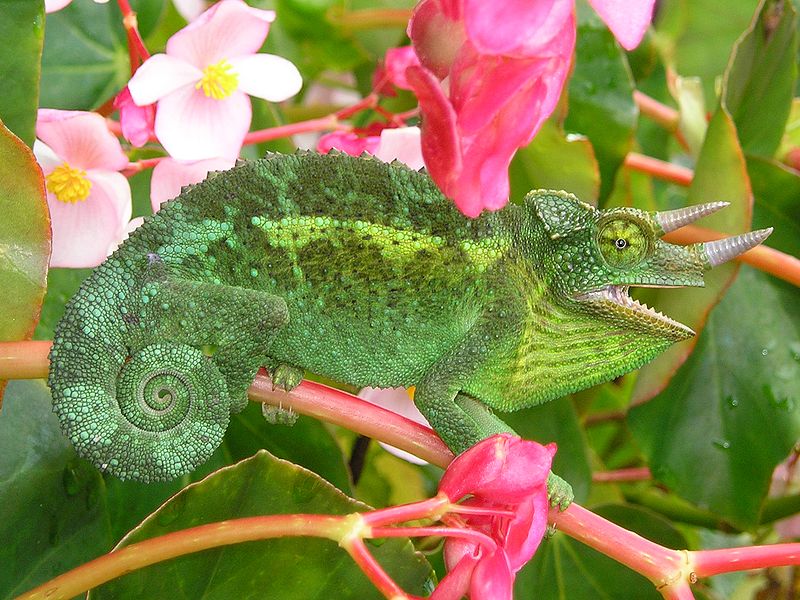
Photo from Wikimedia

I think today’s Wild Fact was sub-consciously inspired by Monday’s episode of “How I Met Your Mother”.  In case you missed it, they were bugging the main character, Ted, about his inability to properly pronounce “Chameleon”.  Well, it is a few days later and I am writing about a cool looking reptile called the Jackson’s Chameleon.  Do you think this is a coincidence or was my sub-conscious mind still thinking about these fancy colour changing animals?

You can tell right off the bat that this isn’t your ordinary, every day Chameleon, well the males anyway.  As you can tell, the males have three large horns, which makes them pretty easy to pick out of a crowd.  Actually, you would think this would be a disadvantage for an animal that tries so hard to blend in.  So what is the purpose of the horns?  Great question!  Well, as you may have guessed they play a role in self-defense and also help out during the mating season.  If threatened by a predator, the Jackson’s Chameleon will use their horns to ward off the bad guy.  During mating season though, these horns become jousting weapons between competing males.  It is literally like a jousting match as both males will charge at each other with their heads down.  Obviously, the one with the longer horn usually wins! I keep picturing two Chameleons wearing American Gladiator outfits and jousting while standing on a pedestal.

Photo by Peter Halasz (Wikimedia)

The other key feature of any chameleon is their ability to change colour.  Of course, today’s featured animal also has this capability.  Typically, they remain bright green, however, their colour will change quickly depending on their stress level, temperature and other environmental factors.  This whole colour changing thing does help males during mating season though.  When they approach a potential mate she will either turn a dark colour which means “Go Away” or she will remain bright green which will make the male very happy.  Chameleons are lucky!  This colour changing trait takes all the guess work out of finding a date.  They don’t need to see if she is playing with her hair or what way her feet are pointing…nope, they just watch her colour.  I guess it is sort of like a more advanced mood ring.

So I guess that just about does it for today’s colourful Wild Fact.  Enjoy the rest of your day, folks.

Digg This
Reddit This
Stumble Now!
Buzz This
Vote on DZone
Share on Facebook
Bookmark this on Delicious
Kick It on DotNetKicks.com
Shout it
Share on LinkedIn
Bookmark this on Technorati
Post on Twitter
Google Buzz (aka. Google Reader)

Wild Fact #617 – The Oddball in the Family – Namaqua Chameleon

February 24, 2011 - 12:00 am No Comments

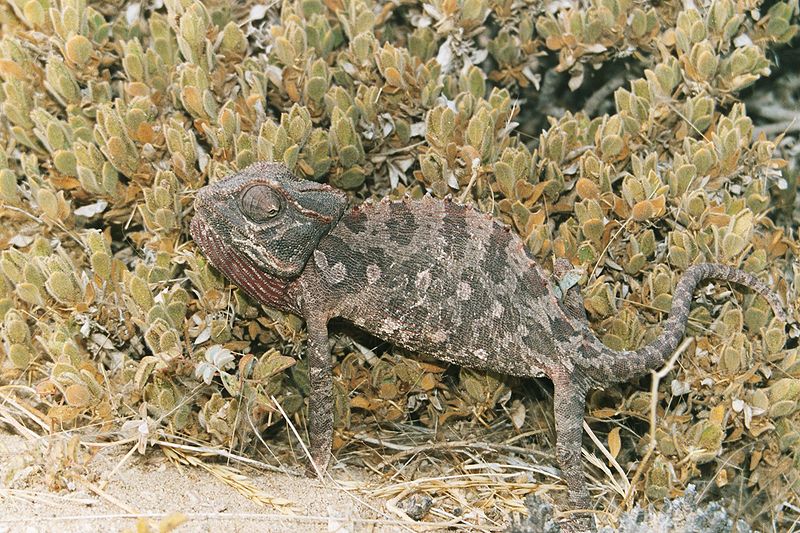
Photo by Sabine's Sunbird (Wikimedia)

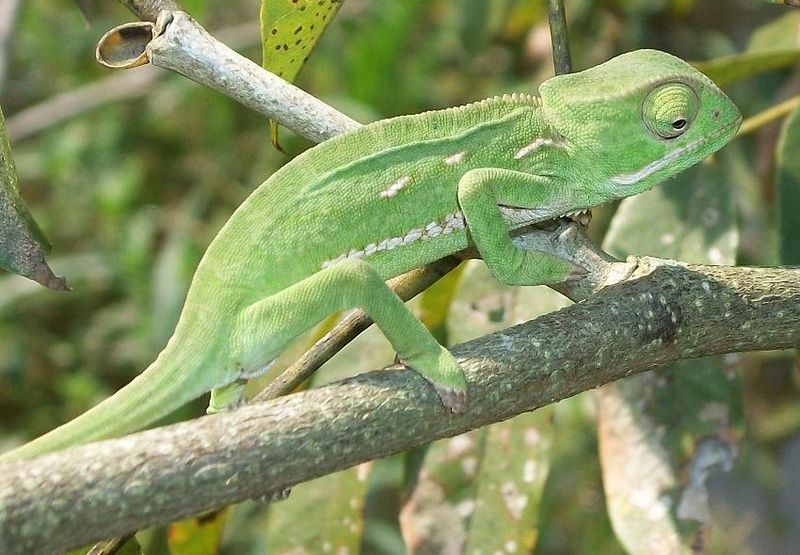
Since yesterday’s topic was a little more serious, and should have been since White Nose Syndrome is a serious topic, I figured we could all use a light-hearted post today.  Normally, I would go find a cute or funny monkey to write about since everybody likes monkey’s.  But, I wanted to be different today so I went to the deserts of Namibia to find the Namaqua Chameleon.   Come on, look at the pictures of this Chameleon and tell me that they are not the perfect animal for a nice, light-hearted post?

Perhaps I don’t know as much about Chameleons as I thought I did because I am pretty sure they like to hang out in trees.  If I am right about this then where in the world are they going to find a tree in the middle of a desert? For the record, the answer to this rhetorical question is they won’t find any trees.  This is only one of several differences we will discuss about the Namaqua Chameleon.

Photo by Hans Stieglitz (Wikimedia)

As a result of living in a completely different habitat than other Chameleons the Namaqua has evolved a few different adaptations.  For starters these guys are actually able to spread their toes apart. I know this may not seem like a big deal to us but most other Chameleons have their five toes fused into a set of three and set of two.  Naturally, this helps our forested friends grip branches and do other things that tree dwelling animals like to do (such as throwing fruit at the people down below……..OK, so maybe I am thinking about monkey’s again).  Obviously a Chameleon that lives in the desert doesn’t need to worry about gripping branches.  As a result, their toes can spread apart which gives them the ability to run along the flat open ground.

This leads us into the next adaptation.  Generally, we think of Chameleon’s of being a slow, care-free animal species.  Not the case with the Namaqua….well, they may be care-free, I am not sure as I have never met one.  This desert Chameleon needs to be able to run at high speeds to catch their fast moving prey (usually beetles).  Let’s face it, food is scarce in the desert so you don’t want to miss out on dinner because you are too slow and lazy.

One last thing before we end today’s fact.  The most famous trait about the Chameleon is their ability to change colour.  Well, the Namaqua Chameleon is able to complete this formidable task as well.  They don’t just using their colour changing super powers for threat displays, courtship and camouflage like their boring, tree dwelling cousins.  Nope, they use this amazing gift to help regulate their temperature.  They have the ability to turn a darker colour to absorb the sun and heat up or turn a lighter colour to reflect those powerful rays and cool down.  This has to give them an advantage over the other animals in the desert.

So this post seemed to turn into another longer post.  I guess I am just in a talkative (writeative?) mood this week.  I hope you enjoyed our trip to the Namib Desert.  Time to get the sand out of your shorts and relax for the rest of the day.  See you tomorrow!

Digg This
Reddit This
Stumble Now!
Buzz This
Vote on DZone
Share on Facebook
Bookmark this on Delicious
Kick It on DotNetKicks.com
Shout it
Share on LinkedIn
Bookmark this on Technorati
Post on Twitter
Google Buzz (aka. Google Reader)

Wild Fact #651 – The Poor Man’s Chameleon – Anoles

January 7, 2011 - 12:00 am 2 Comments

Photo from Wikimedia

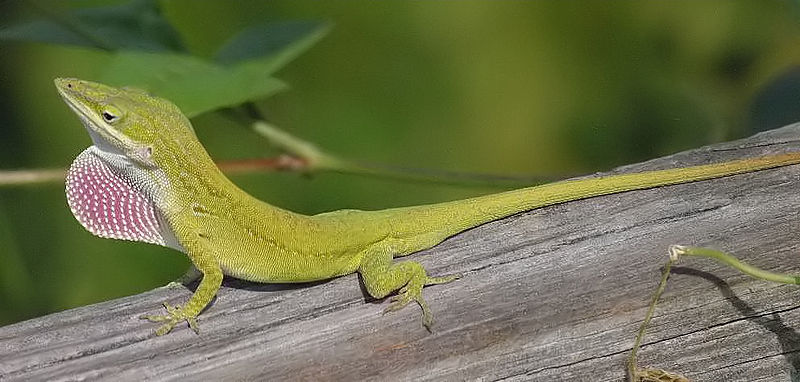
For some strange reason I was in the mood for a trip to the Rainforest today.  In fact, I think I might stay there all weekend.  Anyone with me?  No?? Really?!?  What if I told you that we were going to have a chance to study some Anoles?  All right, first I will explain what Anoles are and then you can decide if you would like to join me on my tropical, weekend getaway.  I still can’t believe I am having this much difficulty convincing you to go on a trip.  For the record, these conversations I have with myself really do entertain me.

So what in the world are Anoles?  Well, I am sure you can tell by the picture that they are a type of lizard.  The Anole Lizard is actually closely related to Iguanas, however, people often confuse them as a Chameleon or a Gecko.  We will make sure not to make this mistake on our trip.  So how could people think that this lizard is actually a Chameleon?  Great question and it is funny since I was thinking the same thing.  It probably has to do with the fact that the Anoles have something in common with a Chameleon. Go ahead and take a guess.  You are absolutely correct!  The Anole Lizard is capable of altering their skin colour.  It appears that the mood and surroundings of the Anole Lizard will dictate their colour.  For example, in North America, Green Anoles, which are very common among pet owners will turn from their usual green colour into a nice brown colour when they become stressed.  This is a sign that the owner should probably do something to relieve the stress of their little friend.

Photo by Paul Hirst (Wikimedia)

There are about 372 known species of Anoles found throughout southeastern United States and the Caribbean.  Interestingly enough when the Green Anole and the Brown Anole overlap they display an unique behaviour.  In these areas the Green Anoles will stick to the higher branches of the trees while the Brown Anole hangs out on the lower branches.  Don’t get me wrong, I am sure the odd rebel crosses the border but for the most part they stick to their own territories.

Anoles Fast Fact – If you don’t like bugs around your house then you may consider getting a couple of Anoles.  They are actually very effective at pest control consuming cockroaches, spiders and other insects.  Typically they will also run away from humans.  Oh and one last thing before we go.  Apparently a Green Anole will turn yellow after it feeds.  Can any Green Anole pet owners confirm this?  I think it would be pretty cool to have your own Hypercolor lizard.

So have you made your decision yet?  I thought you might change your mind so grab your bags and lets catch our flight.  It is going to be a great weekend in the Rainforest.

Digg This
Reddit This
Stumble Now!
Buzz This
Vote on DZone
Share on Facebook
Bookmark this on Delicious
Kick It on DotNetKicks.com
Shout it
Share on LinkedIn
Bookmark this on Technorati
Post on Twitter
Google Buzz (aka. Google Reader)

Wild Fact #965 – Peek-a-boo, I See You – Chameleon

October 9, 2009 - 12:00 am 3 Comments

Photo compliments of http://animal.discovery.com/tv/a-list/creature-countdowns/cheats/images/cheats-chameleon.jpg

Photo compliments of http://animal.discovery.com/tv/a-list/creature-countdowns/cheats/images/cheats-chameleon.jpg

Happy Friday ladies and gentlemen and to my Canadian readers, happy long weekend!! I have probably been pushing the limits this week with longer than usual posts so I will try my best to keep this one a little shorter, since it is Friday and all!

I bet by reading the title of today’s Wild Fact (go ahead and read the title again, I will wait) you think that this fact will be on how chameleons can change colour to match their surroundings.  Well, I tricked you, today’s fact is about another chameleon adaptation.  For the record they change colours as a form of camouflage as well as a social indicator to other chameleons. All right, so if the changing of colour isn’t unique enough to be Wild Fact #965 then what else is so gosh darn cool about the chameleon?

It all has to do with the way the chameleon hunts.  You see, chameleons eat small to mid-size insects such as locusts, mantises, crickets and grasshoppers (some of the larger chameleons may eat small birds and other lizards).  Since chameleons may actually be deaf they rely very heavily on sight to hunt these little critters.  Even though they are deaf they may still be able to communicate via vibrations in the ground, similar to snakes. Okay, back to the whole eye-sight thing! The upper and lower eye-lid of the chameleon are fused together which leaves a small pinhole opening for the pupil to see through.  You are probably thinking that this doesn’t seem like it will help the crazy, colour changing chameleon hunt its prey.  This small pinhole would allow the chameleon to focus a little easier but the real interesting part is the fact that they can focus and rotate each eye individually. Let’s put that a different way, one eye can be focused to the right while the other eye is focusing in on something to the left.  This feature effectively allows them to see 360 degrees at any time.  Although, when they see a scrumptious meal, they are able to focus both eyes on the target which will bring it into stereo.  Just remember the next time you think you are sneaking up on a chameleon, it probably sees you!

Chameleon Fast Fact – Chameleons can see small insects from a distance of 5-10 cm away.  I know this doesn’t sound like much but for a lizard, that is pretty impressive. The fact that their tongue is sometimes longer than their body length, they will have no problems catching these insects.

So much for keeping the post shorter.  Oh Well!

Thanks for another great week of comments everyone!  Have a great weekend and Happy Thanksgiving to my Canadian friends!

Digg This
Reddit This
Stumble Now!
Buzz This
Vote on DZone
Share on Facebook
Bookmark this on Delicious
Kick It on DotNetKicks.com
Shout it
Share on LinkedIn
Bookmark this on Technorati
Post on Twitter
Google Buzz (aka. Google Reader)