Posts Tagged ‘Insects’

Wild Fact #505 – Mmmmmm….French Fries! – Colorado Potato Beetle

August 1, 2011 - 12:00 am No Comments
Colorado Potato Beetle

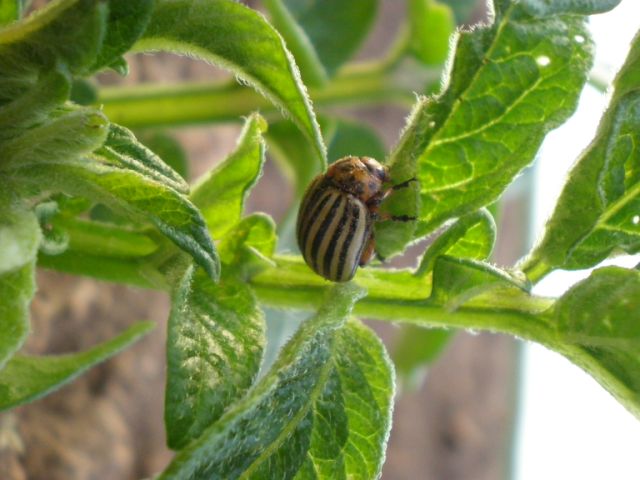
Colorado Potato Beetle - Photo Courtesy of L. Carter

Now I know we tend to be sluggish on Monday mornings but I think this is a great opportunity for a Pop Quiz. You know, it will get those brain cells of yours working. Last week, I mentioned that we would have a theme for this week of Wild Facts. The first animal we are looking at is the Colorado Potato Beetle so your one question Pop Quiz is this. What is the theme for the week? Let’s learn a little more about the Colorado Potato Beetle as you think about your answer.

The Colorado Potato Beetle is also known as the Colorado Beetle, Ten-Striped Spearman, Ten-Lined Potato Beetle, and of course the Potato Bug. No matter what you decide to call them, these insects are about 10 mm (0.4″) long and have a beautiful yellow/orange colour broken up by 5 dark coloured lines. Wait a minute! If they only have 5 dark lines, why are they called the Ten-Lined Potato Beetle? That is a good question but shouldn’t you be focusing on your pop quiz? Obviously, if you count the dark and light lines, it equals ten…. At least I hope it does.

Controlling the population of the Colorado Potato Beetle may be tough since the females tend to be very prolific, laying up to 800 eggs. Instead of putting all of their “eggs” in one basket, the Potato Bug will generally lay batches of 30 eggs in any single location. Don’t worry, I did the math for you and that is about 27 batches of eggs they will lay. Normally these eggs hatch anywhere between 4 and 15 days; however, this is largely dependant on the temperature and the amount of light. If the conditions are not appropriate than these eggs will enter a stage called diapause, which is a fancy way of saying they will delay their hatching until spring.

Potato Beetles

Prolific Potato Beetles - Photo Courtesy of L. Carter

So why would you want to try and control these colourful little Potato Bugs? As you may have guessed by now, the Colorado Potato Beetle is a major pest of lettuce……what did you think I was going to say? Okay, you are right, they destroy potato crops but may also damage tomatoes and egg plants. No matter what your opinion is on the use of insecticide, you would think this would be an effective way to remove these pests from your garden, right? Wrong! The Potato Bug is capable of rapidly building up an immunity to insecticides. Even introducing natural predators doesn’t work too well since this pest is so prolific, with their 800 eggs and all. So how do they control these insects? Well, there really isn’t an amazing way to do it, so if you can find a cost effective way to remove the Potato Bug, I guarantee you will become quite wealthy.

All right, that does it for the first Fact of our themed week. Oh, I guess I have to mark your quiz before we leave. If you “guessed” this weeks theme to be Garden Pests or something similar then you get a sticker! See you tomorrow for the next pest.

Digg This
Reddit This
Stumble Now!
Buzz This
Vote on DZone
Share on Facebook
Bookmark this on Delicious
Kick It on DotNetKicks.com
Shout it
Share on LinkedIn
Bookmark this on Technorati
Post on Twitter
Google Buzz (aka. Google Reader)

Wild Fact #521 – Hit the Lights – Cockroach

July 8, 2011 - 12:00 am 1 Comment

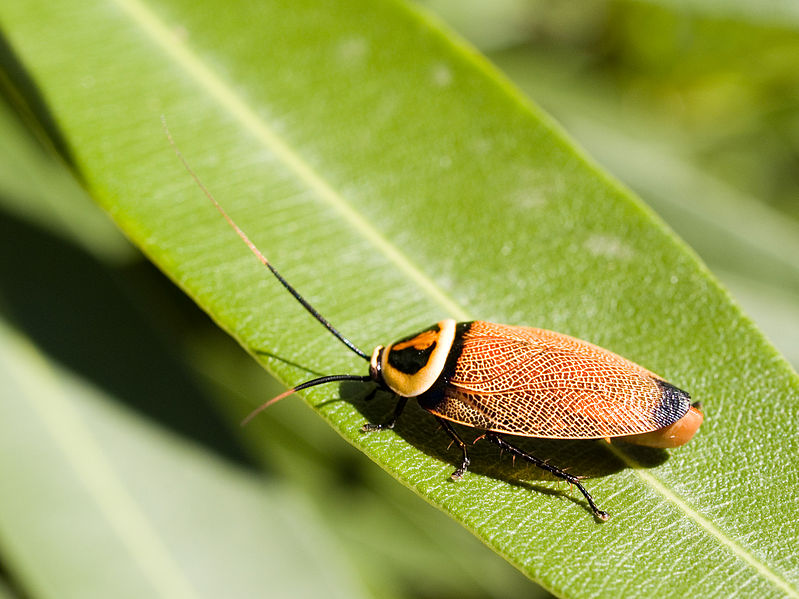
Photo by Cyron Ray Macey (Wikimedia)

Welcome ladies and gentlemen to the last Wild Fact of the week. Today’s animal may give you the heebie-jeebies but you will want to read through to the very end because the Cockroach is one interesting insect. Did you know that there are over 4000 Cockroach species inhabiting our little planet?  Luckily, only about 30 of these species ever come in contact with humans on a regular basis. Now we all know that the Roach is a pest and nobody wants them around but did you know they are actually very beneficial to the ecosystem? That’s right and we will find out how very shortly.

So why does everyone hate Cockroaches so much? Well aside from their ugly bug-like appearance, they feed on decaying matter. Therefore, if you have them in your home then it may mean you need to hire a house cleaner since you probably have some decaying material kicking around. So perhaps, we don’t dislike the Cockroach so much as what they represent. Oddly enough, it is this very behaviour that makes those 4000 species of Roaches beneficial to our ecosystems. Their eating habits definitely help keep our world in check by breaking matter down. See, Cockroaches are good!

40-50 million year old preserved Cockroach - Photo by Anders L. Damgaard (Wikimedia)

Still not convinced that Roaches are great and want to get away from them. Unfortunately, the only way to get away from Cockroaches is to find Atlantis and live beneath the sea. These creepy critters are pretty much found in every type of habitat across every continent. Water is your only safe spot. You have to be impressed with the adaptability of these insects, right? What do you mean that doesn’t impress you?

Did you know that Cockroaches are over 300 million years old (so don’t expect them to leave anytime soon) but the species we have today are considerably smaller than the first Roach. Aren’t you happy that you weren’t living 300 million years ago? Although, I think if you were, Cockroaches would be the least of your concerns.

So there you have it, the last Wild Fact of the week. I hope you enjoyed learning a little bit about the infamous Cockroach. Enjoy the weekend and I will see all of you on Monday.

Digg This
Reddit This
Stumble Now!
Buzz This
Vote on DZone
Share on Facebook
Bookmark this on Delicious
Kick It on DotNetKicks.com
Shout it
Share on LinkedIn
Bookmark this on Technorati
Post on Twitter
Google Buzz (aka. Google Reader)

Wild Fact #539 – A Smelly Situation – Stink Bug

June 14, 2011 - 12:00 am 3 Comments

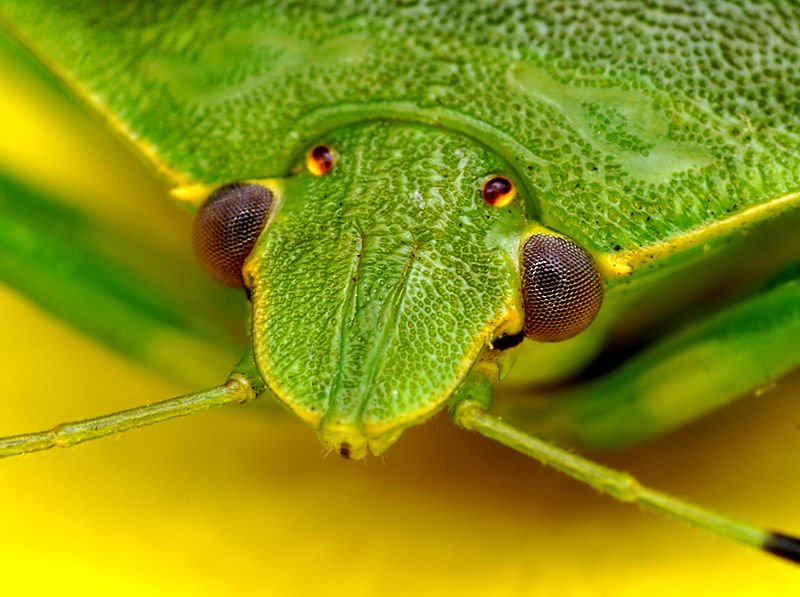
Photo by Opoterser (Wikimedia)

Welcome back to the latest Wild Fact of the week.  I am not going to lie to you, today’s animal fact is really going to stink –  and not just because I am writing it late at night.  Nope, it will literally smell since we are going to be learning about the pesky Stink Bug. The term “Stink Bug” is the common name used for an entire family of insects in which there are thousands of different species.  Sure I could of picked an individual species but I figured we would keep it broad and talk about the entire family of these stinky bugs.

With so many different species, you could have probably guessed that you can find a Stink Bug just about anywhere in the world.  This is great news since it means we don’t have to travel very far to learn about these interesting creatures.  Let me guess, by now you are wondering why they are called Stink Bugs? Believe it or not, they get this name since these critters have the ability to secrete a extremely foul smelling liquid.  Sure it may be tough for the Stink Bug to make friends but it is even tougher for them to get eaten by a predator since this smell thwarts the attempts of most potential attackers.  Let’s face it, nobody wants to eat something that smells terrible.  Actually, this may not be true since some birds have been known to tolerate the stench and horrible taste so maybe it just depends how hungry you are.

Photo by David R. Lance (Wikimedia)

At this point, I am starting to wonder how a Stink Bug could ever attract a mate when they smell so bad.  Well, believe it or not, they actually attract their special partner using their unique odours.  This strong smell makes it easy for the mates to find each other and then flirt over a cup of coffee.  Not all Stink Bugs will rely on this smelly attractive force as some have been known to create sound by rubbing their legs or wings together.  Naturally, this beautiful cricket-like song attracts a potential mate into the area.  Once she gets close enough, I am sure she will smell him whether she wants to or not.

Even though today’s Wild Fact stunk, I hope you enjoyed it and I am looking forward to seeing you here tomorrow.  Enjoy the rest of your day.

Digg This
Reddit This
Stumble Now!
Buzz This
Vote on DZone
Share on Facebook
Bookmark this on Delicious
Kick It on DotNetKicks.com
Shout it
Share on LinkedIn
Bookmark this on Technorati
Post on Twitter
Google Buzz (aka. Google Reader)

Wild Fact #553 – The Picnic Saviour – Damselfly

May 25, 2011 - 12:00 am Comments Off

Photo by Fir0002 (Wikimedia)

So the sun is shining and the mercury is rising which is a sign that spring has finally sprung and summer is on its way.  Some of the main indicators of spring is of course the Robin, Dragonflies and even Damselflies.  Since we have already looked a the Robin and Dragonflies, we are going to explore the life of the pretty little insect that is extremely beneficial to humans.  How are they beneficial, you ask?  Well, just imagine you and your sweetheart are enjoying  a nice romantic picnic when all of a sudden you are bombarded by mosquitoes and blackflies.  Of course this isn’t very pleasant but Damselflies are doing their best to ensure that your picnic isn’t taken hostage by natures annoying insects.  Okay, so maybe they are just hungy and enjoy eating those pesky little bugs, but the end result is still the same….less mosquitoes and blackflies to bother us.

Photo by Michael Apel (Wikimedia)

Now you may be thinking that the Damselfly is just another version of the more popular Dragonfly.  Although, they look similar to each other and they both belong to the order Odonata, there are a few distinct differences between the two.  One of the biggest differences is the Damselflies ability to put their wings parallel to their back when resting.  This may not seem like an amazing feat but good ol’ Dragonflies can’t do this and as a result their wings are always sticking out to the side.  As well, Damseflies are typically smaller and weaker fliers than their bigger and stronger cousins.  Finally, if you look close enough you will notice that the Damselflies hindwings and forewings are virtually identical.

Damselfly Fast Fact – Although, the Damselfly is talented enough to tuck their wings onto their back, they are not skilled enough to be able to wallk.  That’s right, this particular insect has no problem landing but they are incapable of walking due to the position of their legs. In reality though, why would you walk when you can fly? If I had wings, I wouldn’t even bother landing!

So that just about does it for another spring time Wild Fact. I hope you enjoyed learning about this beneficial insect.  Have a great day!

Digg This
Reddit This
Stumble Now!
Buzz This
Vote on DZone
Share on Facebook
Bookmark this on Delicious
Kick It on DotNetKicks.com
Shout it
Share on LinkedIn
Bookmark this on Technorati
Post on Twitter
Google Buzz (aka. Google Reader)

Wild Fact #729 – You Feel That Tension? – Pond Skater

September 7, 2010 - 12:00 am 1 Comment

Photo by: Bruce J. Marlin

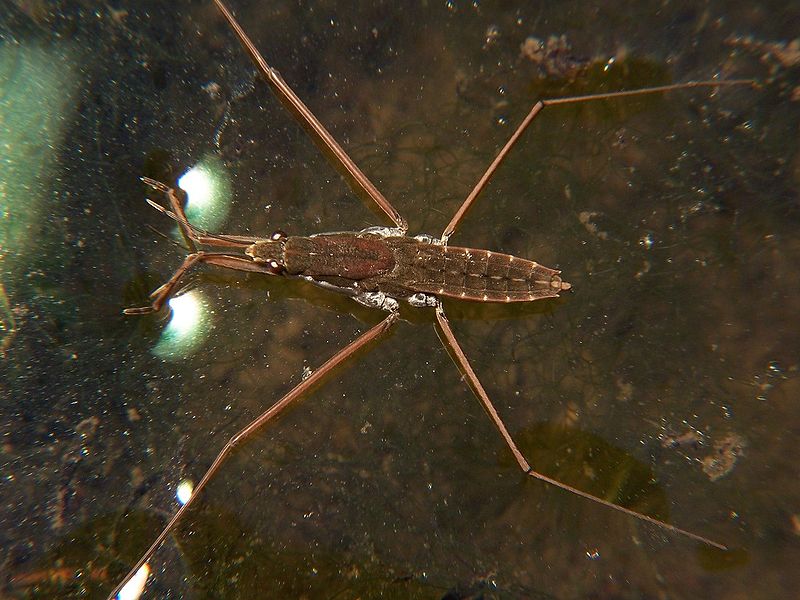
I wanted to talk about an animal today that the majority of my readers could relate with so I have decided to write about the Pond Skater.  If you are not familiar with them then perhaps you don’t live in the Northern Hemisphere where there are more than 5oo different species. If you do live on this half of the world and still have no idea what the heck a Pond Skater is then I suggest you check out their alternative names.  Pond Skaters are also referred to as Water Striders, Water Bugs, Magic Bugs, Skimmers, Water Scooters, Water Skaters, Water Skeeters, Water Skippers and of course Jesus Bugs. That is a ton of names but I guess that is bound to happen when there are 500 different species.  Let’s take a minute to learn more about these Water Striders (my goal is to refer to them by each of their alternative names throughout the entire post, wish me luck!)

Water Bugs can be found on the surface of slow moving streams, ponds, marshes and other areas with relatively still water. After all it would be tough to walk on top of fast moving water, wouldn’t it? Obviously these Magic Bugs are best known for their ability to walk on water.  I am not sure why everyone is so amazed with this feat as just about anyone can walk on water in the Northern Hemisphere during the winter months. So how do these little guys manage to do it when there is no ice helping them out? Well they rely on the surface tension of the water.  They all have specialized legs that are covered by tiny hairs, called microsetae, with small nanogrooves.  It is this leg structure that actually allows the Skimmers to stand on water.

Photo by: ISAKA Yoji

While the Water Scooters are hanging out on the surface of small ponds and marshes they will be actively hunting for other small invertebrates on the water or just below the water surface. Remember those tiny hairs on the Water Skaters specialized legs? Those microsetae are also used to detect vibrations in the water. If a poor insect accidentally falls in the water the Water Skeeter will detect the ripples the insect makes and know exactly where to find their helpless lunch. Surprisingly the Water Skippers are able to get to their prey quickly being able to move at speeds of 1.5 m/s across the pond surface.  I guess they need to make sure they get there before another predator finds their meal.

Pond Skater Fast Fact – The Jesus Bug (not my favourite alternative name for some reason) are very agile as a result of their long legs. In fact they are actually able to jump in order to evade a predator or catch their prey. You may think that these Pond Skaters spend all of their time on the water since they are so perfectly adapted.  Truth is these insects tend to fly far from the water to hibernate for the winter.  As spring approaches they will emerge and fly back to their watery homes.

I hope you enjoyed today’s fact on the animal with many names.  Have a great day!

Digg This
Reddit This
Stumble Now!
Buzz This
Vote on DZone
Share on Facebook
Bookmark this on Delicious
Kick It on DotNetKicks.com
Shout it
Share on LinkedIn
Bookmark this on Technorati
Post on Twitter
Google Buzz (aka. Google Reader)

Wild Fact #801 – The Dragon’s of the Insect World – Dragonfly

May 28, 2010 - 12:00 am 8 Comments

I have been waiting for quite some time to complete a post on the Dragonfly and what could be a better time then to close out Insect Week here at Wild Facts? I actually saw my first Dragonfly of the year on my holidays and I love seeing them since it usually means a decline in the population of black flies and mosquitoes. So sit back and let’s learn about one of my favourite insects.

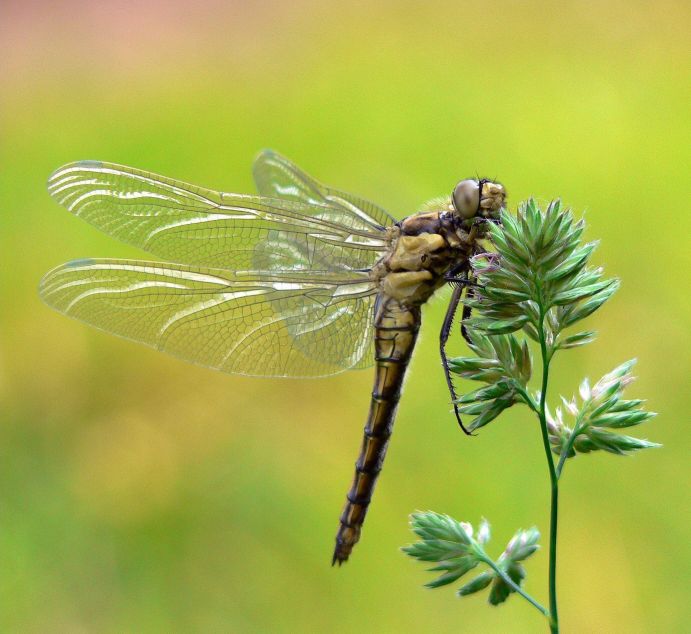
As I briefly mentioned the dragonfly is a large predatory insect that will feed on mosquitoes, bees, flies and other small insects. Even the larvae stage (also known as a “nymph”) of the dragonfly feeds on small aquatic insects and eggs.  The adult dragonfly is absolutely harmless to humans, however, in the larvae form they will produce a nasty bite if you give them the opportunity.  I personally think that the larvae form is the most interesting aspect of the dragonfly and I will explain why below.  What are you still doing reading this paragraph? The interesting stuff is in the next paragraph… sheesh!

The dragonfly nymph lives exclusively in the water and some species may  live in this form for up to five years.  Let’s see, at five years, that would put them in Senior Kindergarten. Just like graduating kindergarten and going to grade one this nymph will decide to graduate and turn into the adult form.  At this time they will leave the water by crawling on some emergent vegetation.  This exposure to the fresh air actually starts their breathing process. Soon enough their body will begin to crack open and the adult dragonfly will emerge out of this body.  I have had the privilege of witnessing this process and I have to tell you, it is pretty impressive.  Everyone makes a big fuss about the beauty of a caterpillar turning into a butterfly but I think the dragonfly is far better.  I have included a picture of the larvae form below.  Just think about the whole process.  When it is time the dragonfly will actually emerge leaving this aquatic body behind.  Pretty cool eh?

Dragonfly Fast Fact – Fossils of dragonflies exist that are over 200 million years old.  These dragonfly fossils have a wingspan of 2 feet.  This makes me wonder how big the mosquitoes and black flies were back then! Today the largest dragonflies live in Costa Rica but they only have a wingspan of 7 and a half inches.

The skin of a Dragonfly nymp. The Dragonfly emerged from that hole just behind the head.

Digg This
Reddit This
Stumble Now!
Buzz This
Vote on DZone
Share on Facebook
Bookmark this on Delicious
Kick It on DotNetKicks.com
Shout it
Share on LinkedIn
Bookmark this on Technorati
Post on Twitter
Google Buzz (aka. Google Reader)

Wild Fact #802 – False Alarm – Thrips

May 27, 2010 - 12:00 am 2 Comments

Photo by Luis Fernández García

Well folks, I just got back from a 9 hour flight from Ontario so I hope this post makes sense.  I made a surprise trip home to visit my family. Since my family are some of my biggest fans, I couldn’t mention the trip on Wild Facts.  This would be the reason I have not been responding to the comments as quickly as usual.  I am back now and everything is back to normal so let’s continue with our insect themed week.  We have talked about some large insects so I wanted to go in the opposite direction today.  We are going to look at the Thrips.  I know it sounds like the name of a band or  some medical condition like rickets.

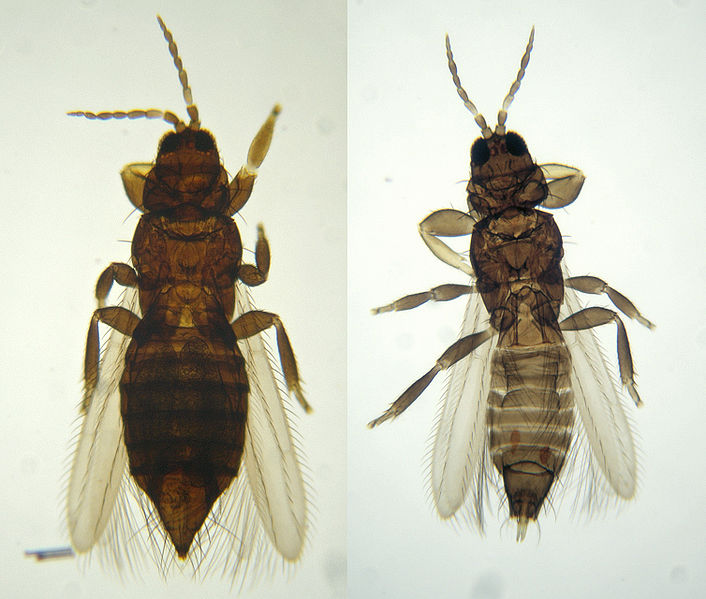
In reality, Thrips are actually a tiny, little insect that can range in size from 0.5 mm to 14 mm (0.020″ – 0.55″).  Although there are some thrips that 14 mm long they tend to be under 1 mm.  Basically, they are tiny. In fact they are so small they will actually feed on an individual spore of fungus or an single plant cell.  There are about 5000 species of thrips that have been discovered so far and they can be found throughout the world in leaf litter, fungi and flowers. I always wonder how you discover a bug that is only 0.5 mm in size.  I have a hard time seeing a billboard while driving but don’t tell anyone since I don’t want to lose my license.

I am going to introduce you guys to a new word but don’t worry I will give you a definition soon.  Thrips are actually a thigmotactic species which simply means they like to be in confined spaces.  Hmmmm, I wonder if that  means being thigmotactic is the opposite of being claustrophobic? Geez, it is big word day here at Wild Facts.  Adult and juvenile (larvae) thrips will often congregate together.  This behaviour has been known to cause an unusual problem for humans.  Any guesses? Well, it isn’t the usual problems that other insects inflict on us “poor” humans.  Nope, these guys will often cause smoke detectors to go off as the masses enter this nice comfy shelter. And you just thought it was a dying battery! So if you get the urge to pull the fire alarm at school, you can now blame it on a mass of thrips.  Okay, I was just kidding.  Please don’t run out and start pulling the school alarms.

Well, that does it for another day of Wild Facts.  See all of you tomorrow.

Sources:
Thrips: Thysanoptera – Physical Characteristics, Habitat, Diet, Behavior And Reproduction, Thrips And People, Western Flower Thrips (frankliniella Occidentalis): Species Account – GEOGRAPHIC RANGE, CONSERVATION STATUS

Digg This
Reddit This
Stumble Now!
Buzz This
Vote on DZone
Share on Facebook
Bookmark this on Delicious
Kick It on DotNetKicks.com
Shout it
Share on LinkedIn
Bookmark this on Technorati
Post on Twitter
Google Buzz (aka. Google Reader)

Wild Fact #803 – Ninja of the Bug World – Assassin Bug

May 26, 2010 - 12:00 am 3 Comments

The latest insect to be added to Wild Facts this week is the Assassin Bug.  I don’t know about you but just the name of this bug is awesome.  It sounds like it will be the deadliest bug in the world.  I just picture an important queen bumblebee giving a speech to all of her drones when the Assassin Bug takes her out before any of the other bugs know what is going on.  I smell a blockbuster movie coming from this.  All right, so they sound cool but are they actually that interesting?  Let’s find out!

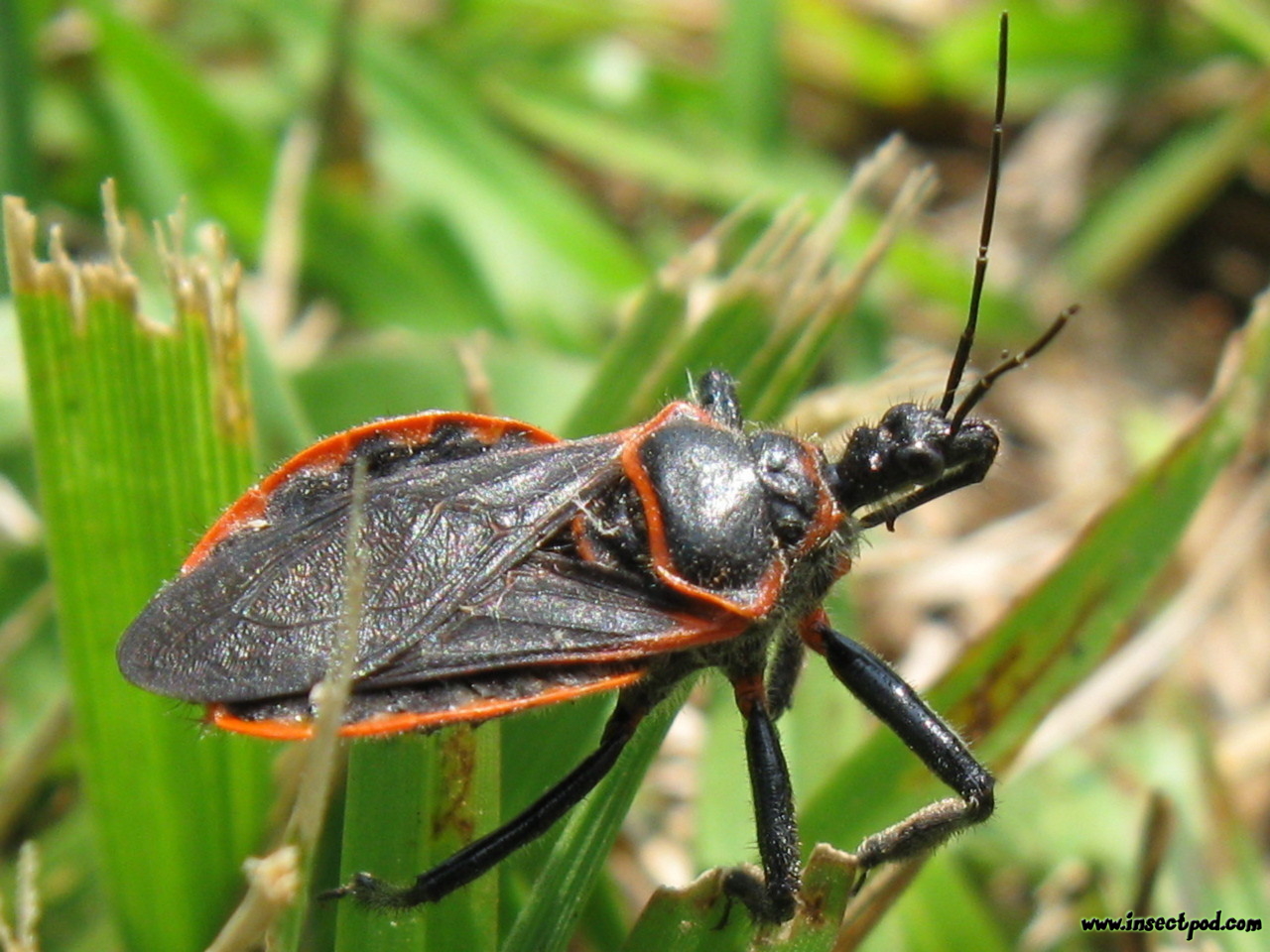
As you may have guessed, the assassin bug is a predatory bug that will use its sucking-piercing mouth parts to feed on other insects.  Not to let you down, these bugs get their name from their hunting style.  You see they tend to remain concealed and still until they ambush any unfortunate prey going for a nice stroll. In one quick and accurate strike they will inject a deadly poison into their prey.  This is the gross part folks! This poison will cause the tissues to break down so the assassin bug can simply suck up their food like a McDonald’s milkshake.

If you are the type of person that likes to pick up weird bugs then I do recommend some caution with these killer bugs.  If they are handled roughly they will pierce your skin in self-defense.  This will feel a lot like a bee sting and will be followed by numbness and swelling.  I highly doubt they will try to suck up your hand though. There is a sub-species of assassin bug called the “Kissing Bug”.  Trust me when I tell you that they didn’t get this name from being all lovey-dovey.  Nope, they received this name for their habit of biting the lips and eyes of humans while they sleep.  See, isn’t that interesting?

Well, I am off now!  Have a great night sleep!

Digg This
Reddit This
Stumble Now!
Buzz This
Vote on DZone
Share on Facebook
Bookmark this on Delicious
Kick It on DotNetKicks.com
Shout it
Share on LinkedIn
Bookmark this on Technorati
Post on Twitter
Google Buzz (aka. Google Reader)

Wild Fact #805 – The Bigger they are, The Harder they Fall – Titan Beetle

May 24, 2010 - 12:00 am 16 Comments

It may be a holiday but as they say the show must go on so hold onto your hats because here comes another Wild Fact.  After writing about the Glow Worm on Friday, I had a great idea (well I think it is a great idea).  I am going to do a whole week dedicated to insects.  Now before you throw your monitor out of the window in disgust, I promise to choose some of the most exciting insects I know about.  To get the week started right we are going to learn about the Titan Beetle.  Trust me, you will want to stick around for this one!

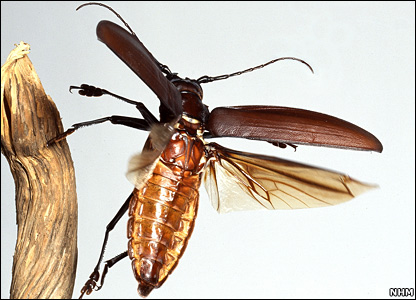
The Titan Beetle happens to be the largest beetle that can be found in the Amazon rain-forest.  As you can imagine it is also one of the largest insect species in the world.  What creeps me out about this is the fact that there is an insect out there bigger than the 16 cm (6.5″) Titan Beetle.  This beetle is over half a foot! Just because they are big doesn’t mean they are vicious, right? The good news is that the adult Titan Beetle does not feed.  The bad news is their mandibles are capable of breaking pencils in half and would definitely break the skin.

Since they don’t feed, the adults simply survive in this form to mate.  They will fly around looking for a partner before they perish.  So the question you have to ask yourself is what do the juveniles look like?  Well that is a good question that I can’t answer for you.  Believe it or not we have yet to find any larvae of the Titan Beetle.  It is assumed that they spend their time inside wood and may take several years before emerging.  They have found some exit holes that researchers think belong to the Titan Beetle.  Judging by the holes it would put the grub at over 2″ wide and up to a foot long. I know, ewwwww!

Since today’s fact wasn’t that gross or icky, I expect to see you tomorrow for the next interesting insect fact.  Have a good one!

Digg This
Reddit This
Stumble Now!
Buzz This
Vote on DZone
Share on Facebook
Bookmark this on Delicious
Kick It on DotNetKicks.com
Shout it
Share on LinkedIn
Bookmark this on Technorati
Post on Twitter
Google Buzz (aka. Google Reader)

Wild Fact #806 – A Very Bright Insect – Glow Worm

May 21, 2010 - 12:00 am 8 Comments

Happy Friday Everyone!  The weekend is here and I am ready for an exciting long weekend.  We are going to end the week with an insect. I know, ewww, but I promise it will be an “enlightening” fact. I remember having a toy when I was a kid called a Glow Worm.  This thing looked like a large worm with a hat and it would light up when you squeezed on it.  Today, we are going to look at the real life Glow Worm.  First we have to wait until night time since they are nocturnal and really what is the point of looking for a glowing animal during the day.

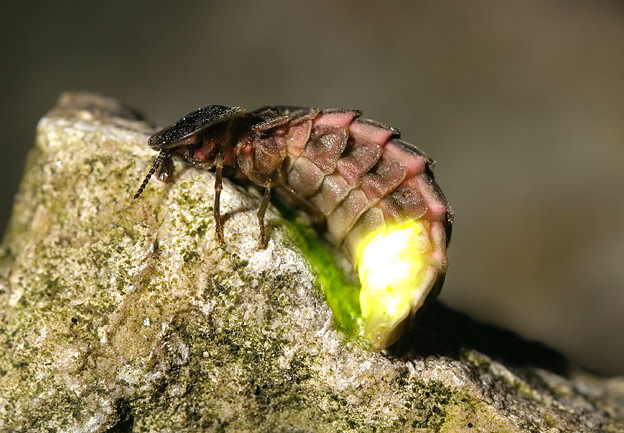
Now that it is dark out let’s look for some glowing insects.  I know they may look like worms but they are actually glowing insect larvae.  Glow worms are usually the larvae of certain beetles although there are some for flies as well.  They can be found living in woodlands and caves throughout the world, except for the Americas.  These hearty little Glow Worms can even survive above the Arctic circle which is pretty impressive.

So what is the point of having a rear-end that lights up? Well as usual, the light is used to attract a mate.  In other animals it is the male trying to attract their partner but not with the Glow Worm.  Nope, it is the female that will spend about two hours every night during mating season hoping to catch the eye of their male partner.  As you can imagine man-made structures such as street lights have caused some issues with this strategy.  I bet that male glow worm is confused when he goes to a street light hoping to find a potential mate.

The glow worm is usually about 1-2 inches in length and will survive for about 5 months.  During this time they tend to feed on snails and slugs but will also eat other insects.  As you can imagine a glowing bug has numerous predators including birds, spiders, larger insects, centipedes and reptiles. I guess being able to glow isn’t always a good thing.

Well that does it for me today!  Now let’s go and enjoy our long weekend.  Don’t forget to check back on Monday as Wild Facts doesn’t take holidays.

Digg This
Reddit This
Stumble Now!
Buzz This
Vote on DZone
Share on Facebook
Bookmark this on Delicious
Kick It on DotNetKicks.com
Shout it
Share on LinkedIn
Bookmark this on Technorati
Post on Twitter
Google Buzz (aka. Google Reader)