Posts Tagged ‘Lizards’

Wild Fact #387 – A Good Defense is the Best Offense – Northern Alligator Lizard

January 12, 2012 - 12:00 am No Comments
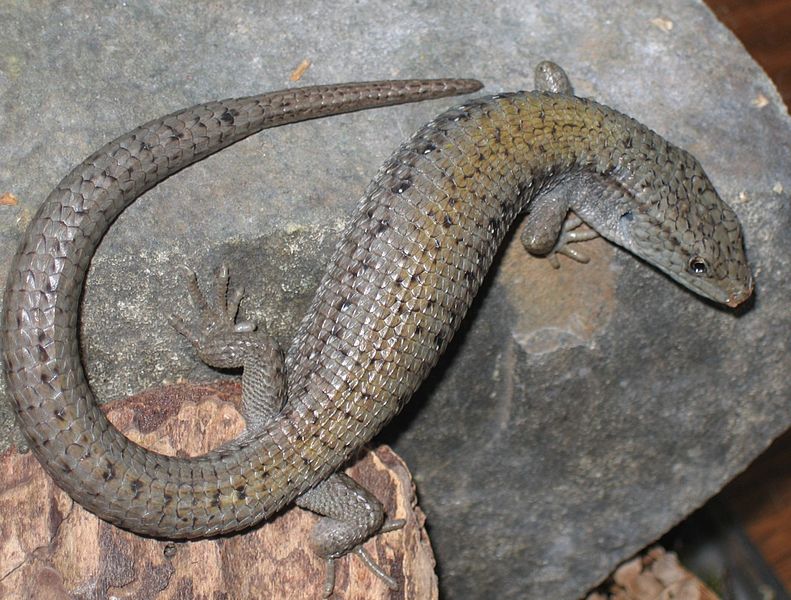
Northern Alligator Lizard

Photo by Meggar (Wikimedia)

Today we continue learning about obscure animals. Although today’s animal is a little more popular, you may be surprised to find out that you have an alligator living in your backyard……if your backyard is on the west coast in North America.  Okay, so maybe it is a Northern Alligator Lizard but that doesn’t take away from their awesomeness. Although, they may not be as large as a real alligator (thank goodness), they are known to be one of the largest lizards species in Canada, which is pretty impressive, right? So what are we waiting for? Let’s head out to your backyard and start looking for the incredible Northern Alligator Lizard.

The Defense Specialist

We may have a tough time spotting this medium-sized lizard since they are known to be quite secretive and will typically flee once spotted. Trust me when I tell you not to pursue a fleeing Alligator Lizard. I guarantee you will not be a happy camper once you catch them. Once caught the Northern Alligator will try a few different defence strategies. They will release a foul smelling mix of musk and faeces, followed by biting and if the situation calls for it, they will simply drop their tail and scurry away. Dropping their tail is a common trend among lizards and acts as a distraction to the predator, giving them just enough time run and hide. The tail of the Northern Alligator Lizard does grow back, however, it tends to be shorter, fatter and darker. I guess this is one way to tell which lizards have had a tough life.

Northern Alligator Lizard

Click for Source

Anti-Social Lizards

Although the Northern Alligator Lizard doesn’t mind the cold, which is why they can be found living in Canada, they are still not big fans of winter. Therefore, this lizard species will hibernate in underground dens known as, hibernacula. The Northern Alligator Lizards living in British Columbia tend to stick around their hibernacula all year long. I guess they are afraid that winter can hit anytime! During the summer months, the Northern Alligator Lizard can often be found in groups as they sun themselves on the rocks. Although, they can be found in groups, the Northern Alligator Lizard is not a social animal and will hardly interact with the neighbouring sun tanners. Sometimes you just want to relax and soak up the sun without having to worry about entertaining other lizards, right?

That does it for today’s Wild Fact. I will see you tomorrow for the final animal fact of the week.


Digg This
Reddit This
Stumble Now!
Buzz This
Vote on DZone
Share on Facebook
Bookmark this on Delicious
Kick It on DotNetKicks.com
Shout it
Share on LinkedIn
Bookmark this on Technorati
Post on Twitter
Google Buzz (aka. Google Reader)

Wild Fact #450 – The “Cat-Like” Lizard – Leopard Gecko

October 17, 2011 - 12:00 am No Comments
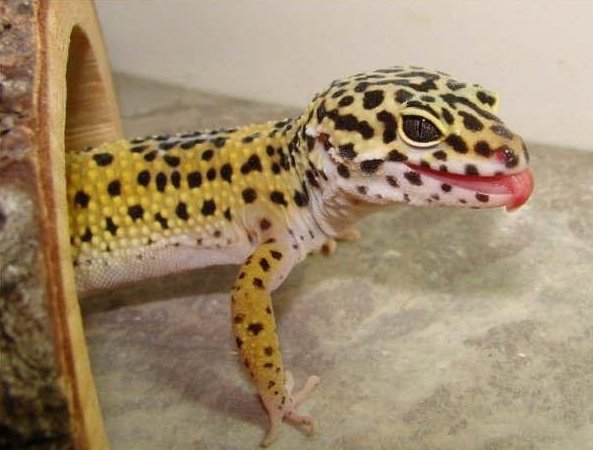
Leopard Gecko

Photo from Wikimedia

I thought today would be a great day to learn about a cute looking animal. After all, it is a Monday, so I am sure at least some of us could use some cheering up. Today’s animal, isn’t the typical “cute and cuddly” but you have to admit the picture of the Leopard Gecko is pretty sweet. Who would have thought that a lizard from the deserts of Asia would be able to make your Monday morning that much better. So what are you waiting for? Chug your coffee and let’s go learn a little more about this fun-looking reptile.

As mentioned, the Leopard Gecko is a ground dwelling, nocturnal lizard that loves to hang out in the deserts of Central Asia, Pakistan and parts of India. For a Gecko, this particular species happens to be quite large as they can easily grow up to 27.5 cm (10.9″) in length and can weigh up to 65 grams (2.3 0z). This weight definitely fluctuates as the Leopard Gecko will go into a semi-hibernation during the cooler winter months. When the temperature dips, this little lizard burrows underground where it survives on its fat cells. Good thing they weigh a whopping 65 grams!

Leopard Gecko

Michelle Reaves, http://www.flickr.com/people/considerthis/

When they aren’t hibernating, this Gecko will spend their days hiding underneath rocks to protect themselves from the scorching sun. Once night falls, they will come out to play. Well, maybe not so much to play as to eat but nonetheless they come out. Interestingly enough, this Gecko is properly named since they use their keen sense of vision and smell to stalk their prey much like that of a Leopard. Therefore if you are an insect or a mealworm living in the Leopard Gecko’s home range then you may want to look over your shoulder every now and again (well, I guess the mealworm doesn’t have to worry since they don’t have shoulders).

Leopard Gecko Fast Fact – The Leopard Gecko has become very popular in the pet trade industry as a result of their size and beautiful colour. Although, in the wild, these Gecko’s will have a darker, duller colour as opposed to their captive friends. I guess they don’t have a need for dull colours when they are in a safe environment.

Well that does it for the first Wild Fact of the week! I hope you enjoyed learning about the Leopard Gecko. See you tomorrow for another fun and exciting Wild Fact.

Digg This
Reddit This
Stumble Now!
Buzz This
Vote on DZone
Share on Facebook
Bookmark this on Delicious
Kick It on DotNetKicks.com
Shout it
Share on LinkedIn
Bookmark this on Technorati
Post on Twitter
Google Buzz (aka. Google Reader)

Wild Fact #612 – Rock, Paper, Scissors – Common Side-Blotched Lizard

March 3, 2011 - 12:00 am 1 Comment

Photo by Chris Brown (Wikimedia)

You know what I love about this Wild Facts Mimicry week?  I love how you can find these imitators in every type of animal.  It doesn’t matter if you are an insect, bird, fish or as we will see today, reptile.  It is obvious that if you can use mimicry successfully you will not only survive but actually thrive in this harsh world of ours.  Today we are going to look at yet another different type of animal mimicry.  To do this we need to explore the intimate lives of the Common Side-Blotched Lizard.

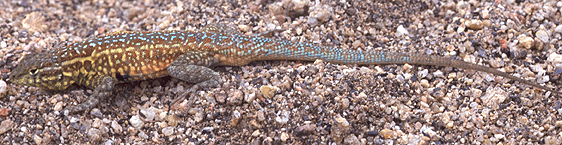
You can find the Common Side-Blotched Lizard along the Pacific coast of North America – all the way from Washington into Mexico.  This particular lizard has developed a rather unusual mating strategy.  In fact, this strategy is often referred to as the “Rock-Paper-Scissor” mating strategy.  You can’t tell me you are not intrigued by this.  I guess I should explain what this means, right?  Well, there are actually 3 different types of males(Orange, Blue and Yellow Throated) and each have their own unique mating patterns.  Let’s talk about the Orange Throated males.  They are the strongest of the bunch and don’t form pair bonds.  Instead they just fight the Blue Throated males for their mating partners.  Basically, they are the bullies of the school yard.  The Blue Throated males form strong bonds with their mate and although they can’t fight off the Orange lizards they can successfully fight off the Yellow Throated Lizards.  So naturally this leaves us with the last type of male and the focus of today’s Wild Fact.

Photo by Chris Brown (Wikimedia)

As you may have guessed the Yellow Throated males are the weakest of the three, however, there is an old saying about “Brains over Brawn”.  Well my friends, these little lizards have used their brains.  They have been able to successfully mimic the females in colouration and size.  This allows them to sneak in and mate with a real female while the Orange Throats are fighting off other males.  Cunning little lizards, aren’t they?

This has to be one of the most interesting mating strategies of all the animals I am aware of.  Obviously it works though since these lizards are still around.

Thanks for reading today’s fact.  Enjoy the rest of your day!

Digg This
Reddit This
Stumble Now!
Buzz This
Vote on DZone
Share on Facebook
Bookmark this on Delicious
Kick It on DotNetKicks.com
Shout it
Share on LinkedIn
Bookmark this on Technorati
Post on Twitter
Google Buzz (aka. Google Reader)

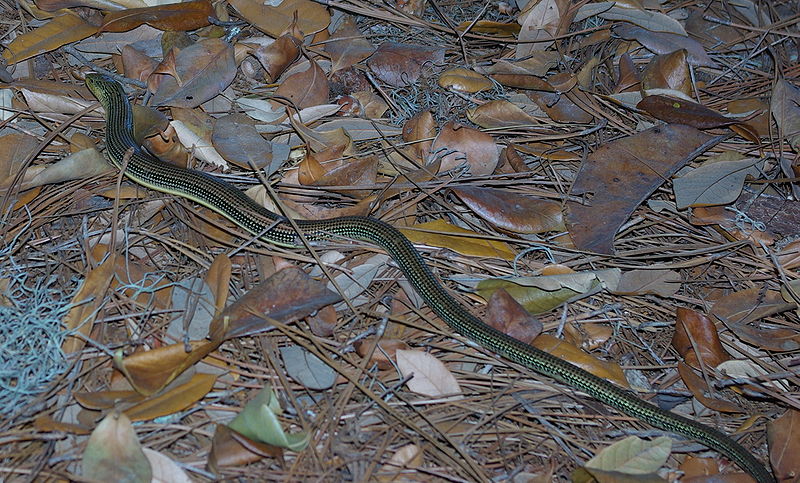
Wild Fact #759 – 7 Years of Bad Luck? – Glass Lizard

July 27, 2010 - 12:00 am No Comments

Photo by NatalieK

You may be a little confused today if you read the title of our Wild Fact and then looked at the picture.  You are probably thinking to yourself that the picture looks more like a snake than a lizard.  If you picked up on this than good for you but believe it or not the Glass Lizard is actually a lizard and not a snake.  As you can imagine these animals are also referred to as Glass Snakes for obvious reasons.  You might be questioning how it can be a lizard if it doesn’t have any legs.  I guess we should address that issue right now, shouldn’t we?

The majority of Glass Lizard species have no legs, however, a few select species actually have very small stub-like legs.  So how is it that we call them lizards instead of snakes? Well, the Glass Lizard still has the head of a lizard including movable eyelids and external ear openings.  These distinct features puts them into the lizard category as opposed to the slippery, slithery snake category. I guess this is another example that illustrates that looks can indeed be deceiving.

The Head of the Glass Lizard

The Glass Lizard can get up to 1.2 m (4′) in length although two-thirds of this length is their tail.  In previous reptile Wild Facts we have discussed that one of the main defense mechanisms for some lizards is to drop off part of their tail.  The Glass Lizard is no exception and has the ability to easily break off sections of their long tail.  This is actually how they get their name.  Get it? Both glass and these lizards break easily? This is actually a pretty clever naming convention, for once. The coolest thing about this is the fact that the portion of the tail that breaks off remains mobile while the rest of the lizard stays motionless.  Obviously this distracts the predator and allows the Glass Lizard to make an escape when the time is right. Unfortunately this cool defense mechanism requires a lot of energy to regenerate a new tail so it will often be smaller.  I guess this is a good way to tell how often the Glass Lizard had to drop off its tail.

I guess that does it for the Glass Lizard.  Make sure you check back here tomorrow for another crazy Wild Fact.  Have a great day!

Digg This
Reddit This
Stumble Now!
Buzz This
Vote on DZone
Share on Facebook
Bookmark this on Delicious
Kick It on DotNetKicks.com
Shout it
Share on LinkedIn
Bookmark this on Technorati
Post on Twitter
Google Buzz (aka. Google Reader)

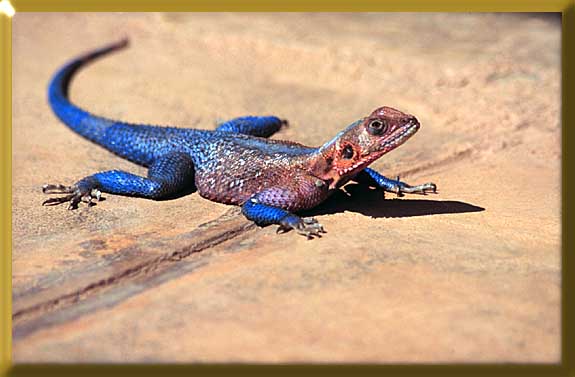
Wild Fact #828 – The Spotlight Hog (errrr… Lizard) – Agama Lizard

April 21, 2010 - 12:00 am 4 Comments

A question about the little lizard in the background of yesterday’s Wild Fact about the Elephant Shrew has sparked today’s post about the Agama Lizard.  I was not certain about the exact species but I am fairly certain that the little lizard in the background was indeed an Agama, which can found across Africa.

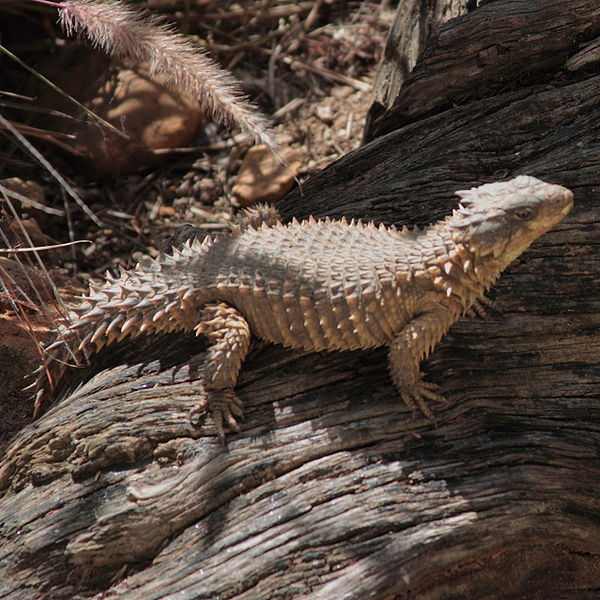
There are at least thirty seven different species found in Africa and happen to be the most common lizard found on the continent.  I guess it is so common that it had no choice but to take away from the elephant shrews two minutes of fame during the photo shoot.  Now let’s take a minute and learn what an agama actually is.  They are mainly insectivorous lizards that are active during the day, however, they will also supplement their diet with fruit, grasses and even the eggs of other lizards.

Perhaps one of the reasons the agama is so prevalent in Africa is due to their ability to adapt.  Originally, they would be mostly found in the forests of Africa, however, as their habitat was destroyed and towns and villages created, the little lizard had to either adapt or perish.  Obviously they chose to adapt and can often be found living in houses and coming out only to feed.  If you happen to spot an agama out in the open and proceed to chase it, don’t be surprised to see this little guy book it out of there quickly on its hind legs.

So what about the bright colours? Often when animals are brightly coloured it is to warn other animals to stay away since they are poisonous.  This is not the case for the agama.  I just brought that up to make myself sound smart. In fact, most agama lizards  are a dull greenish colour.  It is only the dominant males that will have the beautiful colours.  This means that sub-ordinate males and females have the boring green colours.  As with most animals, this colour is a status thing and let’s all the others know who is boss!

That just about does it for the agama lizard.  Have a great day!

Digg This
Reddit This
Stumble Now!
Buzz This
Vote on DZone
Share on Facebook
Bookmark this on Delicious
Kick It on DotNetKicks.com
Shout it
Share on LinkedIn
Bookmark this on Technorati
Post on Twitter
Google Buzz (aka. Google Reader)

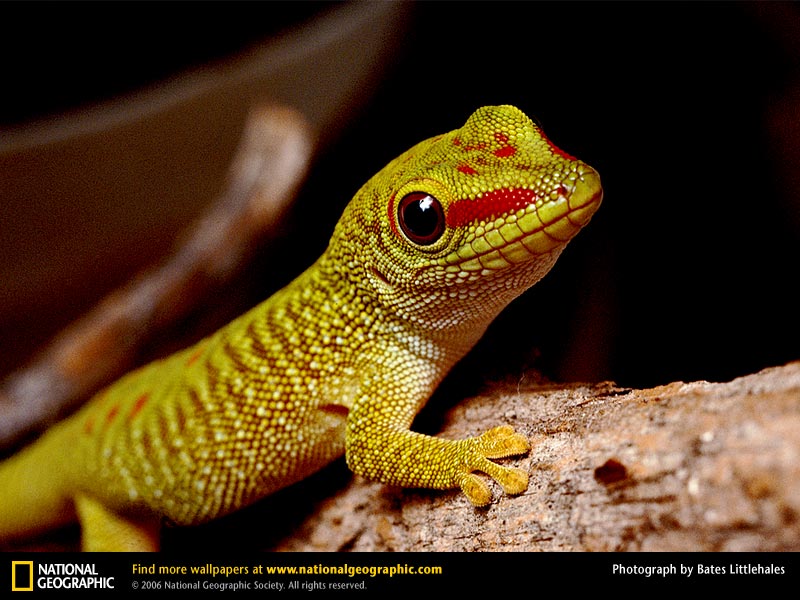
Wild Fact #831 – A Sticky Situation – Gecko

April 16, 2010 - 12:00 am 5 Comments

Photograph by Bates Littlehales

Happy Friday everyone! Another weekend is upon us and I hope you have something fun planned. To get your weekend started on a good note, I chose one of my favourite reptiles to learn about today. Of course I am talking about the one and only Gecko. This little lizard is usually found around the equator in the Southern Hemisphere so that means we need our flip flops and sunscreen for this trip. Let’s Go!

The gecko comes in all kinds of different colours such as green, purple, pink and of course for the boys, blue. These colour variations really make the gecko a beautiful sight to see. They also have a variety of different patterns among the 2000 species thought to be inhabiting earth. If you are a budding scientist and have an urge to name an animal after yourself, then I suggest looking for a new gecko species since it is believed that there are more to be found. Besides it is a great excuse to travel to the warmer southern climates.

If you have ever had a pet gecko then you would know that they are capable of sticking to anything. You will often see them crawling around on the ceiling or the side of their terrarium. In fact, it is thought that the only thing they can’t stick to is Teflon. How about that for a non-stick frying pan commercial. So how do these cute and colourful lizards stick to all of these substances? Well, that is a good question that has a complicated answer but basically the gecko has about 14 000 tiny little hairs on every square millimeter of their foot pad. These tiny, stiff hairs allow the gecko to hang upside down, climb the side of anything or just show off in front of other lizards. You might be thinking that it would be impossible for them to walk if their feet are constantly sticking to things. This would be true but the gecko is able to peel their toes back to relieve these attractive forces and move. This is why it looks as if your pet gecko is double jointed. The truth is the gecko’s toes are designed to bend the opposite way from our fingers and toes. There you go, the next time you have company over and your pet gecko is stuck to your guests “balding” head, you will be able to explain why he is able to do that.

Have a great weekend!

A close-up view of the Gecko's foot

Digg This
Reddit This
Stumble Now!
Buzz This
Vote on DZone
Share on Facebook
Bookmark this on Delicious
Kick It on DotNetKicks.com
Shout it
Share on LinkedIn
Bookmark this on Technorati
Post on Twitter
Google Buzz (aka. Google Reader)

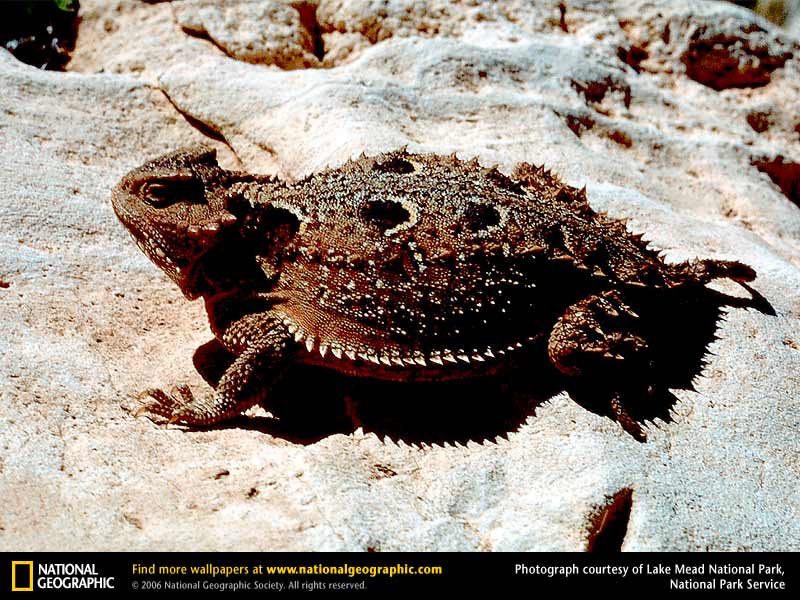
Wild Fact #918 – Look Deep into my Eyes – Short Horned Lizard

December 15, 2009 - 12:00 am 9 Comments
Photograph courtesy Gary M. Stolz/U.S. Fish & Wildlife Service

Photograph courtesy Gary M. Stolz/U.S. Fish & Wildlife Service

Yesterday we discussed an animal that will actually blow itself up to prevent predators from harming their colony.  If you didn’t get a chance to read it yet then I recommend checking it out here. Don’t get me wrong, that is a pretty fascinating defense mechanism but I think today’s animal is even more unique.

The short horned lizard can be found in deserts from North to Central America. Because of their rounded shaped they are often referred to as the horny toad or horned toad but in reality are actually a lizard.  Even though the short horned lizard appears to be well protected by all of their spikes they tend to have numerous predators.  Animals such as coyotes, snakes, roadrunners (beep beep), hawks, lizards and dogs all feast on these little lizards. So how can the short horned lizard ward off such large predators? Well, they have several strategies depending on the risk level. First and foremost the colour of their skin allows them to blend in very well to their environment.  Let’s face it, if you can’t be found then it will be tough for you to be eaten. The next two adaptations are a lot more fun and exciting. So if they are spotted and need to defend against a predator the lizard is able to inflate it’s body to twice it’s size.  This makes the lizard look like a big spiny balloon. If this technique fails to thwart the attempts of their attacker then they will employ the ultimate strategy.  You sitting down?  Some species of horned lizards are able to direct a stream of blood from their eyes to distract the threat while they make their getaway.  They are able to do this by rupturing tiny blood vessels in their eyelids.  Besides confusing the predator the blood contains a chemical that is noxious for dogs, coyotes and wolves.  Unfortunately this strategy does not work well on the flying threats.

Short Horned Lizard Fast Fact: The short horned lizard is able to squirt blood from their eyes up to a distance of 1 m (3 feet).

Digg This
Reddit This
Stumble Now!
Buzz This
Vote on DZone
Share on Facebook
Bookmark this on Delicious
Kick It on DotNetKicks.com
Shout it
Share on LinkedIn
Bookmark this on Technorati
Post on Twitter
Google Buzz (aka. Google Reader)