Posts Tagged ‘Marsupials’

Wild Fact #465 – The Tasmanian Tail – Tasmanian Bettong

September 26, 2011 - 12:00 am No Comments
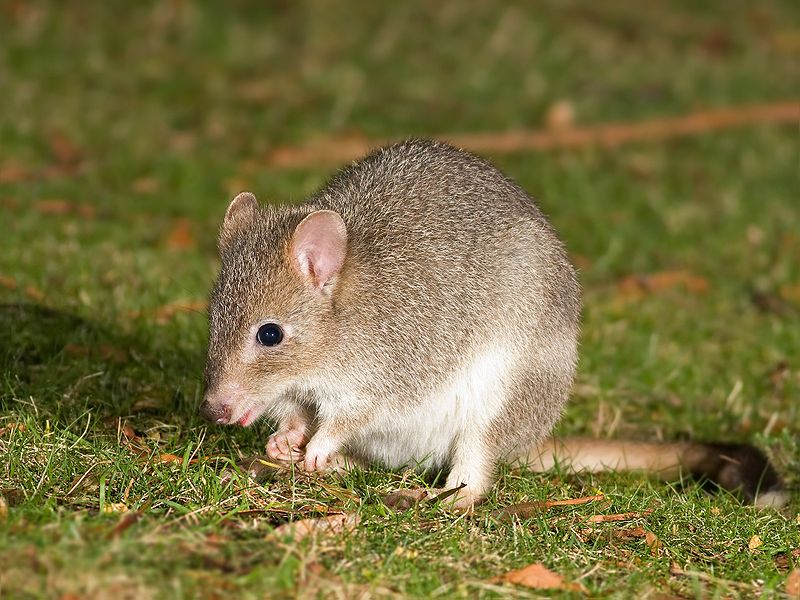
Tasmanian Bettong

Photo by Noodle snacks (http://www.noodlesnacks.com/)

For some strange reason I had this strong desire to take a trip to Tasmania today. You know that little island by Australia that has one of my favourite cartoon characters, the Tasmanian Devil. Well, we aren’t going back to look at the Devil. Instead, I figured we would learn about something a little smaller, the Tasmanian Bettong, which is also known as the Eastern Bettong and the Southern Bettong. So what in the world is a Bettong? Great question so let’s get started and find out, shall we?

The Tasmanian Bettong is basically a small kangaroo with an average weight of 2 kg (4.4 lbs). These little marsupials use to be found throughout Australia, however, the introduction of the Red Fox wiped out the population on the mainland. Now the Tasmanian Bettong is restricted to the eastern side of Tasmania. In retrospect, perhaps it wasn’t a great idea to introduce these different animals to Australia since they seem to have done more harm than good. Okay, getting back to the appearance of our little kangaroo friend….. They typically have a brown-grey colour with a nice white under-belly and their tails are usually just as long as the rest of their body.

Eastern Bettong Distribution

Eastern Bettong Distribution Map

This long prehensile tail actually plays a major role in the life of the Tasmanian Bettong. They are able to curl their tail around a bundle of nesting material, which allows them to easily bring this material back home to make their nest. This nest is also important since the Bettong will spend their daylight hours hiding out in their camouflaged nest made of grass. Once night falls though, these tiny kangaroos begin to venture out in search of food. The Tasmanian Bettong eats a variety of things such as seeds, bulbs, insects, roots but their favourite meal has to be the underground fungi growing around the roots of the Eucalyptus trees.

Tasmanian Bettong Fast Fact – The Tasmanian Bettong is a great colonizer of forests destroyed by fire. Generally it would be tough to survive in such a harsh environment, however, this Bettong has no problems. Why? Well, they are able to easily transport their home from an unburnt area as a result of their cool, prehensile tail, and their favourite food is found underground, protected from the fire.

Well, that does it for the first Wild Fact of the week. I hope you enjoyed our trip to Tasmania and I will see you back here tomorrow for a new animal fact.

Digg This
Reddit This
Stumble Now!
Buzz This
Vote on DZone
Share on Facebook
Bookmark this on Delicious
Kick It on DotNetKicks.com
Shout it
Share on LinkedIn
Bookmark this on Technorati
Post on Twitter
Google Buzz (aka. Google Reader)

Wild Fact #583 – Dig a Little Deeper – Marsupial Moles

April 13, 2011 - 12:00 am 5 Comments

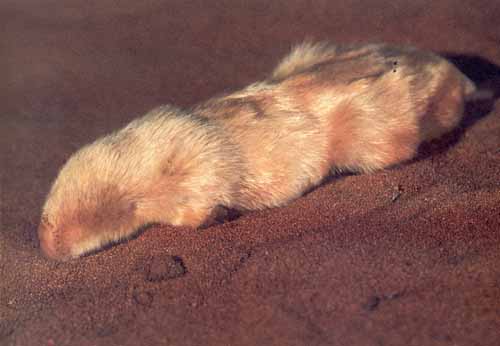
Photo by Bartus Malec (Wikimedia)

It has been awhile since we have talked about a marsupial so I figured today would be a great day to look at a bizarre marsupial.  No, the Marsupial Mole may not be as famous as the Kangaroo but they should be.  As you might expect these rare animals are found in the deserts of Western Australia.  Is it just me or does it seem like every animal in Australia is a marsupial? Like other moles the Marsupial Mole spends most of their time underground rarely coming to the surface.  This might make it tough to spot them but we will give it a shot.  You up for the challenge?

When you live underground, you really don’t have much need for eyes and ears.  And as such the Marsupial Mole is blind since their eyes are simply lenses underneath their skin.  Similarly, their hearing probably isn’t the greatest since they just have tiny holes underneath their fur.  Yup, they don’t actually have ears.  It is a good thing they don’t have eyes because they would have a heck of a time keeping their glasses on their face without ears.

Their lack of eyes and ears is neat but not that uncommon among animals spending most of their time underground.  You know what is different than those other underground animals, though?  Of course you do!  It is their pouch.  How in the world do these little moles have a pouch?  Well for starters their pouch faces backwards so it doesn’t fill up with sand.  Evolution is pretty impressive isn’t it?  As well, they can only carry two young in their pouch at a time.  This is pretty intelligent too since it would be tough lugging a bunch of kids around as you are digging tunnels.

Marsupial Mole Skeleton (Photo by Cliff - Wikimedia)

Speaking of digging tunnels, the Marsupial Mole likes to leave the land the way that they found it.  You see, they will actually fill their tunnels in behind them as they move forward.  You would never be able to tell that a Marsupial Mole just burrowed by you.  Of course, this doesn’t really give the mole much of an escape route, does it?

Marsupial Mole Fast Fact – Have you ever wondered what an animal that lives underground in a desert eats? Like other ground dwellers they feast on beetle larvae and little worms.  Not the greatest diet but it seems to work for this particular mole.

Well I think we dug deep enough into the lives of the Marsupial Moles for one day.  Make sure you come back tomorrow for another fun-filled fact.

Digg This
Reddit This
Stumble Now!
Buzz This
Vote on DZone
Share on Facebook
Bookmark this on Delicious
Kick It on DotNetKicks.com
Shout it
Share on LinkedIn
Bookmark this on Technorati
Post on Twitter
Google Buzz (aka. Google Reader)

Wild Fact #714 – Life is No Video Game – Bandicoot

September 28, 2010 - 12:00 am 4 Comments

I had some great news when I woke up this morning, the snow had pretty much vanished due to the overnight rain.  I am not going to lie, I was quite happy to have winter postponed for a little bit.  Unfortunately, Mother Nature is cruel and decided only to postpone winter for a few hours.  The snow was back by lunch and it has been snowing since.  This is my way of saying that we are heading to Australia today to learn about the Bandicoot.  It is unfortunate that Wild Facts is my only reprieve from the nasty winter weather. I am going to go and pack up my shorts and then we are headed to the sunny south.

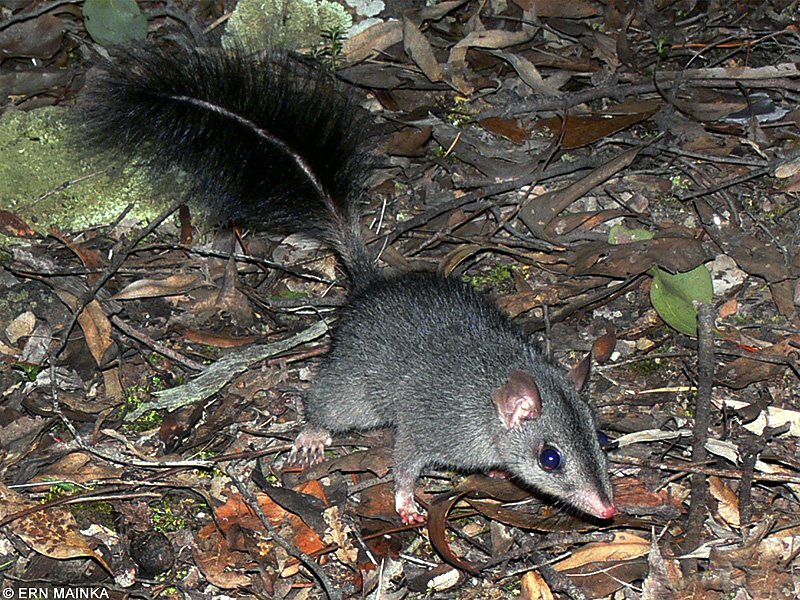
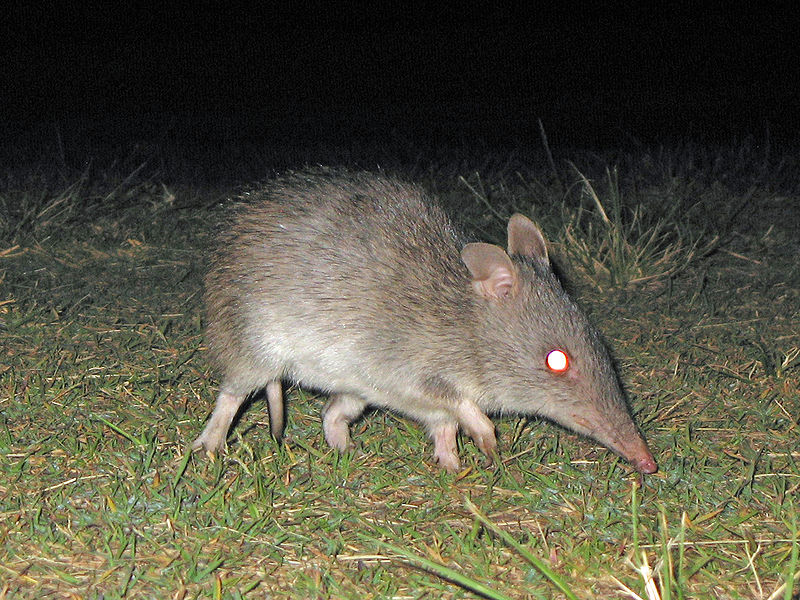
The Bandicoot is a small marsupial found throughout Australia.  I am starting to think that every animal in Australia is a marsupial.  For the new readers, a marsupial, is an animal that puts their young into a pouch with the most famous example being the kangaroo.  Anyway, back to this tiny critter of the south.  Some of you may not find the Bandicoot that cute (or should I say “Coot”) since it has a sort-of rat-like appearance.   Don’t let this rodent appearance fool you though since this little marsupial is more closely related to rabbits than rats.

Bandicoot

Pregnant women everywhere are going to be envious of this next little fact.  The Bandicoot has one of the shortest gestation periods of all mammals, giving birth only 12 days after conception.  Just imagine only being pregnant for two weeks.  Heck, that isn’t even long enough to finish your Lamaze Classes.  Once the babies are born though the Bandicoot will keep them in her pouch until they are strong enough to survive the harsh world on their own.

Unfortunately, 7 of the 11 Bandicoot species are facing some tough times right now and are classed as either critically endangered or extinct.  Not exactly the lists I would want to be on.  The usual culprits are causing this rapid decline in Bandicoot populations including habitat destruction and introduction of exotic animals.  Originally these little critters only had to be on the look out for owls, quolls and dingos.  Since the European settlers arrived they also have to worry about foxes, dogs and house cats.

Well that is the “Crash” course on Bandicoots so I hope you enjoyed our little trip to the beautiful island of Australia.  I assume not everyone will understand the “Crash” pun but if you have kids than you most likely know who Crash Bandicoot is.  Have a great day!!

Digg This
Reddit This
Stumble Now!
Buzz This
Vote on DZone
Share on Facebook
Bookmark this on Delicious
Kick It on DotNetKicks.com
Shout it
Share on LinkedIn
Bookmark this on Technorati
Post on Twitter
Google Buzz (aka. Google Reader)

Wild Fact #860 – Just Hanging Out on a Monday – Tree Kangaroo

March 8, 2010 - 12:00 am 8 Comments

I guess I wasn’t able to convince anyone to appreciate the earwig last week.  Personally, I still think they are pretty cool but what can I say, I am a Wildlife Biologist, so I like all animals. I feel bad that I ended the week with such an “icky” Wild Fact so I thought I would make it up to all of you today with a cute, fuzzy animal.  There is something seriously wrong with you if you don’t like the Tree Kangaroo!!

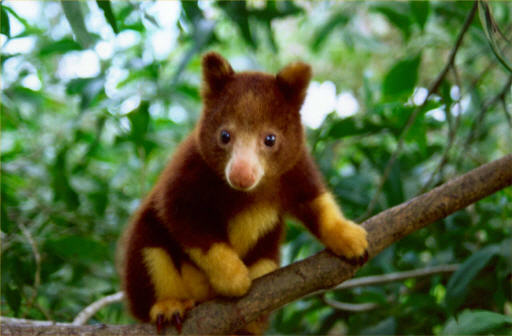
As you can imagine the tree kangaroo is a relative of the regular kangaroo but it prefers to live in trees.  They can be found in the rain forests of New Guinea and Northeastern Queensland.  The tree kangaroo is similar to a turtle.  No, I don’t mean genetically! I mean in the sense that they are awkward, slow and clumsy on land but the minute you put them into their preferred environment (i.e. trees) they become nimble, agile and swift.  I am pretty impressed that I was just able to make a comparison between a kangaroo and a turtle!

So how did these kangaroos get to the trees? It is believed they evolved from animals similar to kangaroos and wallabies since they have retained the large legs. In order to survive in the trees though, they developed strong fore-limbs for climbing and incredibly long tails for balance.  Unlike, kangaroos which have long, narrow feet, which allow them to move quickly on the plains, the tree kangaroo has shorter and wider feet used for climbing.  These feet are even more adapted for life in the trees with their long claws and rubber soles.  Yes, they have rubbery soled feet which obviously provides them with better grip.  It is like they carry that anti-slip bathtub mat with them at all times!

If you have a bit of time then I recommend checking out the following video from National Geographic.  It explains how researchers are using “Critter Cams” to learn more about these mysterious animals.

So there is your cute and cuddly fact to start the week.  Have a good one!

Digg This
Reddit This
Stumble Now!
Buzz This
Vote on DZone
Share on Facebook
Bookmark this on Delicious
Kick It on DotNetKicks.com
Shout it
Share on LinkedIn
Bookmark this on Technorati
Post on Twitter
Google Buzz (aka. Google Reader)

Wild Fact #871 – Jump for Joy, It’s Friday – Wallabies

February 19, 2010 - 12:00 am 2 Comments

http://commons.wikimedia.org/wiki/Commons:GNU_Free_Documentation_License

If you have been following Wild Facts all week (and I know some of you have been) then you may have noticed that we have talked about a couple of Australian animals such as the wombat and the koala bear.  I figured I would end the week with another Australian animal.  Actually, this animal is also a marsupial. Anyone else find it interesting that their are a lot of pouched animals living in Australia? By this point, I am sure you have read the title and realize that I am of course talking about the Wallaby!

Wallabies are smaller than their kangaroo cousins but have some very similar characteristics. Earlier this week I mentioned that the koala bear and the wombat were also related to the kangaroo.  It seems that everything in Australia is related to that hippity-hop animal.  Their family reunions would be a blast although I bet it would be tough to convince them to come out of their pouches long enough to enjoy the company.

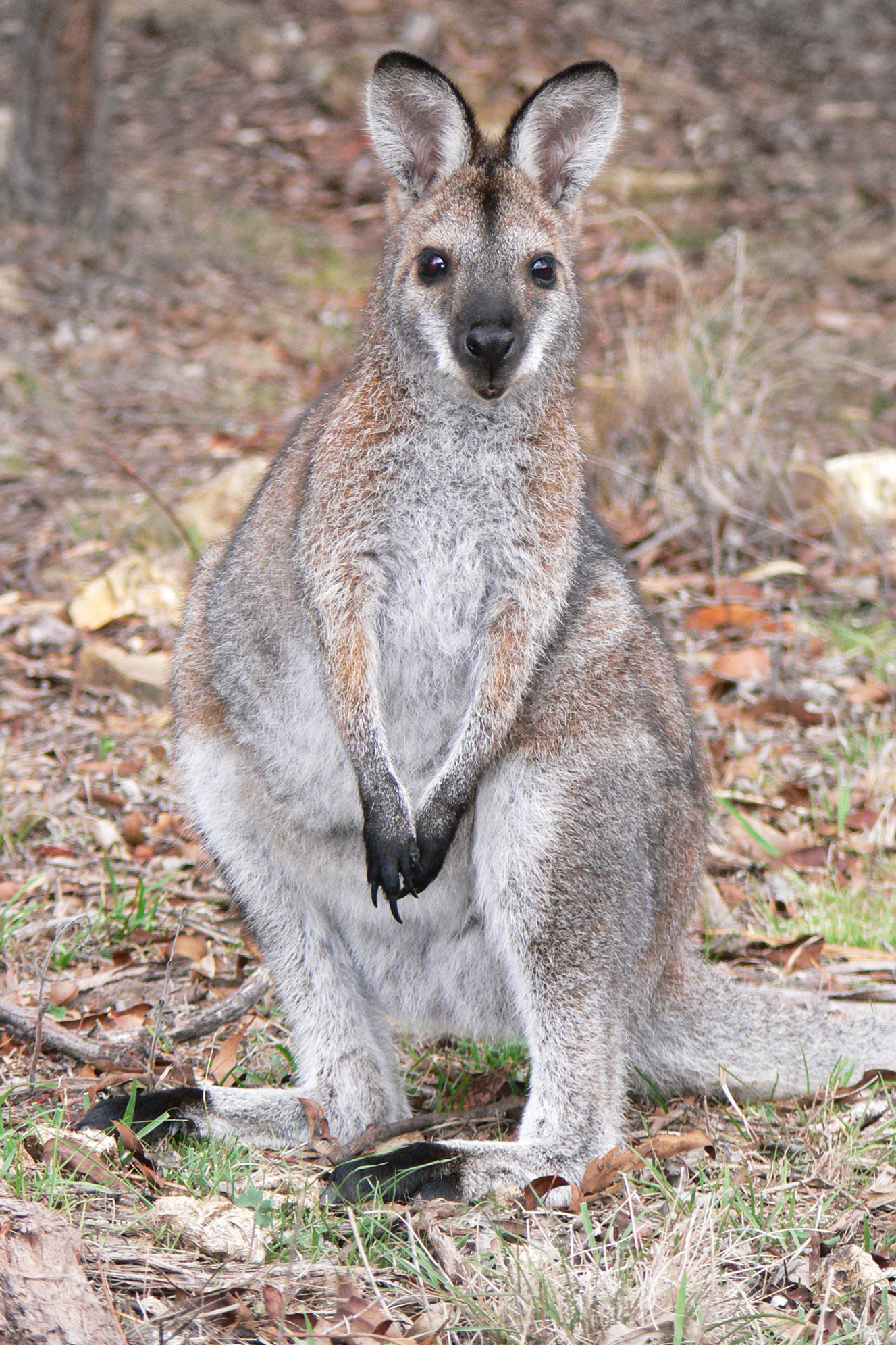
If you look at the picture above (go ahead and look again) you will notice that the wallaby has a very long tail. In fact, their tail can be as long as their entire body.  The wallaby puts this long, powerful tail to good use as it helps balance them while jumping around all day.  As well, they can use this tail to prop themselves up into a sitting position.  How weird would it be to come around a corner and see a bunch of wallabies just sitting on their tails. This is actually possible since wallabies tend to be a social animal and will often forage with other wallabies.  It makes sense since nobody likes eating alone! While we are on the topic of foraging, I guess I should let you know what these critters like to eat. The majority of their diet is made up of grasses, however, when they feel like mixing up their diet they will also feed on leaves, shrubs and berries.  Personally, I would take berries over grass, leaves or shrubs!

If you are bored and feel like watching a baby wallaby at the zoo then check out the video below.

Well folks, that just about does it for me today!  Have a great weekend and I will see you all on Monday.  Although, if I can get motivated, you may see me around the site this weekend but we shall see!

Digg This
Reddit This
Stumble Now!
Buzz This
Vote on DZone
Share on Facebook
Bookmark this on Delicious
Kick It on DotNetKicks.com
Shout it
Share on LinkedIn
Bookmark this on Technorati
Post on Twitter
Google Buzz (aka. Google Reader)

Wild Fact #871 – Jump for Joy, It's Friday – Wallabies

February 19, 2010 - 12:00 am 2 Comments

http://commons.wikimedia.org/wiki/Commons:GNU_Free_Documentation_License

If you have been following Wild Facts all week (and I know some of you have been) then you may have noticed that we have talked about a couple of Australian animals such as the wombat and the koala bear.  I figured I would end the week with another Australian animal.  Actually, this animal is also a marsupial. Anyone else find it interesting that their are a lot of pouched animals living in Australia? By this point, I am sure you have read the title and realize that I am of course talking about the Wallaby!

Wallabies are smaller than their kangaroo cousins but have some very similar characteristics. Earlier this week I mentioned that the koala bear and the wombat were also related to the kangaroo.  It seems that everything in Australia is related to that hippity-hop animal.  Their family reunions would be a blast although I bet it would be tough to convince them to come out of their pouches long enough to enjoy the company.

If you look at the picture above (go ahead and look again) you will notice that the wallaby has a very long tail. In fact, their tail can be as long as their entire body.  The wallaby puts this long, powerful tail to good use as it helps balance them while jumping around all day.  As well, they can use this tail to prop themselves up into a sitting position.  How weird would it be to come around a corner and see a bunch of wallabies just sitting on their tails. This is actually possible since wallabies tend to be a social animal and will often forage with other wallabies.  It makes sense since nobody likes eating alone! While we are on the topic of foraging, I guess I should let you know what these critters like to eat. The majority of their diet is made up of grasses, however, when they feel like mixing up their diet they will also feed on leaves, shrubs and berries.  Personally, I would take berries over grass, leaves or shrubs!

If you are bored and feel like watching a baby wallaby at the zoo then check out the video below.

Well folks, that just about does it for me today!  Have a great weekend and I will see you all on Monday.  Although, if I can get motivated, you may see me around the site this weekend but we shall see!

Digg This
Reddit This
Stumble Now!
Buzz This
Vote on DZone
Share on Facebook
Bookmark this on Delicious
Kick It on DotNetKicks.com
Shout it
Share on LinkedIn
Bookmark this on Technorati
Post on Twitter
Google Buzz (aka. Google Reader)