Posts Tagged ‘Salamander Facts’

Wild Fact #434 – Runt of the Litter – Dwarf Waterdog

November 8, 2011 - 4:52 am No Comments
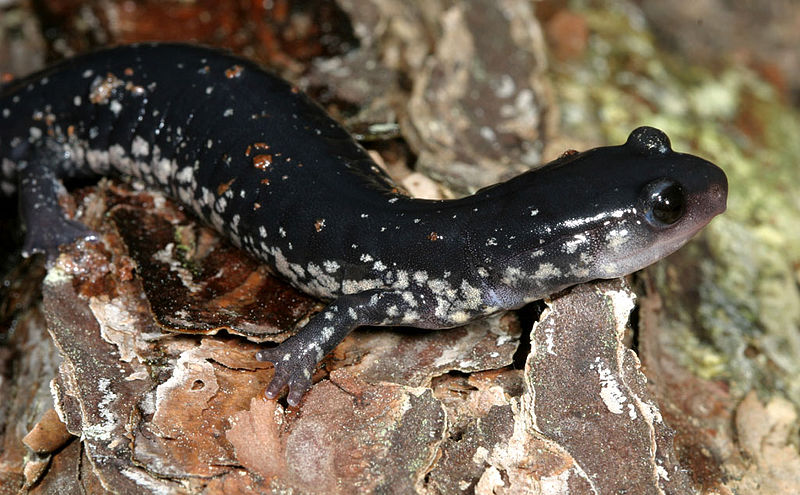
Dwarf Waterdog

Photo by Steve Robie

After spending yesterday looking at the beautifully coloured Oriental Fire-Bellied Toad, today’s amphibian may seem to be a little boring but I promise you will enjoy the Dwarf Waterdog despite their lack of fashion flare. That’s right folks! Today we are heading to the United States to learn about a medium-sized (or small-sized, depending how you look at it) salamander that is endemic to the USA. You are probably going to get wet on this trip so you may want to bring your rubber boots and a change a clothes.

The Dwarf Waterdog is a fully aquatic salamander that loves hanging out in slow-moving streams filled with sand and leaves, however, they will live in clear, fast-moving streams as well. Throughout their home range, there are plenty of deep irrigation ditches that provide the perfect slow-moving habitat for our amphibian friend. Interestingly enough, the Dwarf Waterdog is most active during the winter months, which is definitely different than my behaviour. Similarly, these salamanders tend to be nocturnal, so it may be a challenge to find a few specimens for us to study.

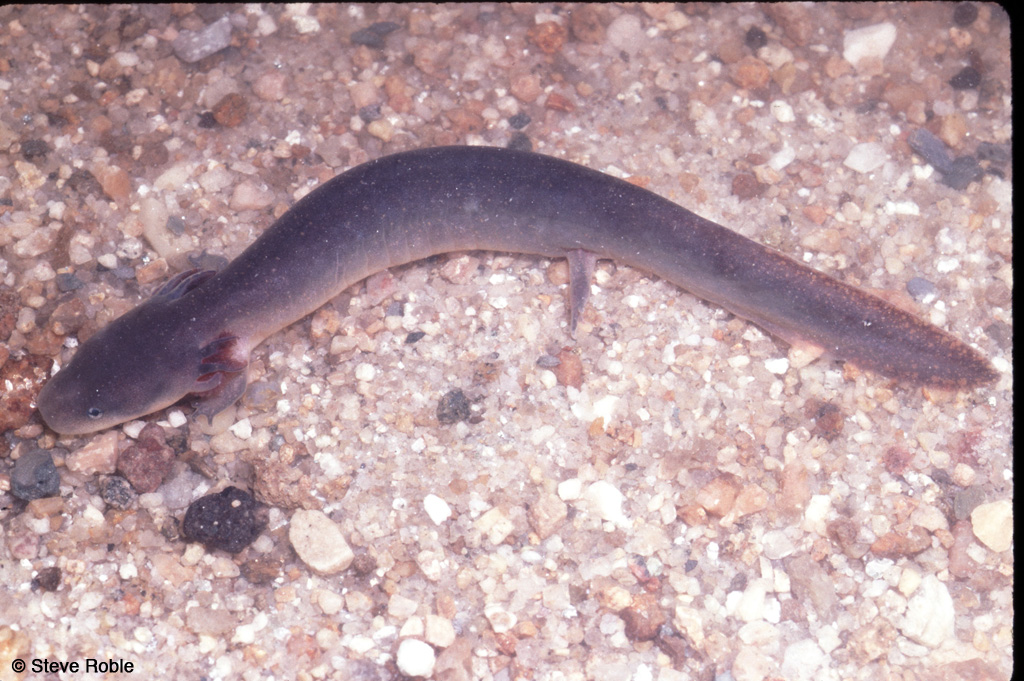
Dwarf Waterdog

Photo by Steve Roble

Okay, so why are they called Dwarf Waterdogs? How small are they? Well, their average length is about 19 cm (7.5″), which doesn’t seem dwarf-like to me. I know plenty of other salamanders that are much smaller than this but weren’t tagged with the dwarf pre-fix, so what gives? Unfortunately, our Waterdog friend here is being compared to other members of its family, Proteidae, which tend to be much larger – about 3 times larger than the Dwarf Waterdog. I guess they are just the runt of the family but I have always found the runt to be just as important as every other member.

Dwarf Waterdog Fast Facts – The Dwarf Waterdog has four-toed feet, a set of large, red, feathery gills and of course the ever-popular flattened tail. Obviously, all of these features allow our amphibian friend to spend the majority of their time in slow (or apparently fast) moving water.

Well, that just about does it for our trip to the United States of America. I hope all of you enjoyed playing around in the streams today and will join me tomorrow for another animal fact. Enjoy the rest of your day.


Digg This
Reddit This
Stumble Now!
Buzz This
Vote on DZone
Share on Facebook
Bookmark this on Delicious
Kick It on DotNetKicks.com
Shout it
Share on LinkedIn
Bookmark this on Technorati
Post on Twitter
Google Buzz (aka. Google Reader)

Wild Fact #481 – An Animal Fit for a King – Spotted Salamander

September 2, 2011 - 12:00 am 1 Comment
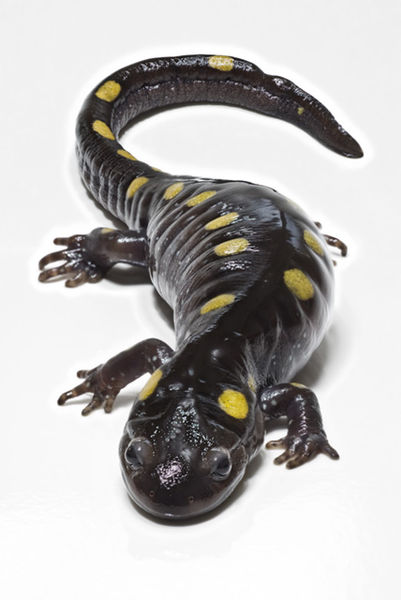
Yellow Spotted Salamander

Photo by Scott Camazine (web.mac.com/camazine)

Before we get into today’s Wild Fact, I have to take a quick second to wish a HAPPY BIRTHDAY to my beautiful niece, Taylor, who is turning an incredible 7 years old today. Have a great day, Tay and enjoy your party at Jungle Cat World this weekend. It appears that the love for animals runs in the family, doesn’t it?

Okay, back to our regularly scheduled Wild Fact…..

Now I know you are all sad because it is Friday and that means you will have to wait 2 days before you get to read another Wild Fact but please try to hold back the tears long enough to read the last fact of the week. We have a very special Wild Fact today as the animal was suggested by my friend, King Somerset (yes, I have royal friends…..so this is an inside joke but I do appreciate his animal suggestion). The great King recommended we learn about the beautiful Spotted Salamander, which can be found throughout Eastern United States and Canada.

Although the Spotted Salamander is quite abundant in Canada and the United States, I bet many people have gone their entire lives without ever getting the opportunity to spot one of these brightly coloured salamanders. No, it isn’t just because people are not very observant but instead the Spotted Salamander lives a very secret life. They spend the majority of their life hiding under rocks, logs or squatting in the burrows of other animals. Personally, I think with all of this secrecy, this salamander species is up to something so we had better keep a close eye on them.

These sneaky little salamanders usually venture away from their hiding place at night in search of some scrumptious dinner. If you don’t feel like staying up late to catch a glimpse of these beautifully coloured salamanders then your best chance would be after a heavy rain. The Spotted Salamander will actually travel long distances over land after a nice heavy rainfall in order to find a mate and to lay their eggs in the perfect pond. This is definitely your best chance to see these wonderful creatures.

Yellow Spotted Salamander

Photo from Wikimedia

If you do spot one of these amphibians, I guarantee you will be amazed by their vibrant colours. Typically, they have a bluish-black body with two rows of yellow or orange spots. Their cool colouring may entice you to pick them up and play with them but you should be warned that the Spotted Salamander is capable of secreting a horrible, milky toxin from glands on their backs and tails. This is obviously used to convince predators not to eat them. You should be fine…..as long as you don’t try eating them!

Spotted Salamander Fast Fact – In the wild, the Spotted Salamander has been known to live up to 20 years, which is pretty incredible for a small amphibian like this.

Well, I hope you enjoyed today’s Wild Fact and if you see King Somerset (well, I guess he is technically a Duke but that is all the same to me) make sure you thank him for suggesting such a great animal. Enjoy your weekend and I will see you on Monday.


Digg This
Reddit This
Stumble Now!
Buzz This
Vote on DZone
Share on Facebook
Bookmark this on Delicious
Kick It on DotNetKicks.com
Shout it
Share on LinkedIn
Bookmark this on Technorati
Post on Twitter
Google Buzz (aka. Google Reader)

Wild Fact #587 – From the Depths of Hell – Hellbender

April 7, 2011 - 12:00 am 2 Comments


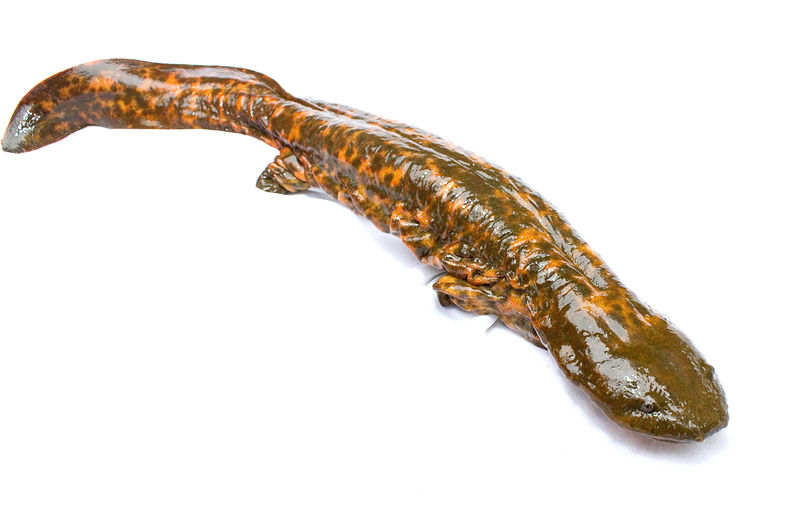
Photo by Brian Gratwicke (Wikimedia)

Today’s Wild Fact is walking on the dark and evil side as we study an aquatic salamander called the Hellbender.  We are not sure where this unusual name for such a harmless animal came from but one theory is this.  Early settlers may have believed that this odd looking creature was from the depths of hell and consequently was bent on getting back there.  Of course this is just a theory since nobody knows for sure.  Heck, we can all make up our own theories – so if you have an interesting theory as to how this salamander got stuck with a name like Hellbender then please feel free to share in the comments below.

In reality the Hellbender is not from the dark and fiery depths of hell.  Instead they are found along the rocky bottoms of rapid flowing streams in North America.  Here is something you may not have known, the Hellbender is the 3rd largest species of salamander in the world.  Only the Japanese Giant Salamander and the Chinese Giant Salamander are larger.  For the record the Hellbender can grow up to 74 cm (29″) long and can weigh up to 2.5 kg (5.5 lbs).  Just imagine a two foot long, slippery, slithery salamander swimming across your path.  Now I am starting to see where the theory that these animals are from hell came from.

Photo by Brian Gratwicke (Wikimedia)

So what does this giant amphibian eat?  The toes of humans of course! Okay, I am just messing with you.  They actually like to feast on crayfish and small fish so your toes are safe…………for now.  Although, it doesn’t seem like these animals are fussy eaters since they have been observed eating toads, tadpoles, lamprey, small mammals and even the skin that they shed.  How hungry must you be to eat your own skin?

You remember when I said that the Hellbender won’t eat your toes?  Well this is still true but it is important to note that this salamander has a very powerful jaw and can deliver a painful bite.  So you may not want to shove your toes in the Hellbender’s face.

It looks like we survived our trip to the darkest depths of our world.  Oh Oh, it looks like we are missing one person……good thing you all signed that liability release form.  You did sign it right?  Okay, I am done being silly for today.  See you tomorrow for the last fact of the week.


Digg This
Reddit This
Stumble Now!
Buzz This
Vote on DZone
Share on Facebook
Bookmark this on Delicious
Kick It on DotNetKicks.com
Shout it
Share on LinkedIn
Bookmark this on Technorati
Post on Twitter
Google Buzz (aka. Google Reader)

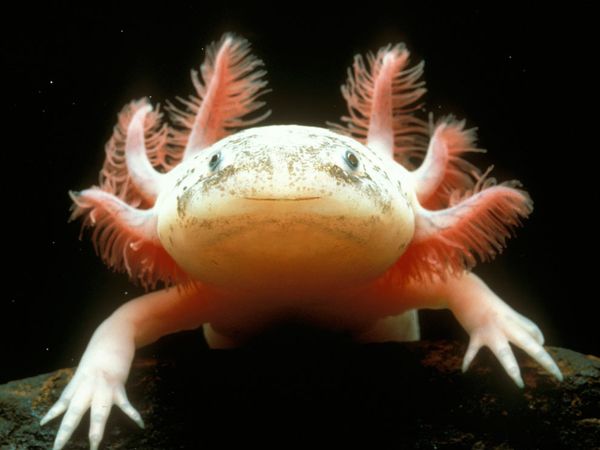
Wild Fact #743 – Kid at Heart – Axolotls

August 18, 2010 - 12:00 am 4 Comments

Photograph by Stephen Dalton/Animals Animals—Earth Scenes

Yesterday we had the opportunity to learn about the largest land-dwelling salamander, the Tiger Salamander.  Today we are going to look at one of their close relatives, the Axolotls (pronounced ACK-suh-LAH-tuhl) which spends its adult life in the aquatic form.

The Axolotl is one of the few salamanders that retains its larval features throughout their adult life.  That’s right these adult salamanders actually keep their tadpole-like fin as well as their external gills.   Honestly, how cool is it that these little guys remain forever young?  I guess I can’t really call them “little” since some individuals will grow up to a foot long (30 cm), however, the majority remain around the 6″ (15 cm) mark. Either way they get fairly large for a salamander.

If your curiosity is piqued and you want to check out these aquatic salamanders than we need to take a trip to the lake complex of Xochimilco (pronounced SO-chee-MILL-koh) near Mexico City.  It is in this complex that you will discover a different salamander that spends its entire life in the water.  Well, I guess this isn’t always true since in a few rare cases the Axolotl has been known to mature into the land-dwelling salamander leaving its watery home. But for the most part the Axolotl is more than happy to hang out on the bottom of this lake complex.

Photo by Erzengel

One of the traits they share with their land-dwelling cousin, the Tiger Salamander, is their longevity.  The Axolotl has been known to live up to 15 years in the wild.  Throughout this time they will feed on a variety of aquatic animals such as worms, mollusks, insect larvae and other various crustaceans.  Unfortunately the population of the Axolotl is beginning to dwindle as large fish are introduced into their lakes knocking them off the top of the food chain.  As you can imagine there are problems living so close to a highly populated center such as Mexico City.  As a result of this increasing human population the Xochimilco lake complex is being drained and what isn’t drained is contaminated. To make matters worse the Axolotl is a favourite among the pet trade and roasted Axolotl is considered a delicacy in Mexico.  One population estimate has the number of wild Axolotl around 700-1200 which is down considerably from the 6000 that were estimated in 1998.  It is a very possible reality that the Axolotl will become extinct in the wild if something is not done soon.

If you would like to find out more about the Axolotl or what you can do to help than I suggest checking out EDGE – The Evolutionarily Distinct and Globally Endangered website for ways that you can make a difference.

Thanks and have a great day!

Digg This
Reddit This
Stumble Now!
Buzz This
Vote on DZone
Share on Facebook
Bookmark this on Delicious
Kick It on DotNetKicks.com
Shout it
Share on LinkedIn
Bookmark this on Technorati
Post on Twitter
Google Buzz (aka. Google Reader)

Wild Fact #744 – The Burrowing Tiger – Tiger Salamander

August 17, 2010 - 12:00 am No Comments

Photo by Gary M. Stolz

One of the trends I have noticed while writing these Wild Facts is I really enjoy talking about exotic animals.  This usually means I often forget to comment on some of the cool animals that exist in North America. Well today we are going to look at one of those “boring” North American animals. So get comfortable because we are about to embark on a journey that will take you underground and through the lakes and streams of USA and Canada as we learn about the Tiger Salamander.

The Tiger Salamander is recognized as being the largest land-dwelling salamander in the world.  They can grow up to 35 cm (14″) long and weigh up to 126 g (4.4 oz).  On average these beautiful salamanders are usually about 15-20 cm (6-8″) long.  As you can imagine they get their name from their vertical stripes resembling that of a tiger.  This can be a little misleading though since many Tiger Salamanders don’t have the typical striped pattern.  They come in a range of stripes, blotches and colours with some salamanders having no markings at all. I think those “no marking” salamanders should be charged with false advertising.

I see you!

You may be surprised that you have lived in the States your whole life but have yet to see a Tiger Salamander.  Don’t be too hard on yourself since the adults are rarely seen out in the open.  Tiger Salamanders spend the majority of their life about a half meter (1.5′) below the surface in specially made burrows.  They will remain on land in these burrows until it is time to mate when they will seek out their favourite watering hole.  This burrowing amphibian is a voracious feeder and will emerge at night to feed on many animals such as worms, insects, frogs and occasionally other salamanders. I bet they really enjoy leaving the burrow for a night out on the town.  It is always healthy to have date nights.

Tiger Salamander Fast Fact – I know it might seem like the Tiger Salamander has a boring life living underground but it is a highly successful life choice.  Surprisingly this particular salamander is capable of living between 10 to 16 years in the wild.  That is pretty impressive for a small amphibian.

Digg This
Reddit This
Stumble Now!
Buzz This
Vote on DZone
Share on Facebook
Bookmark this on Delicious
Kick It on DotNetKicks.com
Shout it
Share on LinkedIn
Bookmark this on Technorati
Post on Twitter
Google Buzz (aka. Google Reader)