Posts Tagged ‘Snake Facts’

Wild Fact #476 – Fashionable Females – Wagler’s Pit Viper

September 9, 2011 - 12:00 am No Comments
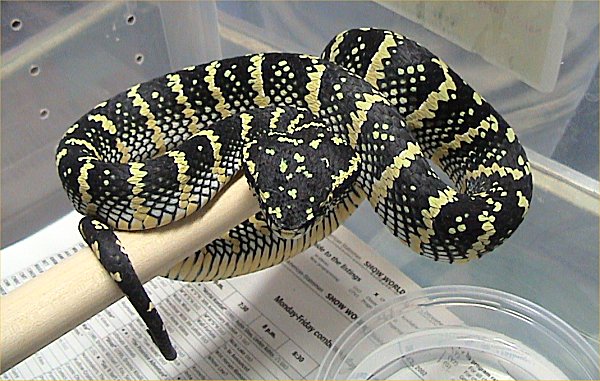
Wagler's Pit Viper

Photo by LA Dawson (Wikimedia)

It looks like we are at the end of another week of Wild Facts. I figured since we were in Southeast Asia observing the Dhole yesterday, we might as well stick around that part of the world for the weekend. As a result, we are going into the rainforest today to look for the Wagler’s Pit Viper. This impressive snake has many common names including Temple Pit Viper, Bamboo Viper, Temple Snake and Speckled Pit Viper. In case you are wondering, the “Temple” references are a result of the abundance of these snakes located around The Temple of the Azure Cloud in Malaysia. Perhaps this will be a great starting place for us!

During our trip, it should be easy to distinguish between the male and female Temple Vipers as this snake definitely displays sexual dimorphism (I know, I know.. enough of the science talk.. this just means the females look different than the males). For instance the females will typically grow up to 1 m (3′) in length while the males usually tap out around 75 cm (29.5″). Unlike most animals we discuss, it is the female vipers that tend to be more colourful. In fact, the females have four different colour phases – The Malaysian, Sulawesi, Kalimantan and the Philippine Phase. Throughout these phases they have a diverse colour range including variations of blue bars, yellow spots, green or black backgrounds and more. Meanwhile, the male Wagler’s Pit Viper is just a plain ol’ boring green colour.

Wagler's Pit Viper

Photo by Nelly de Rooij (Wikimedia)

Don’t feel too bad for the males since these snakes are almost entirely arboreal (what is with the big words today, eh? Just means they live in the trees), so the green colouring does provide them with a nice camouflage. While in the trees, these snakes predominantly feed on lizards, birds and even rodents. Since these snakes live in tropical climates, they don’t need to waste their energy on keeping warm, which means they can actually get by with only 3 meals a month. I have a hard time making it through the day without at least 5 meals… I have no idea how they can last a whole month with that tiny amount of food.

Well, that just about does it for this week of Wild Facts. Take the weekend to enjoy Southeast Asia and I will see all of you on Monday.

Digg This
Reddit This
Stumble Now!
Buzz This
Vote on DZone
Share on Facebook
Bookmark this on Delicious
Kick It on DotNetKicks.com
Shout it
Share on LinkedIn
Bookmark this on Technorati
Post on Twitter
Google Buzz (aka. Google Reader)

Wild Fact #525 – How to Hide the Bulge – Wart Snake

July 4, 2011 - 12:00 am No Comments

Photo from Wikimedia

I hope all of you enjoyed your long weekend  (or are still enjoying it since I believe my American friends have today off) and managed to properly celebrate Canada Day or Independence Day.  Speaking of that, Happy Independence Day to all of my wonderful American readers. I hope you are all enjoying your day filled with BBQs and fireworks. Okay, let’s move onto our fun animal fact. Today’s fact was inspired by my 2 year old niece even though she doesn’t know it yet.  You see she was at the zoo the other day and manage to pull a huge piece of snake skin (don’t worry, it wasn’t attached to the snake) out of the cage and wanted to bring it with her for the rest of the day. Now I believed they returned the shedded skin back to the proper place but it got me thinking about snakes, so today’s Wild Fact is on the Wart Snake.

The Wart Snake is group of a primitive water snakes comprised of 3 different species which are found in Australia and Indonesia. I thought this would be the perfect snake to talk about since their most prominent feature is their incredibly loose and baggy skin. It actually looks like their skin is a few sizes too big for them.  Perhaps they have all lost a lot of weight recently.  Their scales are also pretty neat since they don’t overlap like most snakes.  Nope, they actually project out from the body and consequently look like little warts.  I wonder how they came up with the common name for this snake?

Photo from Wikimedia

These snakes are entirely aquatic and will spend most of their time at the bottom of a river or a stream just waiting to ambush the poor unsuspecting prey swimming by.  So what do they eat? Naturally, they like to feast on great tasting fish, which they capture by coiling around them.  Besides being responsible for their name the wart-like scales also help the Wart Snake catch their food since these raised scales will hold the squirmy fish in place.  How about that, the scales are trendy and practical.  Unlike typical snakes, the Wart Snake will not bulge after eating a hearty meal.  Their skin is so loose and baggy that their body remains slack and normal at all times.  Even snakes know that you can hide a chubby stomach by wearing loose fitting clothing – intelligent little critters.

Okay, so that does it for the first Wild Fact of the week.  Now let’s get back to celebrating Independence Day by BBQing up some tasty burgers.  Enjoy the rest of your day!

Digg This
Reddit This
Stumble Now!
Buzz This
Vote on DZone
Share on Facebook
Bookmark this on Delicious
Kick It on DotNetKicks.com
Shout it
Share on LinkedIn
Bookmark this on Technorati
Post on Twitter
Google Buzz (aka. Google Reader)

Wild Fact #593 – Moth Collectors Beware! – Sidewinder

March 30, 2011 - 12:00 am No Comments

Photo by Victorrocha (Wikimedia)

To celebrate the middle of the week, I am going back to the documentary on some of the deadliest animals.  What?  Everyone loves learning about the animals that can kill us, right? Today we are looking for a little reptile called the Sidewinder, which is a venomous pit-viper.  I know, I know – snakes are gross, but it is best to learn about them now so you don’t try playing with one of these when you are out in the wild.  Oh and for the record, the “wild” that I am referring to are the deserts of southwestern USA and northwestern Mexico.

The Sidewinder is relatively small compared to other snakes as they only measure between 43 – 76 cm (17 – 30″) in length.  Now don’t go thinking that you can go and cuddle a Sidewinder just because they aren’t 15′ long.  Nope, these little rattle snakes can still pack a pretty good venomous punch.  Granted it may not be as bad as some of the other rattlesnake species but you will still be in a great deal of pain.  In fact, one person who had been bit compared the pain to sticking your arm in a bucket of burning oil.  That sounds pleasant, doesn’t it?  To accompany that burning pain, you may also have to deal with nausea, chills, dizziness and of course shock.  So make sure you take a good look at the picture so you can recognize this little guy while wandering through the desert.

Photo from Wikimedia

The good news is that the Sidewinder isn’t looking to eat you so they will only attack as a form of self defense.  Now if you were a lizard or a rodent then you really need to be on the lookout.  When a Sidewinder is young they will feast on reptiles, which they attract to them with their tail.  Yep, these young little snakes will move their tail in a fashion that either mimics a fluttering moth or a slow moving caterpillar.  Just imagine the look of surprise on the lizard as they go in for the kill.  As the Sidewinder gets older their appetite shifts to rodents and they no longer have a need for this luring tactic.  I guess you need to be careful if you are out catching moths in the desert.  I would hate to accidentally catch a venomous snake.

That does it for another Wild Fact.  Enjoy the rest of your day.

Digg This
Reddit This
Stumble Now!
Buzz This
Vote on DZone
Share on Facebook
Bookmark this on Delicious
Kick It on DotNetKicks.com
Shout it
Share on LinkedIn
Bookmark this on Technorati
Post on Twitter
Google Buzz (aka. Google Reader)

Wild Fact #715 – All About the Eyes – Eyelash Viper

September 27, 2010 - 12:00 am 2 Comments

Photo from Wikimedia

I hope everyone enjoyed last weeks edition of Wild Facts where we discussed various animals that have become extinct for one reason or another.  Today we are going to go back to learning about animals that are still roaming this wild earth.  Monday’s Wild Fact was chosen as a result of the weather in the Yukon Territory this weekend.  How could the weather dictate a Wild Fact, you ask?  Well, much to my dismay we managed to get almost a foot of snow last week (in September, I know!!) so I wanted to write about an animal that would never be found living in these cold climates.  If you can’t tell, I am not even close to being ready for winter yet.  All right, so what animal depicts my escape to warmer climates?  Of course it is a slippery, slithery snake called the Eyelash Viper.

Naturally the Eyelash Viper is a venomous snake which is found in Central and South America.  Although poisonous they are relatively small snakes averaging about 75 cm (2.5′) in length.  Don’t get me wrong, I still wouldn’t want a two and a half foot viper slithering all over me in the middle of the Rain-forest but at least they aren’t 30 feet long like some pythons.  It is not uncommon to see the Eyelash Viper in zoos and other exhibits.  They have a wide range of colours which would definitely appeal to the crowds.

View of their Eyelashes - Photo by: Tad Arensmeier (Wikimedia)

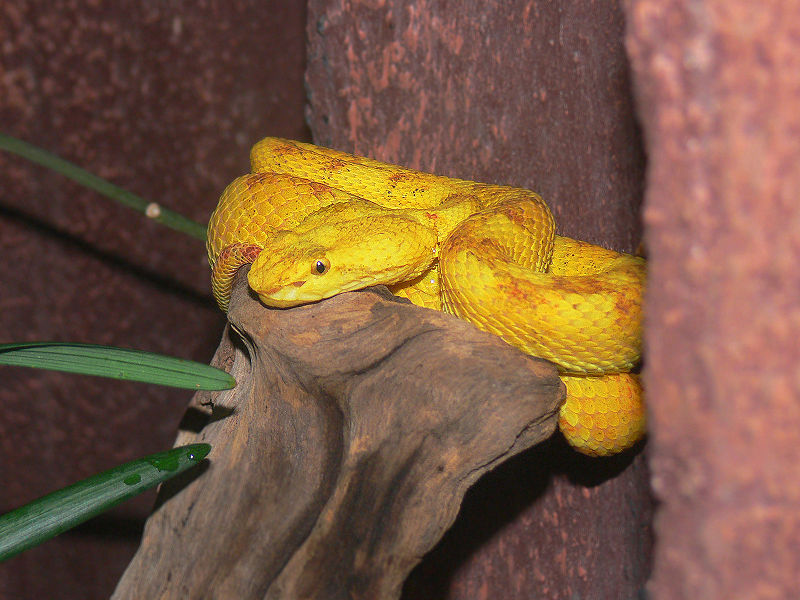
This particular snake would not be called the “Eyelash” Viper for no reason, right?  Of course not!  They get this name due to a set of scales over their eyes which looks like eyelashes.  Biologists believe these scales assist the snake with their camouflage.  I know you are probably questioning how this helps them blend in.  Well with eyelashes predators mistake them for humans and often leave them alone.  Obviously, I am kidding but seriously these scales help break up the snakes outline among the trees where it hides.  This way the other animals don’t realize that it is a streamlined, sneaky snake hiding in the leaves.

I mentioned that the Eyelash Viper is a venomous snake so just how dangerous are they?  If you are a small animal than their bite could very well be fatal.  For larger animals including humans the bite isn’t usually deadly unless they manage to inject a large amount of venom.  Luckily for us the Eyelash Viper is not an aggressive snake, however, they will attack the instant they are touched.  Since they are usually hanging out in the trees humans usually get bit in the hands or arms so be careful when you are walking through the Rain-forest.

That does it for the tropical animal of the day.  I guess I will go back to looking at the snow.  Have a good one, folks!

Digg This
Reddit This
Stumble Now!
Buzz This
Vote on DZone
Share on Facebook
Bookmark this on Delicious
Kick It on DotNetKicks.com
Shout it
Share on LinkedIn
Bookmark this on Technorati
Post on Twitter
Google Buzz (aka. Google Reader)

Wild Fact #757 – The Big Squeeze – Burmese Python

July 29, 2010 - 12:00 am 3 Comments

Photo by Mariluna

Well Wild Fact followers, I made it back after an incredible adventure flying around Kluane National Park. If you enjoy hiking, camping and just being around nature than I highly suggest taking a trip up to the Yukon to check out this National treasure.  I am done promoting the beautiful scenery of Canada’s north for today so let’s move on to our Wild Fact.  If you are a little squeamish about snakes than today’s fact may not be for you; however, I promise that the Burmese Python will keep you entertained for the next five minutes.

We can find the Burmese Python hanging out in the grassy marshes of Southeast Asia.  They shouldn’t be too tough to find since they are among the largest snakes on earth. Make sure you are sitting for this next little tidbit of information.  This particular snake is capable of reaching up to 7 m (23′) in length and can weigh up to 90 kg (200 lbs).  I think accidentally stumbling upon a 200 lb snake would definitely startle me.  For some reason I keep thinking about that movie, “Anaconda”.

The Burmese Python starts its life out slithering around the trees, which sounds safe for us, right? But as these snakes mature and become heavier they have a tough time climbing trees so they quickly become ground dwelling snakes.  These giant snakes are also proficient swimmers as they are capable of staying submerged for up to 30 minutes. So let’s see, the trees, ground and now water is not safe from these massive snakes.  Where else is there to go in Southeast Asia? Believe it or not their docile nature, quick growth rate and beautiful appearance makes these snakes very popular among pet owners. Personally, I think it is crazy to have a 200 lb snake that could easily crush you hanging around the house. But I guess I am just a little old fashioned like that.  In all honesty the Burmese Python is not known to be aggressive and usually not a threat to humans.  Although some pet handlers have suffered serious consequences from improperly treating and handling their pythons.

Burmese Python Fast Fact – The Burmese Python has about 400 sets of ribs and a very flexible spine. This obviously allows them to easily move without the use of legs.

That does it for today’s Fact on the Burmese Python.  Have a great day everyone!

Digg This
Reddit This
Stumble Now!
Buzz This
Vote on DZone
Share on Facebook
Bookmark this on Delicious
Kick It on DotNetKicks.com
Shout it
Share on LinkedIn
Bookmark this on Technorati
Post on Twitter
Google Buzz (aka. Google Reader)

Wild Fact #822 – Don’t Mess with this Viper – Russell’s Viper

April 29, 2010 - 12:00 am 3 Comments

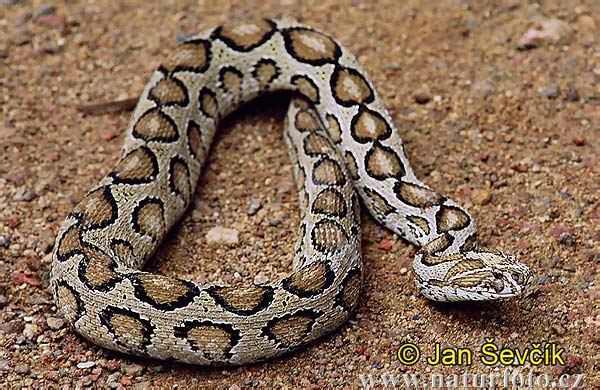
Photo by Jan Sevcik

We can’t have a week of Wild Facts dedicated to the venomous creatures of earth and not talk about a snake.  Today we are going to look at the Russell’s Viper, which could be one of the most deadly snakes in the world. The worst part is it has a smaller relative, the Saw-Scaled Viper, which is just as deadly.  We will learn more about their poison in a second but first let’s get some additional information on this interesting snake.

The Russel’s Viper can be found throughout much of Asia including India, Southern China and Taiwan.  This particular snake can grow as long as 1.7 m (5.5′) and comes in earthy type colours such as brown, gray and deep yellow.  They have a flattened head with a blunt snout and large nostrils. Now that we have an idea what they look like, lets find out just how poisonous they really are.

As mentioned the Russell’s Viper is one of the deadliest snakes in the world and coupled with their smaller relative, the Saw-Scaled Viper, account for more snake bite deaths than all other species put together.  The Russell’s Viper will transfer a large amount of venom into a single bite.  This does not bode well for the victim. Some of the symptoms from a Russell’s Viper bite include pain lasting for 2-4 weeks (this should be an indication of how venomous these guys really are), drop in blood pressure and heart rate, bleeding of the gums, vomiting, swelling, and of course death may occur over two weeks after the bite.  Even if you do survive the deadly bite there can be life long complications such as renal failure and a total lack of blood coagulation. Interestingly enough males bitten by this snake may lose their facial hair, have decreased libidos and actually have a reduction in male hormones. I am not sure why the cobra and the python gets all of the attention.  I would definitely take a cobra or a python over this crazy snake!

Well that just about does it for this fact.  Make sure you tune in Friday for the final fact.  I can promise you won’t be able to guess this venomous animal!

Have a great day!

Digg This
Reddit This
Stumble Now!
Buzz This
Vote on DZone
Share on Facebook
Bookmark this on Delicious
Kick It on DotNetKicks.com
Shout it
Share on LinkedIn
Bookmark this on Technorati
Post on Twitter
Google Buzz (aka. Google Reader)

Wild Fact #909 – Life at Sea – Pelagic Sea Snake

December 28, 2009 - 10:23 pm 2 Comments

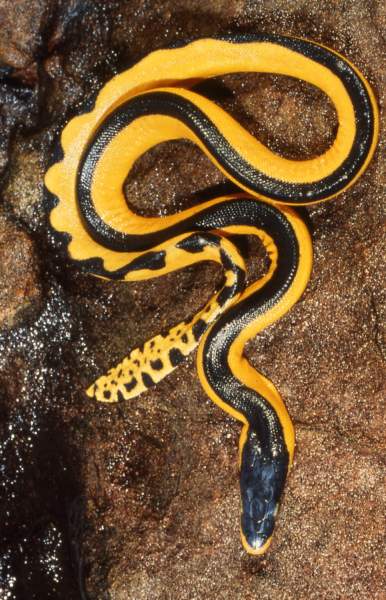
We will continue with the Galapagos Island theme today. This time we are going to head to the waters surrounding the famous islands. The pelagic sea snake (also referred to as the Yellow-Bellied Sea Snake) is an interesting animal that spends almost all of its time at sea.  In fact, this particular snake becomes helpless when washed up on land.

The pelagic sea snake is a venomous snake that can get up to about 1 meter (3 feet) in length.  So how do these slippery reptiles live? Well, during the day they will be out hunting and when night falls they head to the ocean floor and sleep.  Occasionally, they will need to come to the surface to grab a breath of fresh air. Impressively, the sea snake can stay underwater for almost three and a half hours.  How can they breathe underwater for so long? That is a very good question! Thank you for asking.  The pelagic sea snake utilizes something called cutaneous breathing.  Basically, they are able to breathe through their skin by removing the oxygen from the water and releasing carbon dioxide (maybe they are the cause of climate change!).  Another interesting feature of the sea snake that allows them to live under water is their salt gland.  This special gland under their tongue allows them to filter the salt out of the water.  Obviously, this is a very important characteristic for surviving in a marine environment.

For the most part, you don’t need to worry about these venomous snakes as they don’t tend to be aggressive; however, they have been known to aggregate together by the thousands.  Something tells me that most of you would not try swimming through thousands of yellow-bellied sea snakes or any kind of snake for that matter.  I for one don’t blame you!

I hope you enjoyed the second installment of the Wild Facts – Animals of the Galapagos.  Have a great day!

Digg This
Reddit This
Stumble Now!
Buzz This
Vote on DZone
Share on Facebook
Bookmark this on Delicious
Kick It on DotNetKicks.com
Shout it
Share on LinkedIn
Bookmark this on Technorati
Post on Twitter
Google Buzz (aka. Google Reader)