Posts Tagged ‘Spider’

Wild Fact #382 – The Tired Traveler – Rabid Wolf Spider

January 19, 2012 - 12:00 am No Comments
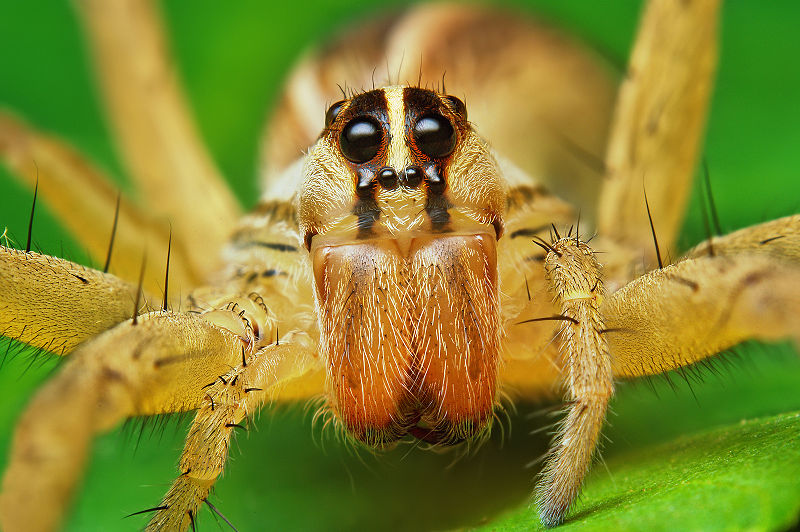
Rabid Wolf Spider

Photo by Thomas Shahan (Wikimedia)

Today’s Wild Fact may be creepy but I promise it won’t bite……on second thought, it probably will bite a little. The Rabid Wolf Spider is known to be rather aggressive, however, they are not typically dangerous to humans. This is a good thing since they are one of the most common spiders found throughout the United States. Although, they are typically found on the western side towards Texas, they have been spotted as far east as Maine and Florida….which is pretty much as far east as you can go. So is anyone up for a quick trip to the States to find one of these magnificent creatures? How come it’s always harder to get people to come on a spider expedition then it is for something cute like a monkey?

What’s My Name!?

The Rabid Wolf Spider probably has one of the coolest names in the Animal Kingdom. They received this wicked name as a result of their hunting ability. Apparently, this spider prefers to hunt their prey, which includes crickets, ants, grasshoppers and other spiders, by slowly stalking them from a distance over a certain period of time. Yes, this is a similar hunting strategy that wolves and wild dogs employ, hence the name. I am guessing the “Rabid” tag was added on as a result of their aggressive nature but this is just my own hypothesis. 

Rabid Wolf Spider

E.R. Degginger / Color-Pic, Inc.

A Grumpy Spider

As mentioned, the Rabid Wolf Spider is one of the most common spiders in the United States of America and as such they have adapted to a wide variety of environments. This particular spider has a tough time staying in one location and is known to wander from spot to spot for most of their lives. As a result, they have a lot of interactions with humans and other spiders. Perhaps, this is why they are so aggressive – they are just tired from traveling and want to get to their “next” home without being bothered. The Rabid Wolf Spider is often preyed on by larger animals such as dogs, cats, snakes and other wolf spiders, which means they need to be cautious when traveling around the country. This is why you will typically find these spiders under bushes and throughout the litter of the forest floor – they are trying to hide, so make sure you don’t take them out of their awesome hiding spot.

That does it for today’s Wild Fact. I hope you enjoyed learning about the impressive Rabid Wolf Spider.

Digg This
Reddit This
Stumble Now!
Buzz This
Vote on DZone
Share on Facebook
Bookmark this on Delicious
Kick It on DotNetKicks.com
Shout it
Share on LinkedIn
Bookmark this on Technorati
Post on Twitter
Google Buzz (aka. Google Reader)

Wild Fact #437 – If You’re Happy and You Know it… – Happy Face Spider

November 3, 2011 - 12:00 am No Comments
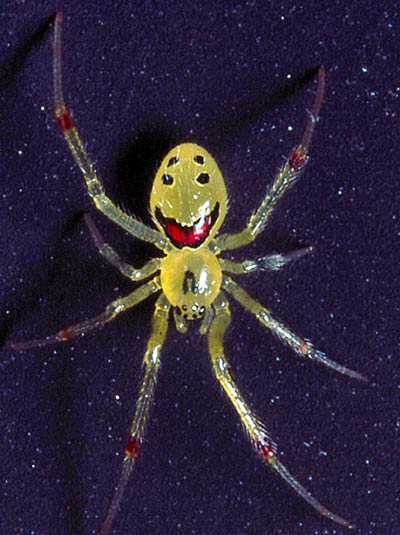
Happy Face Spider

http://news.sky.com/home/world-news/article/15267921

As the week is winding down, I figured everyone could use a good smile to help get them through til Friday. I am willing to bet that today’s animal will put a smile on everybody’s face. In fact, even the Happy Face Spider is smiling, so if he can do it then so can you. Believe it or not, that picture is not photo-shopped or doctored in any way. I know, it is hard to believe that a spider can be so incredibly happy but the proof is right there on its back. Perhaps we should take a minute and find out why this spider is in such a great mood.

The Happy Face Spider is technically known as the Theridion grallator but that isn’t nearly as much fun so we are going to stick with their adopted common name. This uplifting spider is found among the islands of Hawaii, where it was given the local name “nananana makaki’i” which simply means Face-Patterned Spider. The Hawaiian name is probably the most accurate since not all species of this spider has the distinct happy face shown above. I suppose the species pictured above was the first one to fall asleep at the last “nananana makaki’i” party. I just hope for the spider’s sake that it is a washable marker.

Happy Face Spiders

Click for link

So what is the purpose of the smiley face? Well, it is believed that this face-pattern is a great defense mechanism towards birds. After all, would you want to eat a large emoticon, if you were a bird? Okay, so maybe it isn’t that large of an emoticon since the Happy Face Spider is only a few millimetres in length. Nonetheless, I am pretty sure it would catch the birds off guard, and hopefully provide the spider with a few seconds to escape while their predator tries to figure out what they are looking at.

Happy Face Spider Fast Fact –  Although, they are not yet listed on the IUCN list, the Happy Face Spider is becoming threatened since they live in very specialized habitat on the islands of Hawaii. Unfortunately, this habitat is at risk from the introduction of non-native species. It would be an incredibly sad day if the Happy Face Spider ceases to exist.

Well, I hope you are smiling now because I know I am. Enjoy the rest of your day and I will see you tomorrow.

Digg This
Reddit This
Stumble Now!
Buzz This
Vote on DZone
Share on Facebook
Bookmark this on Delicious
Kick It on DotNetKicks.com
Shout it
Share on LinkedIn
Bookmark this on Technorati
Post on Twitter
Google Buzz (aka. Google Reader)

Wild Fact #674 – Long Jump Winner – Jumping Spiders

November 23, 2010 - 12:00 am 2 Comments

Photo from Wikicommons

Lately it seems as though we have been focusing on way to many mammal species so today we are going to learn about a very cool eight legged animal.  Now, I know some of you may not like spiders but I can guarantee that you will find Jumping Spiders to be very interesting.  I am just going to talk about the broad characteristics since there are over 5000 species of Jumping Spiders.  This makes them the largest family of spiders as they comprise about 13% of all spiders out there.  I just realized that I could complete my Wild Facts project 5 times over just with this one family.  Maybe I should start a second blog called Spider Facts!

Since the this family is so large you can virtually find a Jumping Spider species anywhere in the world; however, I doubt they reside in Antarctica or the in the extreme north such as Greenland.  Basically this means that we don’t have to go on a field trip today.  Grab your glass of lemonade and sit out in the backyard for awhile.  For the record I am not going to do this since it was 25 below with the windchill today.  So who wants to learn about some of the unique behaviours and characteristics of this spider?  Wow, I didn’t realize all of you were so excited.  Well let’s get to it then.

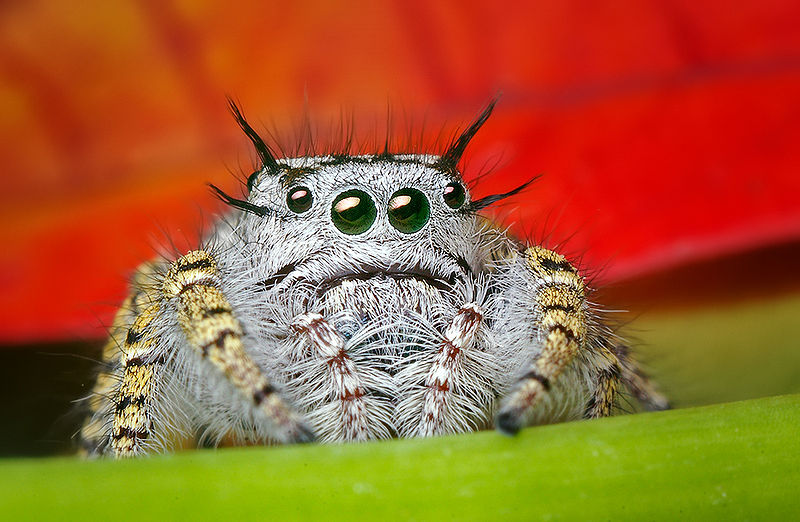
Photo by Thomas Shahan (Wikicommons)

When you look at the picture you probably notice their eyes first and foremost.  This makes sense since these eyes are unique and play a huge role in the Jumping Spiders life.  You see the Jumping Spider spends their days actively hunting other insects.  They aren’t lazy like other spiders that just build a web and hope something flies into it.  These spiders are like a wild cat in the savannah as they wait to pounce on their prey.  They use their keen sense of vision to pick up and track any insect that happens to be in their area.  The spider will then get into position and when the time is right they will pounce.  Jumping spiders can jump about 10 to 40 times the length of their body.  Just so you know their body length is typically between 3-10 mm (0.12-0.39″) so they are pretty small but being able to jump 10-40 times that length is still pretty impressive.

Jumping Spider Fast Fact – Let’s finish up the post talking about their funny looking eyes.  The Jumping Spider will usually have four pairs of eyes so if my math is correct that would be eight eyes.  They typically have these eyes arranged in three rows with two very large eyes in the middle of their flat head.  As mentioned earlier their eyesight is excellent as they rely on it to track their prey.

See, that spider fact wasn’t too bad now was it?  Before you go I recommend checking out the short video of a Jumping Spider in action.  It is from National Geographic so you know it will be good.

Digg This
Reddit This
Stumble Now!
Buzz This
Vote on DZone
Share on Facebook
Bookmark this on Delicious
Kick It on DotNetKicks.com
Shout it
Share on LinkedIn
Bookmark this on Technorati
Post on Twitter
Google Buzz (aka. Google Reader)

Wild Fact #879 – Don’t Put this Spider as your Beneficiary – Black Widow Spider

February 9, 2010 - 12:00 am 6 Comments

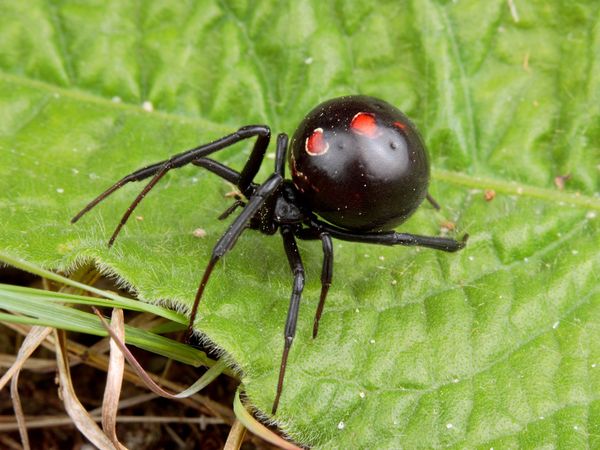
Photograph by George Grall

Warning! If you have a fear of spiders than today’s post is not for you; however, it is probably too late since you have already seen the picture of the popular spider above.  Don’t worry, it is just a picture and won’t do you any harm. In fact, if you keep reading you will find out exactly what harm the Black Widow Spider can cause.

The black widow spider is a popular and much feared spider. It is amazing how scary a spider ranging in size between 1.3-3.8 cm (0.5-1.5″) can seem to us. I guess the reason we panic when we hear about this teeny tiny spider has to do with the fact that it contains venom 15 times stronger than a rattlesnake. Yup, that would scare the pants off me.  Unfortunately, most people don’t realize that the quantity of this venom isn’t usually deadly. For the most part, if you are bitten by a black widow you will experience nausea, muscle aches and it may have difficulties breathing.  Heck, these are some of the same symptoms you would experience from the H1N1 vaccine.  Whatever happened to that pandemic? There have been occasions where the black widow has killed humans, however, they are usually the elderly, young or sick.  It is also important to know that the black widow doesn’t wake up in the morning put on its war paint and head out looking for people to bite.  They are not aggressive and will only bite as a form of self defense, so watch where you sit.

Have you ever wondered why this particular spider is called the black widow? Believe it or not, the reason you are thinking is correct! You were not entirely correct if you were thinking that the female finds some unsuspecting, rich male to marry and then murder him in order to get all of his money. Although, the female may kill and consume their mate after reproduction. This will provide the female spider with the energy required to lay her eggs. As a male, I am happy that I am not a black widow spider.

Digg This
Reddit This
Stumble Now!
Buzz This
Vote on DZone
Share on Facebook
Bookmark this on Delicious
Kick It on DotNetKicks.com
Shout it
Share on LinkedIn
Bookmark this on Technorati
Post on Twitter
Google Buzz (aka. Google Reader)

Wild Fact #879 – Don't Put this Spider as your Beneficiary – Black Widow Spider

February 9, 2010 - 12:00 am 6 Comments

Photograph by George Grall

Warning! If you have a fear of spiders than today’s post is not for you; however, it is probably too late since you have already seen the picture of the popular spider above.  Don’t worry, it is just a picture and won’t do you any harm. In fact, if you keep reading you will find out exactly what harm the Black Widow Spider can cause.

The black widow spider is a popular and much feared spider. It is amazing how scary a spider ranging in size between 1.3-3.8 cm (0.5-1.5″) can seem to us. I guess the reason we panic when we hear about this teeny tiny spider has to do with the fact that it contains venom 15 times stronger than a rattlesnake. Yup, that would scare the pants off me.  Unfortunately, most people don’t realize that the quantity of this venom isn’t usually deadly. For the most part, if you are bitten by a black widow you will experience nausea, muscle aches and it may have difficulties breathing.  Heck, these are some of the same symptoms you would experience from the H1N1 vaccine.  Whatever happened to that pandemic? There have been occasions where the black widow has killed humans, however, they are usually the elderly, young or sick.  It is also important to know that the black widow doesn’t wake up in the morning put on its war paint and head out looking for people to bite.  They are not aggressive and will only bite as a form of self defense, so watch where you sit.

Have you ever wondered why this particular spider is called the black widow? Believe it or not, the reason you are thinking is correct! You were not entirely correct if you were thinking that the female finds some unsuspecting, rich male to marry and then murder him in order to get all of his money. Although, the female may kill and consume their mate after reproduction. This will provide the female spider with the energy required to lay her eggs. As a male, I am happy that I am not a black widow spider.

Digg This
Reddit This
Stumble Now!
Buzz This
Vote on DZone
Share on Facebook
Bookmark this on Delicious
Kick It on DotNetKicks.com
Shout it
Share on LinkedIn
Bookmark this on Technorati
Post on Twitter
Google Buzz (aka. Google Reader)