Posts Tagged ‘tortoise’

Wild Fact #388 – The Comeback Kid – Chelonoidis elephantopus

January 11, 2012 - 12:00 am No Comments
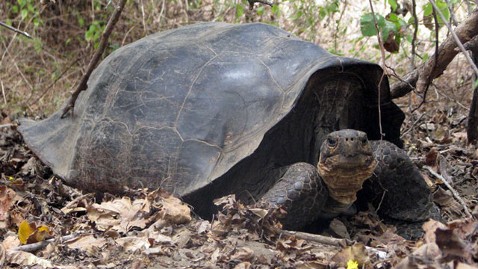
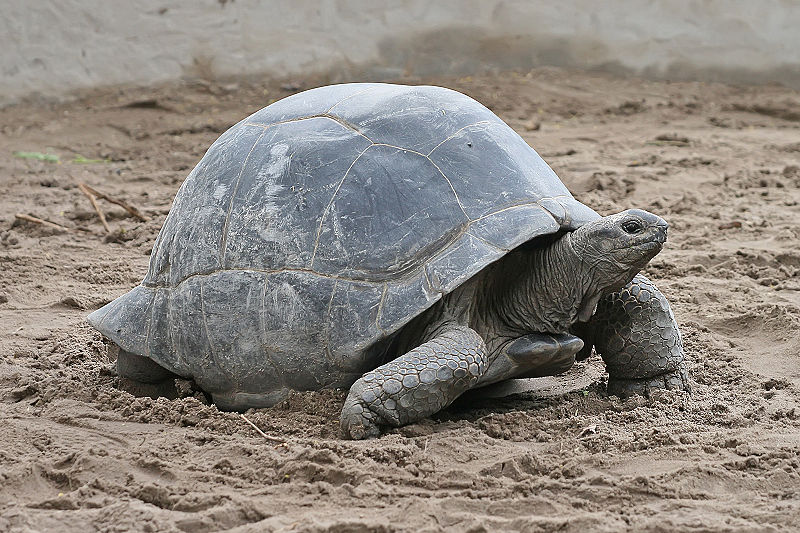
Galapagos Tortoise

Photo from Yale University

This week it seems we are alternating between popular animals and ones that we just don’t know much about. Today’s animal is a type of Galapagos Tortoise that we had thought had been extinct for 150 years. Yes, the Chelonoidis elephantopus falls under the category of “we don’t know much about this animal”. That’s okay though since we are going to do our best to uncover a few facts about this amazing tortoise. Are you ready to take a quick trip to the Galapagos Islands, where it is believed that this once “extinct” animal is making the comeback of the century?

Extinct or Not Extinct? That is the Question

So how do you re-discover a lost species? Through genetic testing of course. That’s right, researchers were studying the genome of closely related species, Chelonoidis becki, when they started finding traces of a long lost generation. It was proven that these hybrids were a direct descendant from the “extinct” tortoise, which means either their mother or father shouldn’t technically exist anymore. Since these tortoises have been known to live up to 175 years, you may be thinking that this is no big deal and that the hybrid was born before their mother or father went extinct. This is a great theory but I forgot to give you one crucial piece of the story…..some of these hybrids were only 15 years old. Yep, this means that there is most likely a hidden population of Chelonoidis elephantopus living somewhere on the island.

Galapagos Tortoise

Click for Source

An Amazing Hiding Spot

Finding these extinct species is now similar to an Easter egg hunt, which would be a lot of fun. It would be monumental for the species if humans were able to find a few specimens, since we would be able to begin a breeding program to help keep this Tortoise population alive. Although, if I were the Chelonoidis elephantopus, I would be a little weary of humans since their drastic population decline was a result of our hunting efforts. Maybe this is the perfect time to make things right and help this animal species do something that is almost impossible……comeback from extinction!

That does it for our trip to the amazing Galapagos Islands. I hope you enjoyed learning about the comeback tour of this “extinct” tortoise.

Digg This
Reddit This
Stumble Now!
Buzz This
Vote on DZone
Share on Facebook
Bookmark this on Delicious
Kick It on DotNetKicks.com
Shout it
Share on LinkedIn
Bookmark this on Technorati
Post on Twitter
Google Buzz (aka. Google Reader)

Wild Fact #533 – A Tad Salty – Diamondback Terrapin

June 22, 2011 - 12:00 am No Comments

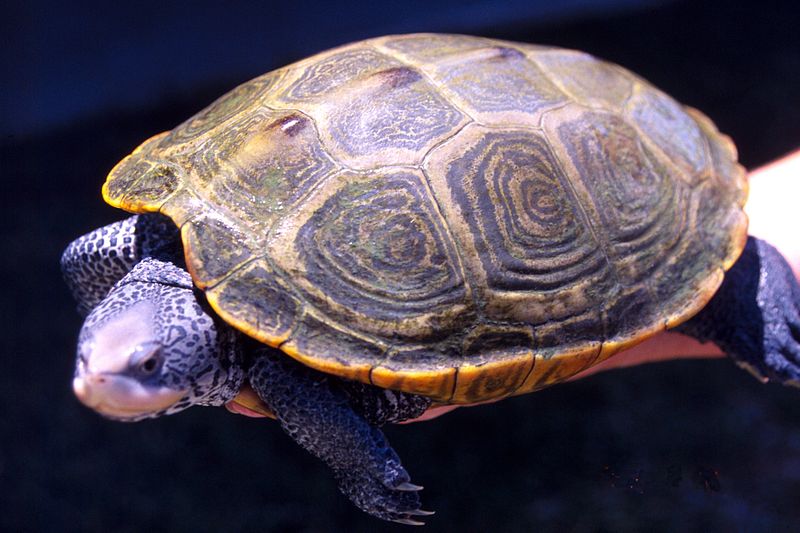
Photo from Wikimedia

Well, yesterday I promised we would learn about an animal completely different from the turtle and the tortoise.  I looked high and I looked low but I think I finally found the perfect animal.  Of course, I am talking about the Diamondback Terrapin which is not even remotely close to the turtle and the tortoise.  Tell me you are not impressed with how different this animal is.  What do you mean they look just like the other two animals we talked about this week?  Okay, so maybe you are right, perhaps the Terrapin is just another common name used for turtles.  At the end of the day, all three  (turtle, tortoise and terrapin) belong to the order Chelonia and are basically very similar.

The Diamondback Terrapin is actually a species of turtle that resides in the brackish, coastal swamps of southern and eastern United States.  So if it is a turtle species, why is it called “Terrapin”?  Good question!  Besides making things confusing, in the old days, the early settlers use to call any turtle that lived in these type of coastal swamps as a Terrapin. In North America, the term is still commonly used for these brackish water turtles.

Photo by LA Dawson (Wikimedia)

It is believed that the Diamondback Terrapin is the only turtle that spends the majority of their time in these brackish waters.  If you are still trying to figure out what a “brackish water” is, it is basically the transition zone between the ocean and freshwater systems.  It has some salt but not nearly as much as the ocean.  Although, the Diamondback Terrapin enjoys hanging out in these salty transition zones, they will still come up to the beach to lay their eggs.  And why not, right? Everyone enjoys a nice beach vacation every now and again.

Diamondback Terrapin Fast Fact – If you look closely at the skin of the Diamondback Terrapin (actually, you don’t even have to look that closely) you will notice that they have a pattern of black spots and lines. Apparently, this pattern is different for every individual Diamondback Terrapin so it acts like their fingerprint.  The police would have their work cut out for them if they had to get the fingerprints from a nefarious Terrapin.

Seriously, this is the last turtle fact of the week.  I just wanted to highlight the differences and similarities of the Turtle, Tortoise and Terrapin.  Basically, they are all turtles with different common names, typically as a result of their habitat preference (i.e. water, land, brackish waters).  I hope you enjoyed our turtle facts.

Digg This
Reddit This
Stumble Now!
Buzz This
Vote on DZone
Share on Facebook
Bookmark this on Delicious
Kick It on DotNetKicks.com
Shout it
Share on LinkedIn
Bookmark this on Technorati
Post on Twitter
Google Buzz (aka. Google Reader)

Wild Fact #624 – Playing in the Sand and Sun – Leopard Tortoise

February 15, 2011 - 12:00 am No Comments

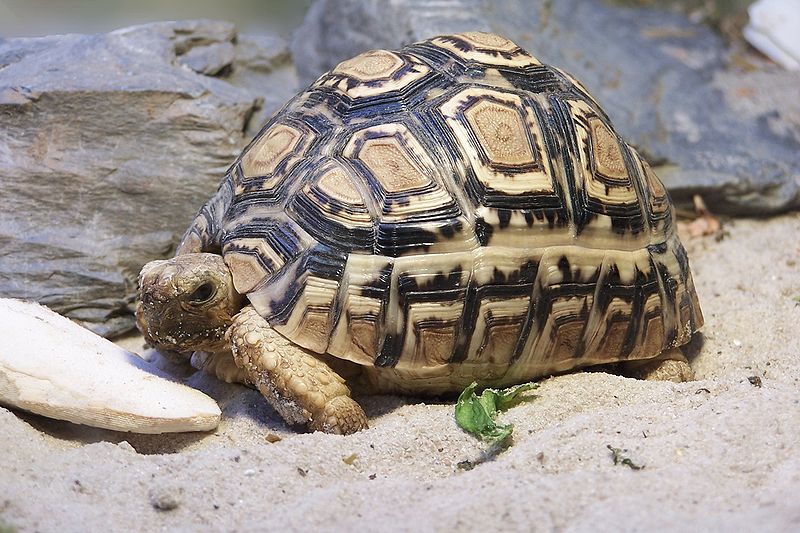
Photo by Berthold Werner (Wikimedia)

Okay, so yesterday was Monkey Monday which means today is going to be Tortoise Tuesday.  To tell you the truth, that was just a coincidence but I might see if I can keep this trend going all week long.  But let’s not get ahead of ourselves since we still need to finish talking about the Leopard Tortoise.  This particular tortoise is actually the forth largest tortoise species in the world.  Not too shabby Mr. Leopard Tortoise.  If you want to catch a glimpse of these massive reptiles then you need to head to the African savanna.  Yep, there are tortoises roaming around in the hot African sun.

I know I said that these animals are the fourth largest of their kind and I also know that you are dying to find out just how big they are.  Well my friends I am going to feed your curiosity right………..now.  The Leopard Tortoise can weigh up to an amazing 54 kilograms.  And for my metric challenged readers, that is about 120 lbs.  As with other tortoise species this particular one also has a hard shell and the ability to pull their limbs in so that no part is left exposed.  That is a pretty handy defense tactic if you ask me.

While you are wandering through the savanna you probably won’t come across herds of these reptiles.  Nope, the Leopard Tortoise is a solitary animal that spends most of their time grazing on grasses.  You may not get to see a group of these guys but you could see the same one over and over again throughout your life.  This is due to the fact that the Leopard Tortoise can live up to 100 years.  This just further proves that the pull your limbs into your shell trick really is a great defense mechanism.

Photo by Muhammad Mahdi Karim (Wikimedia)

I guess it is a great thing these animals are able to live so long since they don’t reach maturity for up to 10 years.  Once they reach maturity the females will lay her clutch of eggs (which could contain as many as 18 eggs) into burrows in the sand.  She covers up the burrows and voila, her parenting is done.  I guess the Leopard Tortoise must save a lot on babysitters.

That does it for Tortoise Tuesday.  Make sure you check back here to see what Wednesday brings us.  Enjoy the rest of your day!

Digg This
Reddit This
Stumble Now!
Buzz This
Vote on DZone
Share on Facebook
Bookmark this on Delicious
Kick It on DotNetKicks.com
Shout it
Share on LinkedIn
Bookmark this on Technorati
Post on Twitter
Google Buzz (aka. Google Reader)

Wild Fact #691 – Twinkle, Twinkle Little Star – Indian Star Tortoise

October 29, 2010 - 12:00 am No Comments

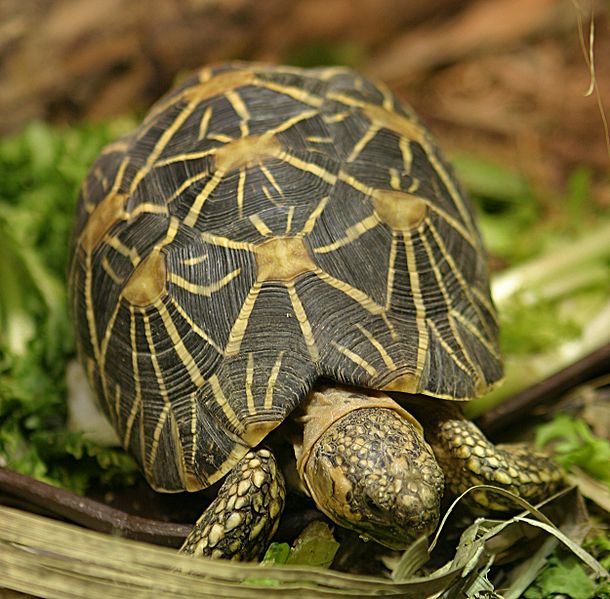
Photo from Wikicommons

Great news folks!  I finally made my way out of the ocean and into the dry and arid forests of India and Sri Lanka.  It is in these dry scrub forests that I came across an interesting animal called the Indian Star Tortoise.  While I sit down to enjoy my lunch, let’s go over a few of the facts about the Indian Star Tortoise. Actually, some of you may already know quite a bit about this little guy as they are quite popular among the pet trade.  Do you have a pet Star Tortoise?

The Indian Star Tortoise clearly received its name from the star shaped pattern found on their shell.  Oh and the fact that they can be found in India. As I mentioned in the opening this Star Tortoise can be found in dry grassland areas and scrub forests.  Naturally this habitat dictates the type of food they eat.  Any guesses? You are right!  They are herbivores which feed primarily on grasses, fallen fruits, leaves and will occasionally eat carrion (dead animals).  This pretty much sounds like my diet right now.

Although the Indian Star Tortoise has a large shell they are still susceptible to several predators.  Some of their most feared predators include birds of prey, reptiles and of course snakes.  Don’t get me wrong their shell does offer them protection as they can pull their head and limbs inside when threatened.  As well the star shaped pattern does more than just make them attractive pets.  The pattern on their dome actually breaks up the hard lines of the shell providing them with a nice form of camouflage.  This way, predators will walk, slither and fly by without even noticing this little tortoise.

Photo by L. Shyamal (Wikimedia)

The mating season for the Indian Star Tortoise varies depending on the specific area the tortoise is living in.  Why is this you ask?  Great question.  In order to mate the tortoise needs to wait for monsoon season.  Since monsoon season happens at different times in different locations so does their mating patterns.  Once the rainy season does strike the female will lay about 7 eggs and hope they can make it through to adulthood.

Indian Star Tortoise Fast Fact – Mathematicians believe the shape of the Star Tortoise shell allows the individual to easily flip back over if they are accidentally knocked on their back.  This is something humans need for getting up off of the incredibly comfy couches.

That does it for this week. Thanks for being a part of another wild week of Wild Facts.  I will be away all next week (actually, I was away for part of this week as well) so that means we will be having another themed week.  I will using another one of Agapelife’s suggestions so please make sure you stop by to check it out next week.  Enjoy your weekend folks!

Digg This
Reddit This
Stumble Now!
Buzz This
Vote on DZone
Share on Facebook
Bookmark this on Delicious
Kick It on DotNetKicks.com
Shout it
Share on LinkedIn
Bookmark this on Technorati
Post on Twitter
Google Buzz (aka. Google Reader)

Wild Fact #733 – One for the Ages – Aldabra Giant Tortoise

September 1, 2010 - 12:00 am 2 Comments

Photo by: Muhammad Mahdi Karim

Today we are all in for a very special treat.  I am sending everyone on a trip to the exotic islands of Aldabra in the Indian Ocean.  I know!  I am pretty excited too.  We are taking a quick trip there to learn about the Aldabra Giant Tortoise which just happens to be one of the largest tortoise species in the world. They are also one of the oldest. I will tell you how big and how old in a second as I want to keep the suspense up for a bit.

These wickedly, cool reptiles can be found in herds (or individually) hanging out in the grasslands or swampy areas of the aforementioned islands.  All right, I can’t handle the suspense any longer.  The Aldabra Giant Tortoise is approximately 1 m (3′) long and can weigh up to an astonishing 250 kg (550 lbs).  Believe it or not there is an Aldabra Giant Tortoise at the Fort Worth Zoological Park that weighs about 790 lbs.  I want to put this into perspective for everyone, a Grizzly Bear will usually weigh about 500 lbs with the larger bears being about 700 lbs.  Who would have thought that a Tortoise could weigh as much as a Grizzly Bear?  The Aldabra Giant Tortoise has a very large, domed shape carapace (shell) which is supported by strong, stocky legs. I am sure this large shell contributes to a good chunk of their weight.  This particular turtle also has a very long neck which allows them to feed on leaves approximately 1 m (3′) off the ground. Personally I am starting to think they are more closely related to a Giraffe than any other animal species.  Obviously I am kidding since the Giraffe is much heavier and much taller.

Giddy Up!!

So we now know that these Giant Tortoise species could probably use a few months on the Atkins diet.  Actually their diet of leaves and grass is probably pretty close to the Atkins diet.  Let’s find out just how long these giant beasts hang around for.  It is thought that many of these Tortoise species are over 200 years old.  The oldest living Aldabra Giant Tortoise was 255 years old and lived from 1750-2005.  I would like to put this amazing stat into perspective as well.  This particular tortoise named Adwaita lived to see the Industrial Revolution, Napoleonic Wars, American Revolution, War of 1812, two World Wars, the invention of the steam engine, the first flight and of course experienced some of the greats such as Darwin, Mozart, Beethoven and one of my favourites, Thomas Edison. Not to mention that the human population when Adwaita was born was probably under 1 billion people worldwide, which of course is about 7 times lower than it is now. I would have loved to have had a conversation with that Tortoise.

Aldabra Giant Tortoise – This particular species of Tortoise had some very powerful friends, such as Charles Darwin who managed to create a wildlife preserve by the end of the 19th Century so these timeless creatures would be protected.  I wonder if our good friend Adwaita helped with that movement?

That is all for today folks.  I hope you enjoyed the unusual history lesson. Enjoy the remainder of your beautiful day.

Photo from Wikimedia

Digg This
Reddit This
Stumble Now!
Buzz This
Vote on DZone
Share on Facebook
Bookmark this on Delicious
Kick It on DotNetKicks.com
Shout it
Share on LinkedIn
Bookmark this on Technorati
Post on Twitter
Google Buzz (aka. Google Reader)

Wild Fact #927 – Lazy but Deadly – Matamata Turtle

December 2, 2009 - 12:00 am 9 Comments

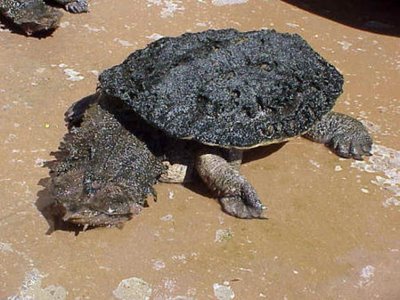
02 Matamata Turtle

Well, I just finished shoveling the driveway so I figured it is time to take a trip south.  Since, I can’t do that in real life at this point in time, I figured I will do it in my virtual, blogging life.  I want to take a trip to South America to describe an unique turtle that lives primarily in the Amazon River. The Matamata turtle has developed some unique adaptations that allow them to laze around all day and still manage to catch its dinner.

You see, the matamata turtle is carnivorous and feeds on fish and invertebrates.  Now you might be thinking that it would be tough for a turtle that prefers to live a sedentary life to be able to capture the sneaky, evasive fish. If you look at the picture of the matamata turtle (go ahead and look again, I will wait!). About time, sheesh, I didn’t say to study every detail of the picture!  Did you notice that the shell of the turtle looks similar to bark while the head resembles fallen leaves (go ahead and look again).  We are going to be here all day while you study this picture!  Naturally, the colouration and shape of the turtle allows it to blend into their surroundings.  Don’t worry, this isn’t the only adaptation that allows it to easily capture a quick meal.  The matamata turtle has flaps on the side of their head and a very large mouth.  The flaps on the head and neck add to the camoflage but they are also very sensitive in detecting the slightest movement of water.  When a fish swims by, these flaps ensure that the turtle is aware that dinner is nearby. When the disguised turtle senses the swimming fish it will thrust its head forward and open its large mouth as wide as possible.  This will effectively create a low pressure vacuum and actually suck the fish into the turtles mouth.  The turtle will then snap its mouth shut and slowly expel the water. Due to the unique construction of the matamata turtle’s mouth, they can’t actually chew their prey. This means the little fishy is swallowed whole.  I think I will stay out of the shallow bays of the Amazon River while on my virtual trip.  I don’t want my foot getting sucked into the mouth of the matamata turtle.

Matamata Turtle Fast Fact: The Spanish meaning for matamata is “It Kills, It Kills”.  That pretty much sums up Wild Fact #927.

Digg This
Reddit This
Stumble Now!
Buzz This
Vote on DZone
Share on Facebook
Bookmark this on Delicious
Kick It on DotNetKicks.com
Shout it
Share on LinkedIn
Bookmark this on Technorati
Post on Twitter
Google Buzz (aka. Google Reader)