Posts Tagged ‘Turtle’

Wild Fact #399 – What’s That Smell?!? – Stinkpot Turtle

December 27, 2011 - 12:00 am No Comments
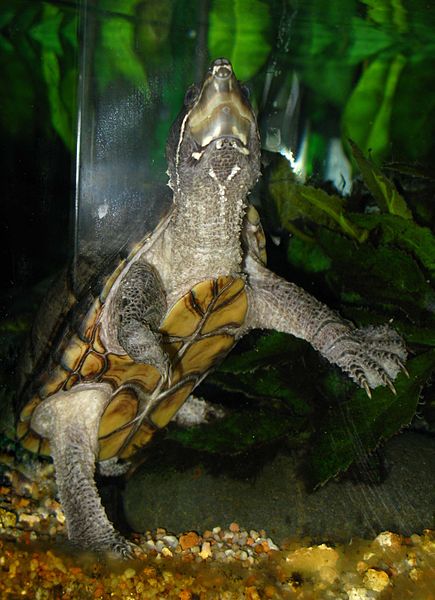
Stinkpot Turtle

Photo by Laurent Lebois (Wikimedia)

I have a hunch that today’s Wild Fact is really going to stink.Yes, that is because we are going to learn about the foul-smelling Stinkpot Turtle. It is also known as the Common Musk Turtle and can typically be found in southeastern Canada and the eastern United States. More specifically, you will find these little turtles hanging out in slow moving, shallow water bodies with a nice muddy bottom. So grab your rubber boots, a pair of nose plugs and lets go learn a little more about this smelly turtle.

Too Stinky To Eat

As you may have guessed, the Stinkpot Turtle gets their name from its ability to release a foul, musky odour. Using that definition, you could probably start calling your Dad a “Stinkpot Turtle”. The purpose of this foul smell is to encourage predators to look somewhere else for dinner. Since they are only 8 to 14 cm (3 to 5 inches) in size, this is an important feature for them. Luckily this tactic works incredibly well as the Stinkpot Turtle is hardly ever preyed on. You know you smell bad when a hungry wild animal doesn’t even want to eat you.

Stinkpot Turtle

Photo from Wikimedia

Cottage Life

As mentioned earlier, the Stinkpot Turtle spends the majority of their time in slow moving water bodies that typically have a muddy bottom. For the most part, they only venture out onto land when ti is time for the female to lay her eggs. With that said, some turtles will go out every now and again to bask in the sun. I guess even turtles can’t resist lying on the beach from time to time. Similarly,  these smelly little turtles have been known to climb up large tree branches, sometimes even higher than 2 m (6 feet) into the air. As boats drive by the turtles will often fall in and go for a nice boat ride. Suntanning and boating… it sounds like a pretty good day at the pond to me.

One Smelly Pet

Although the Stinkpot Turtle smells rotten, this doesn’t stop people from owning them as pets. Recently, the Common Musk Turtle is becoming a popular pet among households. I don’t normally condone having wild animals as pets, however, owning the Common Musk Turtle is taking the pressure off of other more endangered turtles, which is bonus. In fact, the USDA bans the sale of turtles smaller than 4 inches except for the Stinkpot Turtle, so even they are on board with them being used as pets.

That does it for today’s Wild Fact. Enjoy the rest of your day and I will see you tomorrow for another animal fact.

Digg This
Reddit This
Stumble Now!
Buzz This
Vote on DZone
Share on Facebook
Bookmark this on Delicious
Kick It on DotNetKicks.com
Shout it
Share on LinkedIn
Bookmark this on Technorati
Post on Twitter
Google Buzz (aka. Google Reader)

Wild Fact #533 – A Tad Salty – Diamondback Terrapin

June 22, 2011 - 12:00 am No Comments

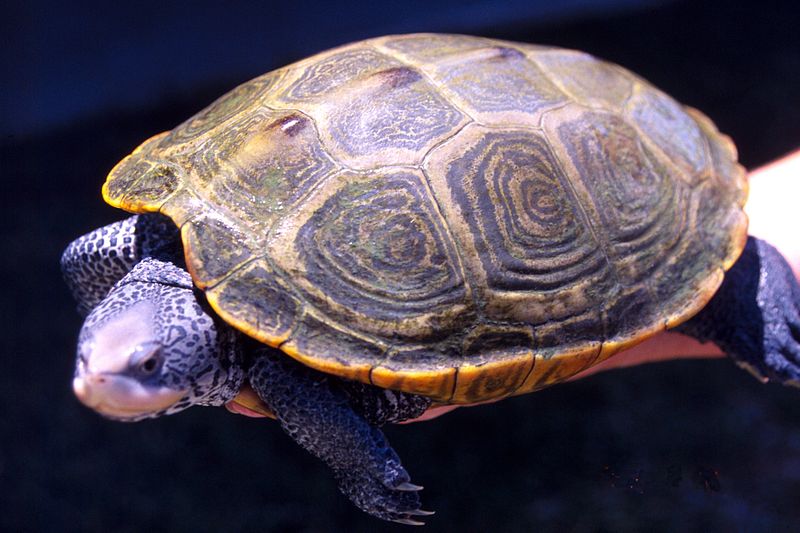
Photo from Wikimedia

Well, yesterday I promised we would learn about an animal completely different from the turtle and the tortoise.  I looked high and I looked low but I think I finally found the perfect animal.  Of course, I am talking about the Diamondback Terrapin which is not even remotely close to the turtle and the tortoise.  Tell me you are not impressed with how different this animal is.  What do you mean they look just like the other two animals we talked about this week?  Okay, so maybe you are right, perhaps the Terrapin is just another common name used for turtles.  At the end of the day, all three  (turtle, tortoise and terrapin) belong to the order Chelonia and are basically very similar.

The Diamondback Terrapin is actually a species of turtle that resides in the brackish, coastal swamps of southern and eastern United States.  So if it is a turtle species, why is it called “Terrapin”?  Good question!  Besides making things confusing, in the old days, the early settlers use to call any turtle that lived in these type of coastal swamps as a Terrapin. In North America, the term is still commonly used for these brackish water turtles.

Photo by LA Dawson (Wikimedia)

It is believed that the Diamondback Terrapin is the only turtle that spends the majority of their time in these brackish waters.  If you are still trying to figure out what a “brackish water” is, it is basically the transition zone between the ocean and freshwater systems.  It has some salt but not nearly as much as the ocean.  Although, the Diamondback Terrapin enjoys hanging out in these salty transition zones, they will still come up to the beach to lay their eggs.  And why not, right? Everyone enjoys a nice beach vacation every now and again.

Diamondback Terrapin Fast Fact – If you look closely at the skin of the Diamondback Terrapin (actually, you don’t even have to look that closely) you will notice that they have a pattern of black spots and lines. Apparently, this pattern is different for every individual Diamondback Terrapin so it acts like their fingerprint.  The police would have their work cut out for them if they had to get the fingerprints from a nefarious Terrapin.

Seriously, this is the last turtle fact of the week.  I just wanted to highlight the differences and similarities of the Turtle, Tortoise and Terrapin.  Basically, they are all turtles with different common names, typically as a result of their habitat preference (i.e. water, land, brackish waters).  I hope you enjoyed our turtle facts.

Digg This
Reddit This
Stumble Now!
Buzz This
Vote on DZone
Share on Facebook
Bookmark this on Delicious
Kick It on DotNetKicks.com
Shout it
Share on LinkedIn
Bookmark this on Technorati
Post on Twitter
Google Buzz (aka. Google Reader)

Wild Fact #536 – Will Work for Food – Bog Turtle

June 17, 2011 - 12:00 am No Comments

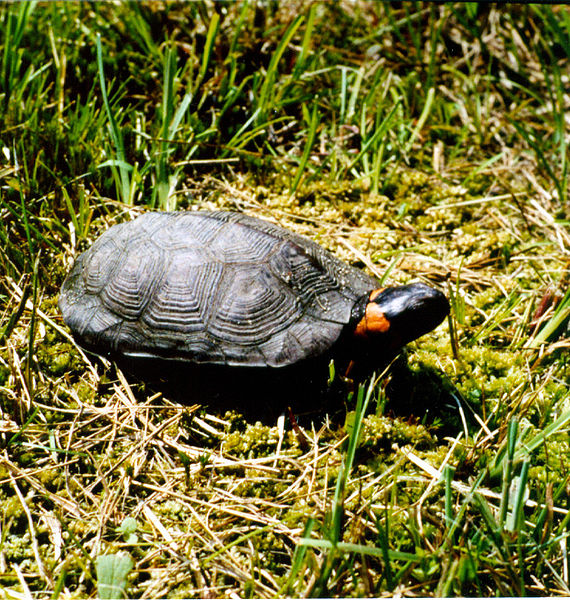
Bog Turtle - Photo from Wikimedia

Wooohoo!  We made it through another week of wild animal facts.  Since it has been so hot in Ottawa, I figured we could end the week by relaxing in a nice wetland in the Eastern United States.  It is here that we will find the smallest turtle in North America.  By now you have read the title and know I am talking about the incredibly awesome Bog Turtle.  For the record, that title really takes the suspense out of these opening paragraphs.  What are we waiting for?  Let’s grab our chest waders and head out to our local bog so we can catch a glimpse of these little turtles.

We had better hurry up and get out to the bog if we want to witness these turtles in their natural habitat.  You  see the wetlands that these turtles love are being destroyed to build new residential and commercial areas for humans.  As a result, the population of the Bog Turtle is rapidly declining but don’t worry, there are numerous conservation groups working around the clock to protect prime areas so these turtles don’t end up homeless.  Actually, right about now, i wouldn’t be surprised to see a homeless Bog Turtle sitting on the side of the street begging for aquatic vegetation.

Baby Bog Turtle (Wikimedia)

Okay, so I mentioned that these turtles are the smallest in North America.  Of course, we all want to know just how small they really are.  On average the Bog Turtle measures between 8.9 and 9.4 cm (3.5 – 3.7″) in length.  Basically, this little turtle would be able to fit in the palm of your hand, which I think is incredibly impressive.  How much habitat could such a small animal actually need?  This question will arise again when you find out that the Bog Turtle spends the majority of their time either buried in the mud (to escape the intense afternoon heat) or hibernating for the winter.  When awake, this seclusive turtle will bask in the sun to start their day before heading out to look for lunch.  What is on the menu for the Bog Turtle?  Well, the special of the day is usually insects mixed in with other invertebrates.   It may not be the most delicious meal but I bet the invertebrate diet lets the Bog Turtle keep their small shape.

Bog Turtle Fast Fact – Besides habitat destruction the Bog Turtle also needs to be on the lookout for poachers.  As you can imagine, these cute little turtles typically end up on the Black Market to be sold as pets.  Their small size makes them the perfect companion but please don’t get a pet Bog Turtle.  They are protected by the United States Endangered Species Act for a reason.

So it looks like we are at the end of another Wild Fact.  I don’t know about you but I don’t feel any cooler after playing in that wetland for the last 2 minutes.  I guess I can spend the rest of the weekend trying to stay cool.  Enjoy your Friday and have a great weekend!

Digg This
Reddit This
Stumble Now!
Buzz This
Vote on DZone
Share on Facebook
Bookmark this on Delicious
Kick It on DotNetKicks.com
Shout it
Share on LinkedIn
Bookmark this on Technorati
Post on Twitter
Google Buzz (aka. Google Reader)

Wild Fact #793 – Heads it’s a Boy, Tails it’s a Girl – Yellow-Spotted River Turtle

June 9, 2010 - 12:00 am 9 Comments

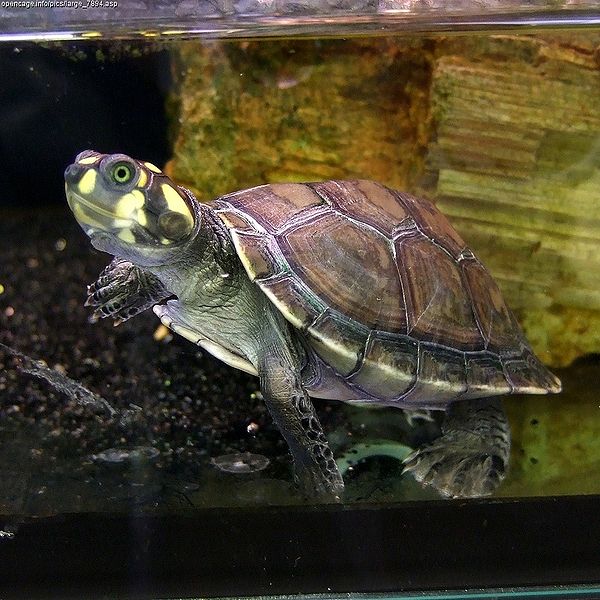
http://commons.wikimedia.org/wiki/File:Podocnemis_unifilis.jpg

I was having a tough time deciding which animal to talk about today when it dawned on me that I haven’t talked about a turtle in a long time.  So today we get to look at the Yellow-Spotted River Turtle.  I recommend you grab your coffee (or juice in a sippy cup for our younger audience), sit back and enjoy the presence of this super cool turtle.

So what makes the Yellow-Spotted River Turtle so super cool?  Well, it is a turtle and all turtles are awesome. I also think it is pretty interesting that these turtles live in the Amazon River basin.  During the wet season though they will also venture out to hang in the flooded forest. I guess if you are a terrestrial animal like a squirrel then you would start to worry when you see the turtles moving in. For some reason, I picture an old, cranky squirrel yelling at his wife, “Martha! Martha! Pack your nuts, the Turtles are here.  We are heading for the hills!” Wow, it must have been a long day for me. I highly recommend you keep reading since I have no idea what else I might say today.

The Yellow-Spotted River Turtle is a type of side-necked turtle which can weigh up to 25 pounds.  For the record, it is the female turtle that weighs the most in this species.  I just realized that I didn’t explain what a side-necked turtle is.  Would you like to know? Of course you would.  Well, the side-necked turtles aren’t like your typical turtle.  You know the ones that pull their heads straight back to hide in their shell.  Nope, these guys simply bend their necks sideways and tuck their head under the lip of their shell.  From what I can tell from this description, the Teenage Mutant Ninja Turtles would have been your typical type of turtle.  Well, as typical as a mutant turtle can be.

Yellow-Spotted River Turtles – The sex of this particular turtle is determined during the very early stages of their life (obviously!).  Believe it or not the temperature that the eggs incubate at will actually determine if you are having a boy or a girl.  Eggs incubated below 32 degrees Celsius (90 degrees Fahrenheit) will produce male turtles.  I am sure you can guess that eggs incubated above this temperature will produce females.

Well that is all for me folks.  Have a great day!

Digg This
Reddit This
Stumble Now!
Buzz This
Vote on DZone
Share on Facebook
Bookmark this on Delicious
Kick It on DotNetKicks.com
Shout it
Share on LinkedIn
Bookmark this on Technorati
Post on Twitter
Google Buzz (aka. Google Reader)

Wild Fact #927 – Lazy but Deadly – Matamata Turtle

December 2, 2009 - 12:00 am 9 Comments

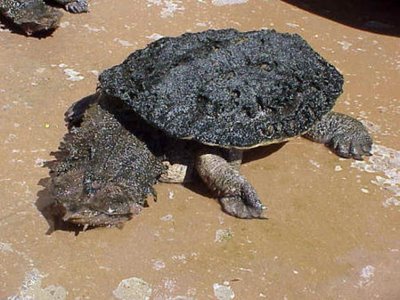
02 Matamata Turtle

Well, I just finished shoveling the driveway so I figured it is time to take a trip south.  Since, I can’t do that in real life at this point in time, I figured I will do it in my virtual, blogging life.  I want to take a trip to South America to describe an unique turtle that lives primarily in the Amazon River. The Matamata turtle has developed some unique adaptations that allow them to laze around all day and still manage to catch its dinner.

You see, the matamata turtle is carnivorous and feeds on fish and invertebrates.  Now you might be thinking that it would be tough for a turtle that prefers to live a sedentary life to be able to capture the sneaky, evasive fish. If you look at the picture of the matamata turtle (go ahead and look again, I will wait!). About time, sheesh, I didn’t say to study every detail of the picture!  Did you notice that the shell of the turtle looks similar to bark while the head resembles fallen leaves (go ahead and look again).  We are going to be here all day while you study this picture!  Naturally, the colouration and shape of the turtle allows it to blend into their surroundings.  Don’t worry, this isn’t the only adaptation that allows it to easily capture a quick meal.  The matamata turtle has flaps on the side of their head and a very large mouth.  The flaps on the head and neck add to the camoflage but they are also very sensitive in detecting the slightest movement of water.  When a fish swims by, these flaps ensure that the turtle is aware that dinner is nearby. When the disguised turtle senses the swimming fish it will thrust its head forward and open its large mouth as wide as possible.  This will effectively create a low pressure vacuum and actually suck the fish into the turtles mouth.  The turtle will then snap its mouth shut and slowly expel the water. Due to the unique construction of the matamata turtle’s mouth, they can’t actually chew their prey. This means the little fishy is swallowed whole.  I think I will stay out of the shallow bays of the Amazon River while on my virtual trip.  I don’t want my foot getting sucked into the mouth of the matamata turtle.

Matamata Turtle Fast Fact: The Spanish meaning for matamata is “It Kills, It Kills”.  That pretty much sums up Wild Fact #927.

Digg This
Reddit This
Stumble Now!
Buzz This
Vote on DZone
Share on Facebook
Bookmark this on Delicious
Kick It on DotNetKicks.com
Shout it
Share on LinkedIn
Bookmark this on Technorati
Post on Twitter
Google Buzz (aka. Google Reader)

Wild Fact #952 – Real Fishing with Alligator Snapping Turtles

October 28, 2009 - 12:05 am 4 Comments

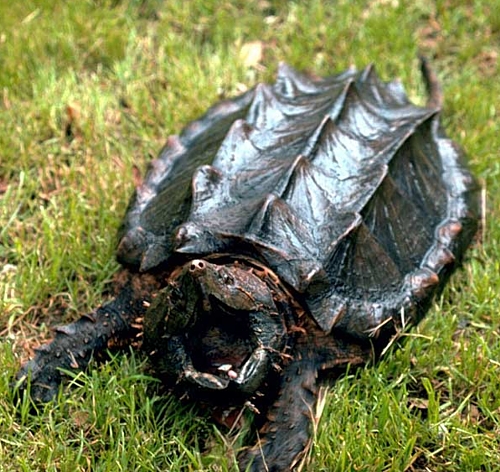
snapping-turtle

I realize I just did a post on a turtle species but trust me, you will like seeing another turtle post. The alligator snapping turtle has a very unique hunting method that I think will interest you.

Before I get into the hunting strategies of the alligator snapping turtle let me explain a little bit about this turtle species. They are the largest freshwater turtle in North America, with the largest on record being over 200 pounds. That is right, they are larger than the common snapping turtle but don’t worry as the alligator turtles are not as aggressive as the common snapping turtle. Nonetheless, you wouldn’t want to mess with these turtles since they have a very strong bite force. If you look at the alligator snapping turtle you will find that it resembles a dinosaur. For this reason it is known as the dinosaur of the turtle world in some circles. These are probably the same circles that contain the crazy animal biologist that has just spent 3 weeks camping by themselves in the bush so they giggle every time they think of a dinosaur turtle! One last feature to note before moving onto the feeding strategy. These turtles will spend the majority of their life submerged in the water and generally only venture onto land when the female needs to lay their eggs.

All right, the moment you have all been waiting for! How does this bizarre looking turtle hunt? Well, that is easy to answer. Since they spend the majority of their time in the water the alligator snapping turtle goes fishing to catch its food! I realize you probably think I am being a smart alec but I need to keep myslef entertained while I write these posts. Besides, I didn’t lie to you about the turtle fishing to catch its prey. You see the inside of the alligator snapping turtles’ mouth is camoflaged and contains a tongue that resembles a worm. Now I am sure you see where I am going with this. So the turtle just lies on the bottom of the lake with its mouth open dangling the worm-like tongue. A fish sees the worm-like tongue thinking it is a yummy meal only to be surprised to find out that they are the yummy meal! I hate to admit this but I am willing to bet the alligator snapping turtle is a much better fisherman than I am.

Alligator Snapping Turtle Conservation Status: Although, this particular turtle as no natural predators other than man they still find themselves at risk.   Unregulated harvesting and habitat loss has lead the United States to protect them throughout the majority of their range.  The alligator snapping turtle is listed as threatened.

If you want to see more about the Alligator Snapping Turtle then check out the video below.

Digg This
Reddit This
Stumble Now!
Buzz This
Vote on DZone
Share on Facebook
Bookmark this on Delicious
Kick It on DotNetKicks.com
Shout it
Share on LinkedIn
Bookmark this on Technorati
Post on Twitter
Google Buzz (aka. Google Reader)

Wild Fact #956 – Leatherback Ninja Turtles

October 22, 2009 - 12:00 am 4 Comments

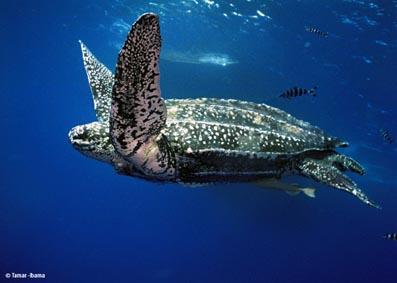
leatherback-underwater

Well, if you are reading today’s post then my automatic posting service is still working, which is great.  I will be back in the Yukon tonight so if I haven’t responded to your comments yet, I will be shortly.  I hope everyone has been having a great week.

I have never had a great memory of all my childhood activities, which is a shame, but for some weird reason I remember the first day that the Ninja Turtles cartoon came on.  I was in the yard playing with my cousin and I remember running into the basement to watch this brand new cartoon.  I have no idea why I am telling you this but this memory popped into my head when I was thinking about writing on the leatherback turtle. I wish I could be writing about the adaptations of the leatherback turtle that allows it to perform martial arts and eat pizza but that isn’t the case.

The leatherback turtle, however, does have some interesting adaptations to allow it to survive in the harsh ocean.  I guess the most obvious adaptation is the fact that the leatherback doesn’t have the normal hard bony shell like other turtles.  As their name suggests they have a leathery skin as opposed to a hard shell or carapace.  This leathery surface provides insulation from the cold water. They do have bony plates embedded underneath this leathery skin. It is the only sea turtle that does not have a hard shell.  The leatherback turtle also has several adaptations that allow it to dive as deep as 2000 metres if it needs to.  It can only stay under for about 30 minutes before requiring oxygen and thus spends most of its time within the first 300 metres of the ocean.  Some of these adaptations include oxygen storage compartments, collapsible lungs, slowed heart rate, etc.  To read about more of these diving adaptations then I recommend checking out this great article located here.

One of my favourite leatherback turtle adaptations has to do with the way the turtle eats.  Have you ever tried to eat a live jellyfish?  I am going to go out on a limb here and say that you haven’t!  Well, as you can imagine it might be difficult holding those little guys in place while you eat them.  The leatherback turtle has developed backward pointing spines in its mouth and throat.  These spines help hold the slippery prey in its mouth while it swallows the food.  Even though, it can’t use nunchucks or a sword, I think this is a pretty cool adaptation.

Leatherback Turtle Fast Fact – Leatherback sea turtles are the biggest turtles on earth. These turtles can be about 2 metres (6 feet) long and weigh up to a ton.  Yes, a Ton!  That is 2000 pounds or for the metric folks, 907 kilograms.

Digg This
Reddit This
Stumble Now!
Buzz This
Vote on DZone
Share on Facebook
Bookmark this on Delicious
Kick It on DotNetKicks.com
Shout it
Share on LinkedIn
Bookmark this on Technorati
Post on Twitter
Google Buzz (aka. Google Reader)