Posts Tagged ‘Marsupial’

Wild Fact #500 – Gliding to Zero – Sugar Glider

August 8, 2011 - 12:00 am 2 Comments
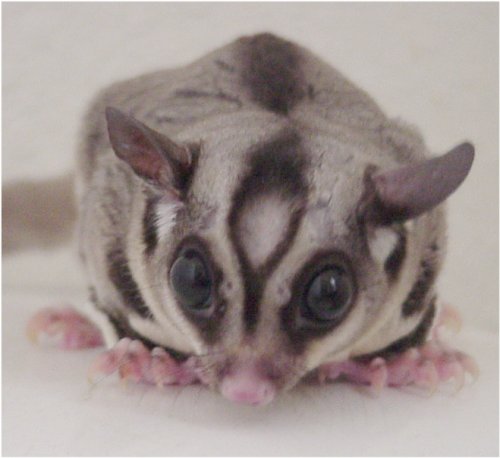
Sugar Glider

Photo by Dawson (Wikimedia)

Welcome to a monumental Wild Fact. You may have noticed that we are officially at the half-way mark of our little Wild Facts project. I want to take this opportunity to thank everyone for their support and enthusiasm up to this milestone. It has been an incredible journey so far and we are just getting started. So buckle up and enjoy the next 500 Animal Facts! To celebrate the mid-point we are going to learn about a cuddly animal called the Sugar Glider. Before we glide through the rest of the Wild Facts, let’s take a quick trip to Australia to check out the Sugar Glider.

As mentioned, the Sugar Glider is native to Australia and New Guinea but can be found in homes throughout the world. That’s right, these lovable little creatures are very popular among pet owners. In fact, they are some of the most common pets that are being plucked out of their natural habitat and illegally traded. Don’t worry though, there are plenty of breeders that will provide the Sugar Glider to you legally but make sure you check your appropriate laws before rushing out and buying one. So before you buy your children a new pet, we should probably find out what they are, right?

Sugar Glider

Photo by Anke Meyring (Wikimedia)

Of course we should.

The Sugar Glider is a gliding possum that has a long, partially prehensile tail, which is quite important for these little critters.  Even though they live in a warm climate, this little marsupial still has a beautiful, soft fur coat that is usually a blue-grey colour; however, some individuals like to be different so they will mix things up with a yellow or tan coloured coat. Okay, it is time to learn about the most interesting feature of the Sugar Glider. In order to glide long distances, they have a thin membrane that stretches out from their fifth finger to their ankle. When they properly utilize this membrane the Sugar Glider is capable of gliding distances of 100 m (300′) as they go from tree to tree. Remember that long, partially prehensile tail I mentioned earlier? Well it is basically their steering wheel while in flight as they use it to stabilize themselves, steer and even land. Maybe we can start a project where we count down a 1000 uses for a tail!

Sugar Glider Fast Fact – The Sugar Glider is playful when hanging out with their own family but the minute you introduce a non-clan member or another animal, they will become fierce attackers. As well, the dominant male in the group will typically scent mark his clan members and their territory. That seems a little possessive but whatever works, right?

I guess we are now officially on the downside of our countdown. I hope you enjoyed the first 500 Facts and I look forward to interacting with all of you as we make our way to zero.

Digg This
Reddit This
Stumble Now!
Buzz This
Vote on DZone
Share on Facebook
Bookmark this on Delicious
Kick It on DotNetKicks.com
Shout it
Share on LinkedIn
Bookmark this on Technorati
Post on Twitter
Google Buzz (aka. Google Reader)

Wild Fact #526 – The Little Wallaby – Quokka

July 1, 2011 - 12:00 am 1 Comment


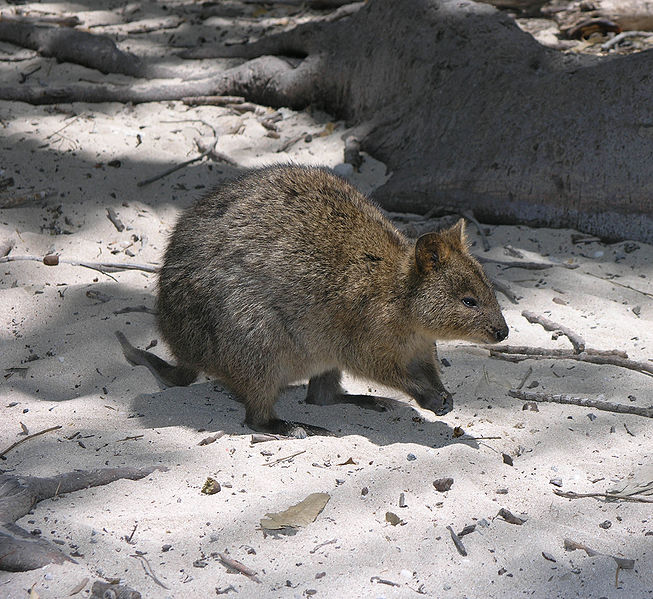
Photo by Sean Mack (Wikimedia)

HAPPY BIRTHDAY CANADA!!!

That’s right, it is indeed Canada Day where we get to celebrate our wonderful country with great friends, fireworks and if you live in Ottawa – the Royal Couple of the Year.  Now I wanted to do an animal that represented Canada but I have already completed facts on critters such as the Beaver and the Canada Goose.  As a result, I decided to write about an animal that has nothing to do with our great Country.  Nope, the Quokka can’t be found in Canada (unless you know someone that has a pet Quokka).  Instead they are found in parts of Australia, so let’s take a trip down under to celebrate Canada’s birthday.

The Quokka is a small marsupial, which is actually about the size of standard house cat (not one of those fat house cats like Garfield). In fact, the Quokka is the smallest Wallaby species that we know about at this point in time.  Compared to other Wallaby species, this particular marsupial has shorter hind legs and a smaller tail, which allow them to manoeuvre through thick forests at great speeds with ease.  Unfortunately, this evolutionary advantage didn’t help them once domestic cats, foxes and dogs were introduced to Australia.  As a result, their population has declined greatly since the early settlers of Australia.  I guess this type of thing is bound to happen but it is tough to see it happen to such a cute animal.

Photo by Hesperian (Wikimedia)


Given their size, it is probably not tough to believe that the Quokka is actually a vegetarian. Although, they spend the majority of their time feasting on grasses found in the undergrowth, they have been known to climb up trees to feed on leaves as well. No matter what they are feeding on they will typically swallow it whole.  Of course, once they do this they will regurgitate their food before eating the recycled plant matter one more time.  I know this doesn’t sound appealing to you or I but it is a great way for them to get all of the nutrients out of their food.  Not only do they get their nutrients but they also get most of their water this way as well.  In fact, the Quokka is able to go months without needing to drink any water.  I can’t even last a few hours!

That does it for our Canada Day Wild Fact.  I hope you all get to enjoy this great day, no matter where you live.  Have a good weekend and I will see you on Monday.

Digg This
Reddit This
Stumble Now!
Buzz This
Vote on DZone
Share on Facebook
Bookmark this on Delicious
Kick It on DotNetKicks.com
Shout it
Share on LinkedIn
Bookmark this on Technorati
Post on Twitter
Google Buzz (aka. Google Reader)

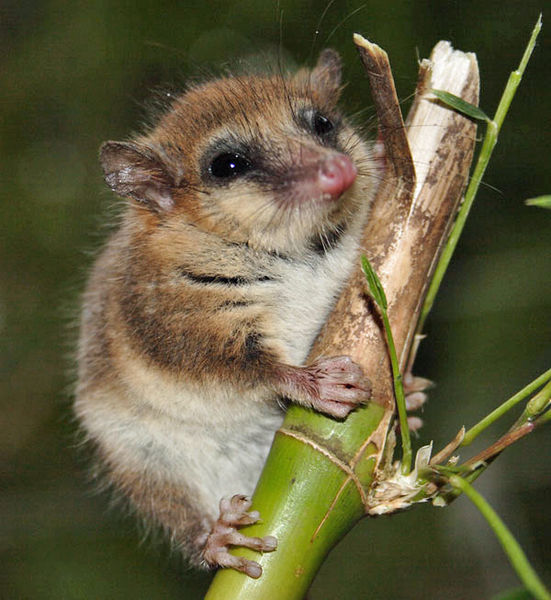
Wild Fact #761 – Not a Fact on the Fruit Cup – Monito del Monte

July 23, 2010 - 12:00 am 1 Comment

Photo by José Luis Bartheld

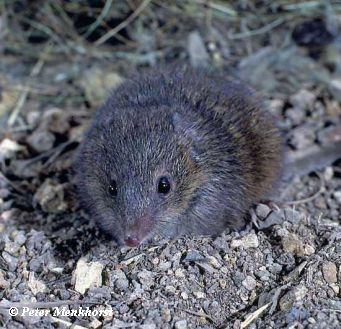
Well it is the end of another week  and I thought we would continue our South American tour through the weekend. Since we are done looking at the Giant Anteater I thought we could head to southwestern South America to learn about the Monito del Monte.  Just so you have an idea of what you are in for today, this creature is also known as the Little Mountain Monkey, so you know it will be a fun Wild Fact.

The Monito del Monte is a not a monkey but rather a marsupial native to Chile and Argentina. Remember folks, marsupials are mammals that have their young mature inside of a nice, warm and comfy pouch (think about the kangaroo).  This little mountain monkey is a nocturnal animal that uses it partially prehensile tail to live a full life in the trees. They like to feed on insects and other small invertebrates but will mix it up with fruit.

The Monito del Monte is often considered to be a living fossil since it is the last remaining member of an extinct lineage.  Just how far does this lineage date back you ask? Well if the scientists did their estimates properly than this little mountain monkey is about 40 million years old.  Now you see why they consider them to be a living fossil?

So I mentioned that these little rascals are marsupials so you can imagine they have an unique breeding behaviour. Well, it isn’t that different compared to other pouched animals.  They will usually have a litter of 1 to 4 in the spring which mature in a fur-lined pouch.  Once the babies are old enough to leave the pouch they will be nursed in a nest and carried on their mother’s back.  The life of a baby Monito del Monte sounds pretty relaxing, doesn’t it?

Monito del Monte Fast Fact – It might be tough to tell from the picture but the Monito del Monte is about the size of a mouse.  If we have to put a number on it I would say they can get up to about 13 cm (5″) in length.  Did you realize that they were this small?

Well that does it for our short South American tour.  Take tomorrow off and enjoy the sights and sounds.  We fly home on Sunday!  Have a great weekend!

Digg This
Reddit This
Stumble Now!
Buzz This
Vote on DZone
Share on Facebook
Bookmark this on Delicious
Kick It on DotNetKicks.com
Shout it
Share on LinkedIn
Bookmark this on Technorati
Post on Twitter
Google Buzz (aka. Google Reader)

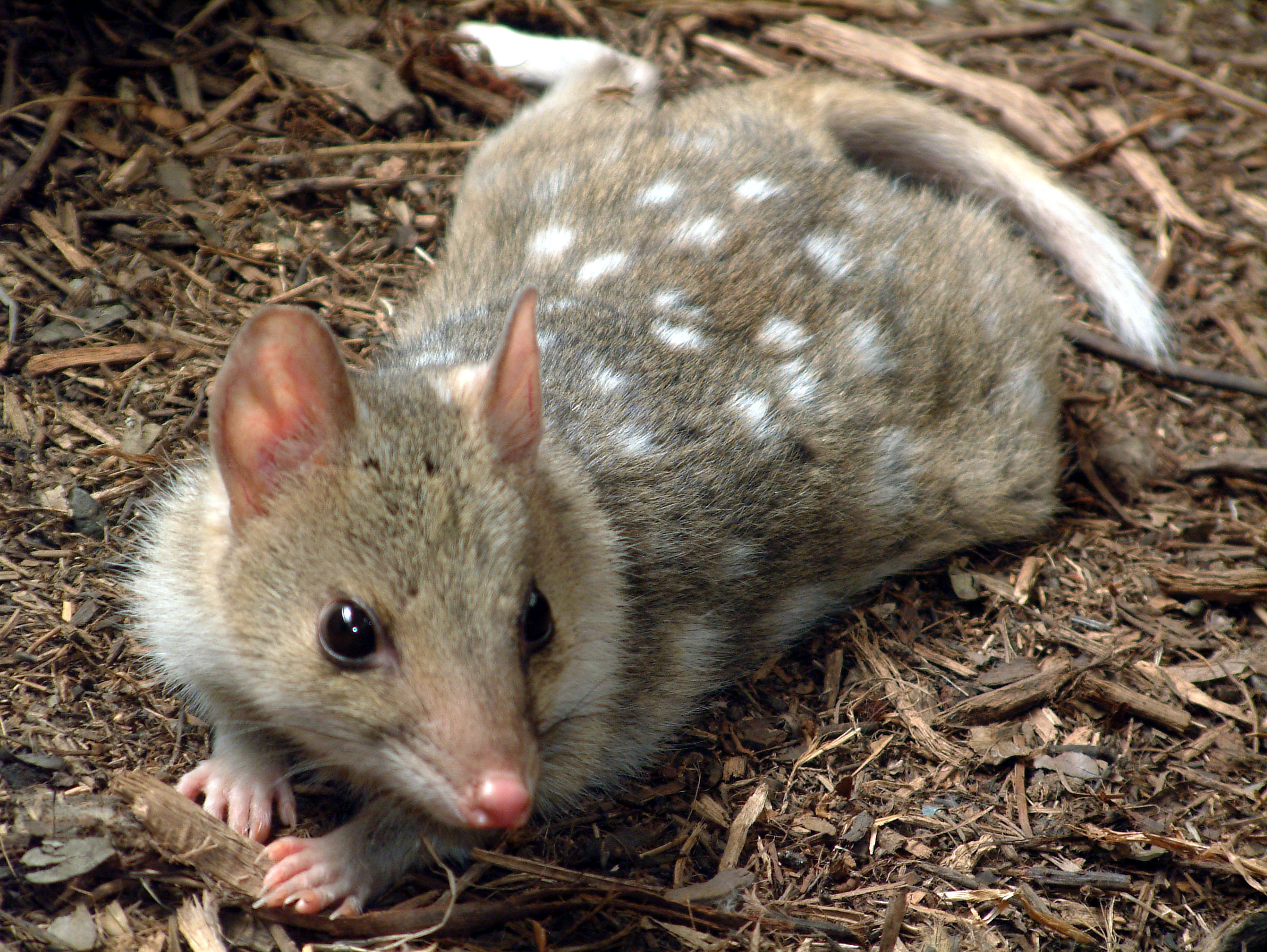
Wild Fact #830 – I Have No Quoll’s with this Animal – Quoll

April 19, 2010 - 12:00 am 4 Comments

A Comfy Quoll

What a beautiful spring weekend here in Whitehorse.  The temperature was about 11 degrees Celsius and the snow is really melting now.  Spring has always been one of my favourite seasons.  Although I love spring so much, I figured we would take a few minutes and head to a country that is experiencing autumn right now.  Of course I am talking about Australia. I want to head south to talk about a little marsupial called the Quoll, which just happens to be native to Australia and Papua New Guinea.

The quoll has often been referred to as the “Native Cat” by the locals due to the resemblance to our furry, feline friends. I don’t personally see the resemblance but then I am dog person. People may think they look like cats but they are actually in the same tribe as one of my favourite Looney Tunes character, Taz the Tasmanian Devil.

All species of quoll’s are roughly the same size weighing in at 1.3-7 kg (3-15.4 lbs).  This size puts them as one of the largest carnivorous marsupials and therefore puts them in a pretty good spot on the food chain.  They feed on animals such as birds, insects, small mammals and reptiles.  Just like humans, they like to mix up their diet every now and again with things such as berries, grasses and nuts.  I am sure your dietitian would agree that variety in your diet is always a good thing.

With winter rapidly approaching in Australia, this little marsupial is getting ready for mating season.  The male will travel great distances to find the right mate.  Since the quoll is a marsupial, the new-born babies are very small and undeveloped.  They will find their way to their pouch where they will be nourished and continue to grow.  The majority of quoll species do not have a true pouch like a kangaroo.  Instead they have little folds of skin on their belly that they baby curls up in.  Eventually, the babies can be seen dangling from the mom’s belly before they move up in the world and travel on her back.

Quoll Fast Fact: The quolls will often share the same toilet as other quolls.  That’s right, they find a nice spot such as rock ledges and set up a public outhouse.  The reason for this has to do with scent marking the boundaries of their territory.

Digg This
Reddit This
Stumble Now!
Buzz This
Vote on DZone
Share on Facebook
Bookmark this on Delicious
Kick It on DotNetKicks.com
Shout it
Share on LinkedIn
Bookmark this on Technorati
Post on Twitter
Google Buzz (aka. Google Reader)

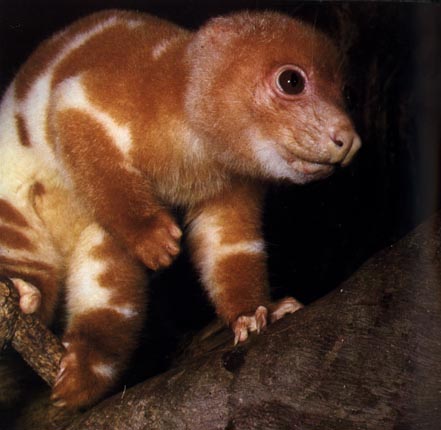
Wild Fact #869 – Heading into Possum’s Lodge – Cuscus

February 23, 2010 - 12:00 am 2 Comments

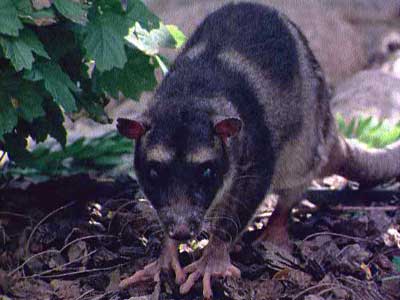
Photo by Michael Morcombe

Lately, I have been realizing that Australia is still a place that I will need to visit soon.  It has always been on the top of my “Must See” list, however, since starting Wild Facts it has dropped in the rankings due to places like Madagascar and Southern Africa which are just loaded with cool animals.  Today, we are going to look at another marsupial that is found in Australia (as well as in Papua New Guinea).  I would really like to make a visit to check out all of these unusual mammals. Anyone up for a road trip?

The Cuscus (no, not that rice-type stuff, couscous) is a sub-species of the possum. In fact it is the worlds largest possum species.  I would like to make it clear that the possum and opossum are two different species. The opossum can be found in North America and is actually the only marsupial found in North America. Although they may have similar names and some similar physical characteristics the possum and opossum are not closely related. Now that we got that mess cleared up, lets get back to our delicious couscous….. I mean, Cuscus!

The cuscus spends the majority of its life hanging around in the canopy of the beautiful Australian trees.  What is one of the best adaptations for an animal that spends most of their time in the trees? That’s right!  A long prehensile tail that acts as an extra arm for hanging in the branches. These little guys use their tail so well that when they were first discovered, Scientists believed that they were related to monkeys. Of course, we know that they are actually more closely related to the possum. Silly Scientists!

Since the cuscus spends most of its time in the trees and only comes out to feed at night, they actually have very few predators. Among them include snakes and birds of prey.  Although, humans are probably their biggest predator.  Apparently they are hunted for their meat and thick fur.  This doesn’t help their population status which is unfortunately dwindling.  The main cause for their population decline though is the destruction of their habitat.  Once again, humans need for natural resources are impacting the local populations of animals.

Cuscus Fast Fact: The cuscus is a very secretive animal so spotting them in the wild is very difficult.  I guess this means we will have to keep our eyes peeled during our road trip to Australia.  I want to be one  of the people lucky enough to see them in their natural habitat……..before it is cut down!

Enjoy the rest of your day everyone!

Digg This
Reddit This
Stumble Now!
Buzz This
Vote on DZone
Share on Facebook
Bookmark this on Delicious
Kick It on DotNetKicks.com
Shout it
Share on LinkedIn
Bookmark this on Technorati
Post on Twitter
Google Buzz (aka. Google Reader)

Wild Fact #869 – Heading into Possum's Lodge – Cuscus

February 23, 2010 - 12:00 am 8 Comments

Photo by Michael Morcombe

Lately, I have been realizing that Australia is still a place that I will need to visit soon.  It has always been on the top of my “Must See” list, however, since starting Wild Facts it has dropped in the rankings due to places like Madagascar and Southern Africa which are just loaded with cool animals.  Today, we are going to look at another marsupial that is found in Australia (as well as in Papua New Guinea).  I would really like to make a visit to check out all of these unusual mammals. Anyone up for a road trip?

The Cuscus (no, not that rice-type stuff, couscous) is a sub-species of the possum. In fact it is the worlds largest possum species.  I would like to make it clear that the possum and opossum are two different species. The opossum can be found in North America and is actually the only marsupial found in North America. Although they may have similar names and some similar physical characteristics the possum and opossum are not closely related. Now that we got that mess cleared up, lets get back to our delicious couscous….. I mean, Cuscus!

The cuscus spends the majority of its life hanging around in the canopy of the beautiful Australian trees.  What is one of the best adaptations for an animal that spends most of their time in the trees? That’s right!  A long prehensile tail that acts as an extra arm for hanging in the branches. These little guys use their tail so well that when they were first discovered, Scientists believed that they were related to monkeys. Of course, we know that they are actually more closely related to the possum. Silly Scientists!

Since the cuscus spends most of its time in the trees and only comes out to feed at night, they actually have very few predators. Among them include snakes and birds of prey.  Although, humans are probably their biggest predator.  Apparently they are hunted for their meat and thick fur.  This doesn’t help their population status which is unfortunately dwindling.  The main cause for their population decline though is the destruction of their habitat.  Once again, humans need for natural resources are impacting the local populations of animals.

Cuscus Fast Fact: The cuscus is a very secretive animal so spotting them in the wild is very difficult.  I guess this means we will have to keep our eyes peeled during our road trip to Australia.  I want to be one  of the people lucky enough to see them in their natural habitat……..before it is cut down!

Enjoy the rest of your day everyone!

Digg This
Reddit This
Stumble Now!
Buzz This
Vote on DZone
Share on Facebook
Bookmark this on Delicious
Kick It on DotNetKicks.com
Shout it
Share on LinkedIn
Bookmark this on Technorati
Post on Twitter
Google Buzz (aka. Google Reader)

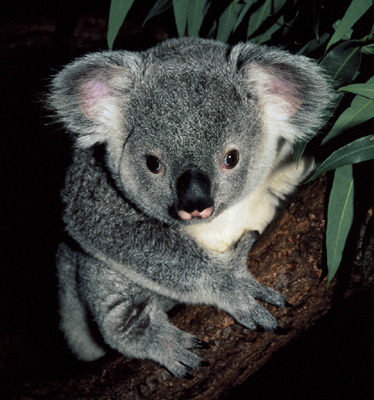
Wild Fact #873 – Another Pouch Potato – Koala Bear

February 17, 2010 - 12:00 am 3 Comments

I realized tonight that I am starting to get too many Wild Facts as I am now having a tough time remembering which animals I have already talked about.  You know I don’t want to repeat the same fact over and over again. I can’t believe that I haven’t done a Wild Fact on the Koala Bear.  That is enough of my babbling, lets get on with the fact!

The Koala Bear isn’t actually a bear.  In fact the closest living relative of the koala bear is the……are you ready for it? The Wombat! That’s right, Wild Fact #874 and #873 are actually related.  Just like the wombat and the kangaroo, the koala bear is a marsupial.  You remember what the means right? I don’t want you to have to go back to yesterday’s fact to look up the definition so I will remind you.  A marsupial gives birth to live young just like other mammals but then the young hops into the comfy pouch where it continues to grow. The baby (also called a Joey) is only about a quarter of an inch long when it heads to the pouch.  It will stay in this external shelter for about 6 months feeding solely on milk.  Interestingly enough the pouch of the koala bear contains a drawstring-like muscle that the mama bear can close and open at will.  To me that is a pretty cool way to ensure your little joey doesn’t fall out.

The koala bear feeds primarily on Eucalyptus leaves, which are low in protein, hard to digest and contain chemicals that are deadly to most other animals.  So why do they feed on such problematic leaves? Simply because other animals can’t suvive off of these leaves, so it ensures food availability.  The koala bear has a very low metabolic rate which allows them to be able to survive off of such low quality leaves.  Due to this low metabolism, the koala bear tends to laze around for about 16-18 hours a day. If you ask me, they are living the dream life! I wish my job was just to sleep all day!

Koala Bear Fast Fact: The fingerprints of the koala bear are incredibly similar to humans. Apparently, it is even difficult to distinguish the two apart using an electron microscope. This is an unverified fact but an interesting one to think about.

Enjoy the rest of your day!

Digg This
Reddit This
Stumble Now!
Buzz This
Vote on DZone
Share on Facebook
Bookmark this on Delicious
Kick It on DotNetKicks.com
Shout it
Share on LinkedIn
Bookmark this on Technorati
Post on Twitter
Google Buzz (aka. Google Reader)

Wild Fact #874 – Pouch Potato – Wombat

February 16, 2010 - 12:00 am 4 Comments

Good news!  I managed to find some time in between my Olympic watching to sit down and write up a Wild Fact.  I figured I would take advantage of the delay in Long Track Speed Skating (Go Canada!) to write up Wild Fact #874.  I know it may seem like I am just squeezing these Facts in whenever I have time but they actually do take precedence over many things.  I enjoy writing these facts so much that I will always find time to write about some interesting animal.  You are all in for a treat today since we will be learning about the cute and pudgy, Wombat.

The wombat is a marsupial, which means it gives birth to tiny little babies that will crawl into their pouch to continue growing.  Yes, that is the same thing a Kangaroo does! In case you are wondering, the babies will remain in the wombat’s pouch for about 5 months. I really hope those little guys are not claustrophobic!  These furry animals are nocturnal which means they head out at night to look for food. The wombat tends to feed on grasses, roots and bark. Perhaps if they foraged during the day they would find something a little tastier to eat!

The wombat has very long claws which they use to dig burrows for themselves. Their underground homes can be quite extensive with several chambers located throughout.  I bet the lady wombats have a huge walk-in closet in their chamber. I was surprised to find out that that certain species of wombats are actually very sociable. These species will form colonies and live together in their elaborate underground homes. Nothing better than the whole family getting together at home!

Like a lot of other animals, some of the wombat species are considered endangered due to habitat destruction. You may have noticed a recurring theme for endangered species that focuses in on habitat destruction. I guess this is to be expected as the human population and our demand for natural resources continues to grow.

Thanks for reading and hopefully learning something about the interesting Australian wombat.  I am off to watch some more Olympic events.  Go Jeremy Wotherspoon!

Digg This
Reddit This
Stumble Now!
Buzz This
Vote on DZone
Share on Facebook
Bookmark this on Delicious
Kick It on DotNetKicks.com
Shout it
Share on LinkedIn
Bookmark this on Technorati
Post on Twitter
Google Buzz (aka. Google Reader)

Wild Fact #959 – Dealing with the Devil – Tasmanian Devil

October 19, 2009 - 12:00 am 8 Comments

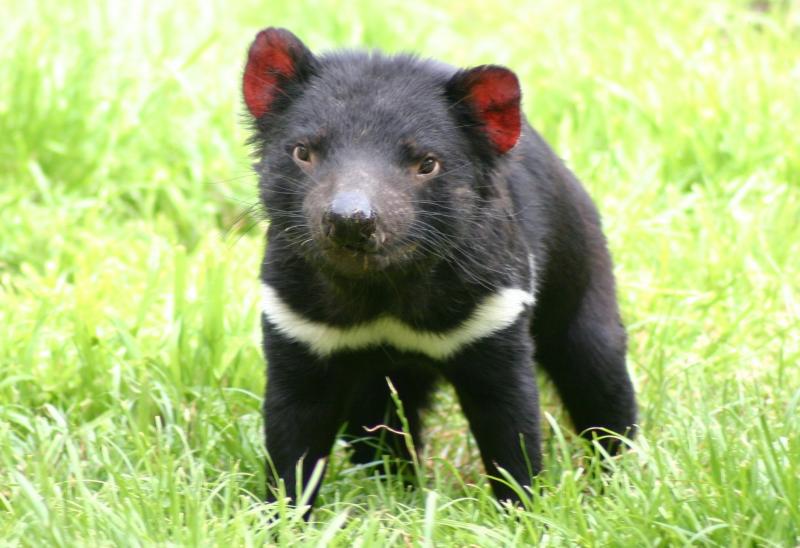
Tasmanian devil

Happy Monday everybody!  Some of you know that I will be away on a meeting this week in British Columbia.  Don’t worry, I worked hard over the weekend to ensure that you will still get your daily dose of Wild Facts this week.  I may be a little slow on responding to comments but please continue to leave them and I will be sure to get back to you as soon as possible.

All right, onto today’s fact! Maybe you liked Tweety Bird or Bugs Bunny but one of my favourite Bug’s Bunny characters was Taz.  Of course Taz was the loud, angry, spinning tasmanian devil.  In real life the tasmanian devil doesn’t spin in circles (although how cool would it be if that was how they traveled) but they do tend to be aggressive and loud while feeding.  As well, tasmanian devils are marsupials, so similar to a kangaroo they will place their young in a pouch until they fully develop.

So what do these crazy animals feed on? Well, they tend to be opportunistic and feed on carrion (dead animals) but will also hunt wombats and can even take down small kangaroos. They are nocturnal animals that will generally hunt during dusk and dawn. Although, the devil hunts alone they will feed with other devils, which generally leads to fighting and very loud noises as they use this form of communication to dictate the feeding order.  They use their long whiskers on their face and head to help them locate their prey when hunting at night as well it helps them know where the other devils are when feeding. Tasmanian devils have excellent hearing and a great sense of smell, which obviously helps them hunt in the dark. Even though they hunt at night, the devil can still rely on its eye sight to locate prey.  They have excellent black and white vision which allows them see moving prey; however, they will have a tough time identifying stationary objects.  So if you are being hunted by a tasmanian devil at night, be sure to stand still! I don’t know if this will protect you so don’t rely on this technique, besides I find knocking your friend down and running to work much better!

Although, these creatures are incredible and very unique their population numbers are dwindling.  In the wild they are only found in Australia on the island of Tasmania.  They are listed as endangered and due to a disease called devil facial tumour disease they are in jeopardy of becoming extinct. With any luck the Government’s programs will be able to help reduce this disease in time to save the tasmanian devil.

Tasmanian Devil Fast Fact: A study observing mammalian bite force relative to its body size has indicated that the tasmanian devil has the strongest bite of any living mammal.  Yes, even greater than a grizzly or a lion!

I hope you enjoyed today’s fact!

Digg This
Reddit This
Stumble Now!
Buzz This
Vote on DZone
Share on Facebook
Bookmark this on Delicious
Kick It on DotNetKicks.com
Shout it
Share on LinkedIn
Bookmark this on Technorati
Post on Twitter
Google Buzz (aka. Google Reader)