Posts Tagged ‘Spiders’

Wild Fact #674 – Long Jump Winner – Jumping Spiders

November 23, 2010 - 12:00 am 2 Comments

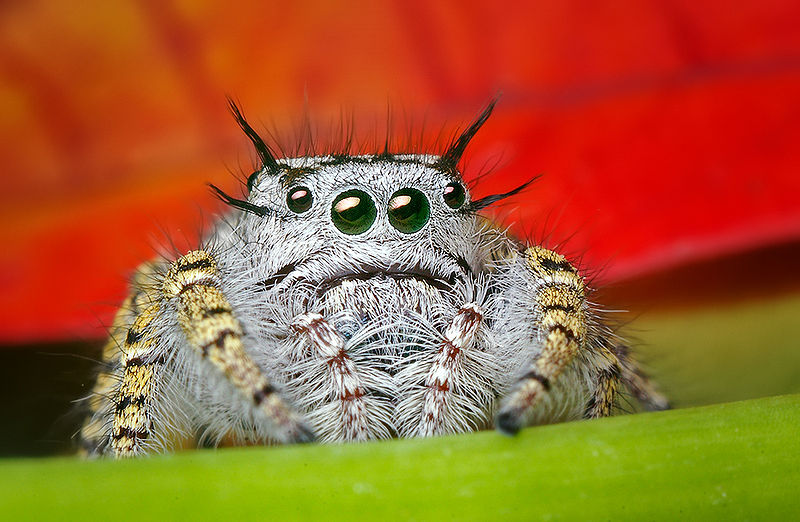
Photo from Wikicommons

Lately it seems as though we have been focusing on way to many mammal species so today we are going to learn about a very cool eight legged animal.  Now, I know some of you may not like spiders but I can guarantee that you will find Jumping Spiders to be very interesting.  I am just going to talk about the broad characteristics since there are over 5000 species of Jumping Spiders.  This makes them the largest family of spiders as they comprise about 13% of all spiders out there.  I just realized that I could complete my Wild Facts project 5 times over just with this one family.  Maybe I should start a second blog called Spider Facts!

Since the this family is so large you can virtually find a Jumping Spider species anywhere in the world; however, I doubt they reside in Antarctica or the in the extreme north such as Greenland.  Basically this means that we don’t have to go on a field trip today.  Grab your glass of lemonade and sit out in the backyard for awhile.  For the record I am not going to do this since it was 25 below with the windchill today.  So who wants to learn about some of the unique behaviours and characteristics of this spider?  Wow, I didn’t realize all of you were so excited.  Well let’s get to it then.

Photo by Thomas Shahan (Wikicommons)

When you look at the picture you probably notice their eyes first and foremost.  This makes sense since these eyes are unique and play a huge role in the Jumping Spiders life.  You see the Jumping Spider spends their days actively hunting other insects.  They aren’t lazy like other spiders that just build a web and hope something flies into it.  These spiders are like a wild cat in the savannah as they wait to pounce on their prey.  They use their keen sense of vision to pick up and track any insect that happens to be in their area.  The spider will then get into position and when the time is right they will pounce.  Jumping spiders can jump about 10 to 40 times the length of their body.  Just so you know their body length is typically between 3-10 mm (0.12-0.39″) so they are pretty small but being able to jump 10-40 times that length is still pretty impressive.

Jumping Spider Fast Fact – Let’s finish up the post talking about their funny looking eyes.  The Jumping Spider will usually have four pairs of eyes so if my math is correct that would be eight eyes.  They typically have these eyes arranged in three rows with two very large eyes in the middle of their flat head.  As mentioned earlier their eyesight is excellent as they rely on it to track their prey.

See, that spider fact wasn’t too bad now was it?  Before you go I recommend checking out the short video of a Jumping Spider in action.  It is from National Geographic so you know it will be good.

Digg This
Reddit This
Stumble Now!
Buzz This
Vote on DZone
Share on Facebook
Bookmark this on Delicious
Kick It on DotNetKicks.com
Shout it
Share on LinkedIn
Bookmark this on Technorati
Post on Twitter
Google Buzz (aka. Google Reader)

Wild Fact #847 – The Mythbuster Edition – Harvestman

March 25, 2010 - 12:00 am 19 Comments

I was having a tough time deciding what to write about tonight until I had a suggestion from one of my biggest fans, my mom!  She originally wanted me to write about the “Dock Spider” but I think I will save that post for another day.  Her second choice was to write about the Harvestman!  Of course, she called them something a little more familiar, “Daddy Longlegs.” Let’s move onto the interesting stuff.

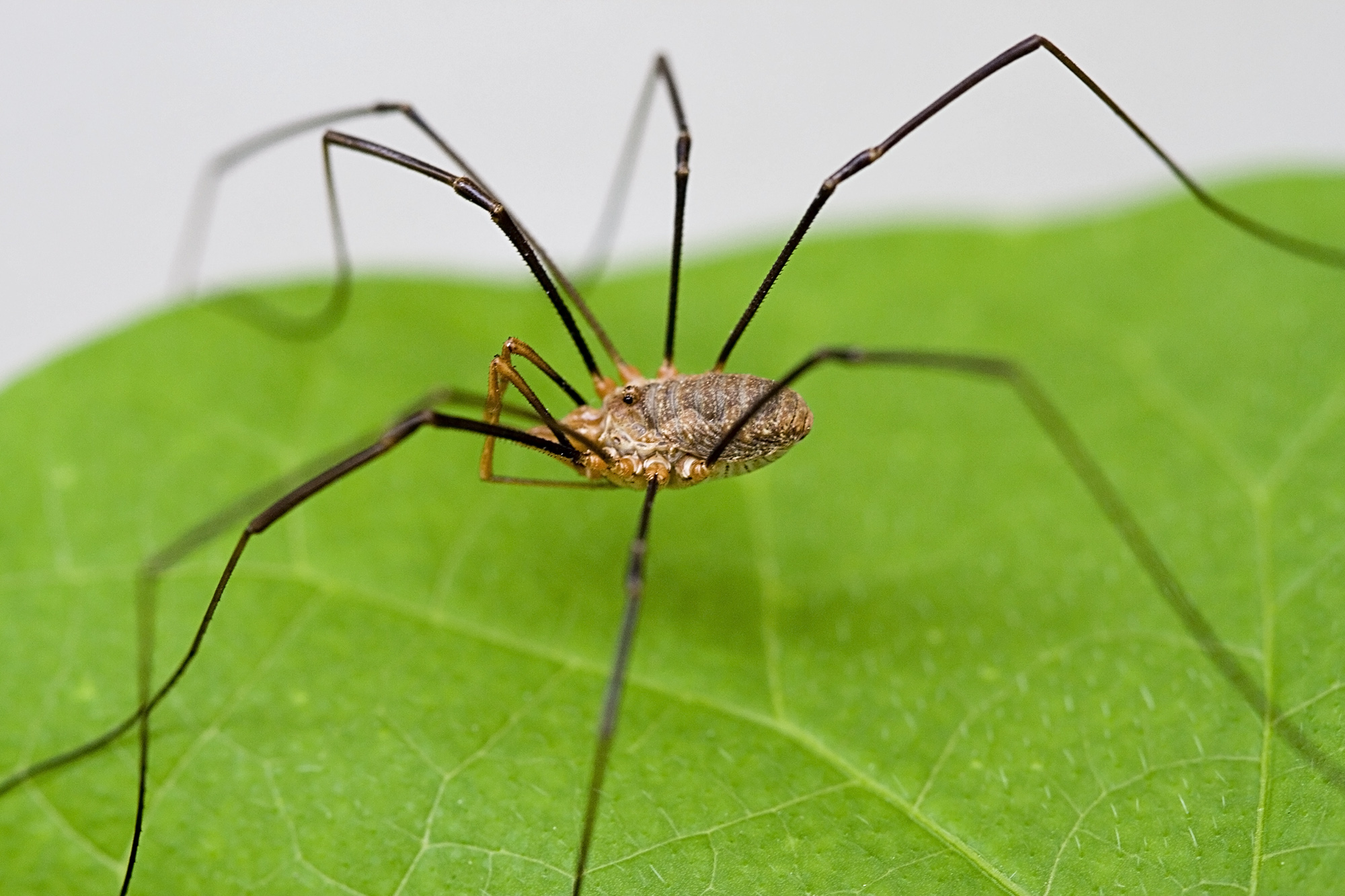
As I mentioned, in North America, the Harvestman is better known as the Daddy Longlegs.  In Europe this common name is reserved for another insect called the Crane Fly, which will also be discussed in the future. The biggest and most important thing you need to know about Daddy Longlegs, I hope you are sitting for this one, is that they are not actually spiders. They may look like spiders but they are very different. Instead of having eight eyes such as a regular spider, the harvestman only have two.  As well, spiders have two body segments while the “daddy longlegs” have their head, thorax and abdomen all fused together into one.  Just to make sure everyone is clear, the daddy longlegs is part of the Arachnid class like spiders, however, they are not actually spiders.  To put it another way it would be the same as mistaking a mosquito for a ladybug.  Mosquitoes are insects but not beetles.

Now, let’s talk about the most prominent feature of the harvestman.  Their extremely long and special second pair of legs.  This set of legs touches the ground before any other part of the harvestman.  They contain special sensory organs that allow them to get an advance taste and feel for the ground ahead.  Basically, these legs act as their nose, tongue, ears and perhaps even as a second set of eyes.  Unfortunately, the harvestman have a defense mechanism that causes them to lose their legs if they are in danger.  This obviously allows them the ability to escape, if necessary.  I tell you this so you don’t handle these special animals too much.  The loss of their legs is a serious problem since it would be like taking away your nose, mouth and ears!

Harvestman Fast Fact: The daddy longlegs are not capable of killing or poisoning their own prey so will resort to eating dead insects or the eggs of insects and spiders.

Digg This
Reddit This
Stumble Now!
Buzz This
Vote on DZone
Share on Facebook
Bookmark this on Delicious
Kick It on DotNetKicks.com
Shout it
Share on LinkedIn
Bookmark this on Technorati
Post on Twitter
Google Buzz (aka. Google Reader)

Wild Fact #879 – Don’t Put this Spider as your Beneficiary – Black Widow Spider

February 9, 2010 - 12:00 am 6 Comments

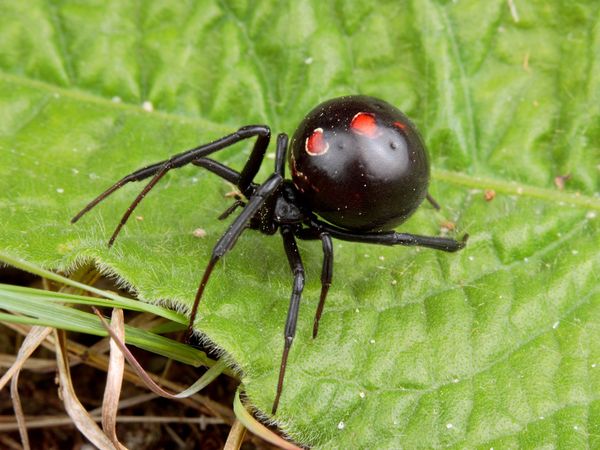
Photograph by George Grall

Warning! If you have a fear of spiders than today’s post is not for you; however, it is probably too late since you have already seen the picture of the popular spider above.  Don’t worry, it is just a picture and won’t do you any harm. In fact, if you keep reading you will find out exactly what harm the Black Widow Spider can cause.

The black widow spider is a popular and much feared spider. It is amazing how scary a spider ranging in size between 1.3-3.8 cm (0.5-1.5″) can seem to us. I guess the reason we panic when we hear about this teeny tiny spider has to do with the fact that it contains venom 15 times stronger than a rattlesnake. Yup, that would scare the pants off me.  Unfortunately, most people don’t realize that the quantity of this venom isn’t usually deadly. For the most part, if you are bitten by a black widow you will experience nausea, muscle aches and it may have difficulties breathing.  Heck, these are some of the same symptoms you would experience from the H1N1 vaccine.  Whatever happened to that pandemic? There have been occasions where the black widow has killed humans, however, they are usually the elderly, young or sick.  It is also important to know that the black widow doesn’t wake up in the morning put on its war paint and head out looking for people to bite.  They are not aggressive and will only bite as a form of self defense, so watch where you sit.

Have you ever wondered why this particular spider is called the black widow? Believe it or not, the reason you are thinking is correct! You were not entirely correct if you were thinking that the female finds some unsuspecting, rich male to marry and then murder him in order to get all of his money. Although, the female may kill and consume their mate after reproduction. This will provide the female spider with the energy required to lay her eggs. As a male, I am happy that I am not a black widow spider.

Digg This
Reddit This
Stumble Now!
Buzz This
Vote on DZone
Share on Facebook
Bookmark this on Delicious
Kick It on DotNetKicks.com
Shout it
Share on LinkedIn
Bookmark this on Technorati
Post on Twitter
Google Buzz (aka. Google Reader)

Wild Fact #879 – Don't Put this Spider as your Beneficiary – Black Widow Spider

February 9, 2010 - 12:00 am 6 Comments

Photograph by George Grall

Warning! If you have a fear of spiders than today’s post is not for you; however, it is probably too late since you have already seen the picture of the popular spider above.  Don’t worry, it is just a picture and won’t do you any harm. In fact, if you keep reading you will find out exactly what harm the Black Widow Spider can cause.

The black widow spider is a popular and much feared spider. It is amazing how scary a spider ranging in size between 1.3-3.8 cm (0.5-1.5″) can seem to us. I guess the reason we panic when we hear about this teeny tiny spider has to do with the fact that it contains venom 15 times stronger than a rattlesnake. Yup, that would scare the pants off me.  Unfortunately, most people don’t realize that the quantity of this venom isn’t usually deadly. For the most part, if you are bitten by a black widow you will experience nausea, muscle aches and it may have difficulties breathing.  Heck, these are some of the same symptoms you would experience from the H1N1 vaccine.  Whatever happened to that pandemic? There have been occasions where the black widow has killed humans, however, they are usually the elderly, young or sick.  It is also important to know that the black widow doesn’t wake up in the morning put on its war paint and head out looking for people to bite.  They are not aggressive and will only bite as a form of self defense, so watch where you sit.

Have you ever wondered why this particular spider is called the black widow? Believe it or not, the reason you are thinking is correct! You were not entirely correct if you were thinking that the female finds some unsuspecting, rich male to marry and then murder him in order to get all of his money. Although, the female may kill and consume their mate after reproduction. This will provide the female spider with the energy required to lay her eggs. As a male, I am happy that I am not a black widow spider.

Digg This
Reddit This
Stumble Now!
Buzz This
Vote on DZone
Share on Facebook
Bookmark this on Delicious
Kick It on DotNetKicks.com
Shout it
Share on LinkedIn
Bookmark this on Technorati
Post on Twitter
Google Buzz (aka. Google Reader)