Posts Tagged ‘Squid’

Wild Fact #442 – The Perfect Partnership – Hawaiian Bobtail Squid

October 27, 2011 - 12:00 am No Comments
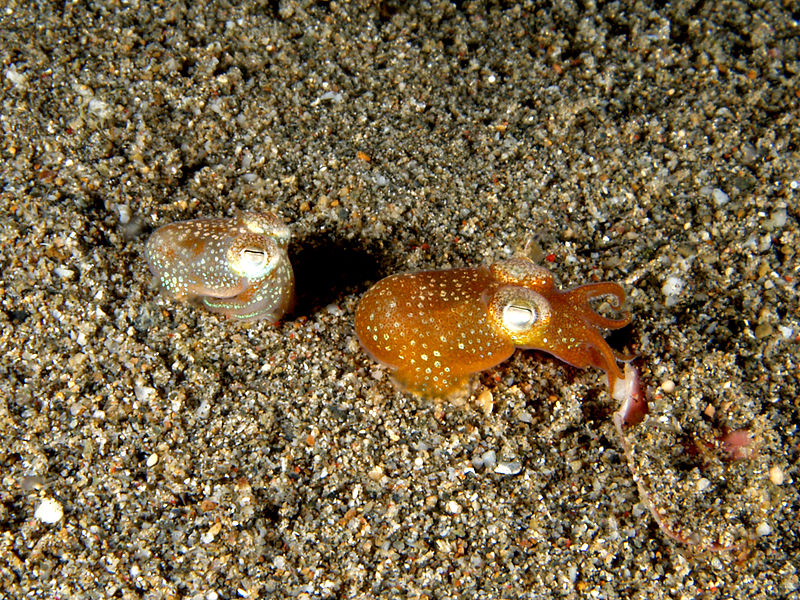
Hawaiian Bobtail Squid

Photo by Nick Hobgood (Wikimedia)

We have spent the last few days hanging around on land but today we are heading to the ocean for a nice, little swim. While we are playing around in the water, make sure to keep your eyes open for a tiny little creature known as the Hawaiian Bobtail Squid. Believe it or not, this animal can be found in the shallow waters surrounding the Hawaiian Islands….shocking, right?  Since winter is right around the corner, I figure we could all use a nice trip to a tropical paradise. So grab your scuba gear and lets learn a little more about the interesting Hawaiian Bobtail Squid.

As I mentioned, this squid is incredibly small. Just how tiny? Well, I had a hunch you would ask that so I came prepared. The Hawaiian Bobtail Squid has a mantle length of 2.54 cm (1″) which is pretty impressive if you stop and think about this for a second. That is one small squid! One of the most interesting features about this particular squid is their symbiotic relationship they have with a bacteria known as Vibrio fischeri.

What is this relationship?

Hawaiian Bobtail Squid

Photo by Nick Hobgood (Wikimedia)

Well, I am glad you asked! This bacteria lives in the mantle of the squid and as a result gets a nice steady meal of amino acids and sugar. The bacteria is so grateful for their food that they provide the squid with a very important feature……light! Wait, what? Yep, you read that right. The bacteria is bioluminescent and is able to determine the amount of light hitting the squid from above. They will then replicate this light on the underside of the squid, making the Hawaiian Bobtail Squid virtually invisible to predators looking up for a nice tasty snack. This is a pretty handy partnership, isn’t it?

Unfortunately, the Squid is not born with these handy, dandy bacteria living in their mantle. Nope, they actually have to attract them using a specialized mucous. Similarly, at the end of the Hawaiian Bobtail Squid’s day, they will expel the bacteria in an attempt to conserve their energy. So even though it is a great relationship, apparently it isn’t a long lasting one. I guess even the best partnerships have to come to an end at some point.

Thanks for taking the time to learn about the Hawaiian Bobtail Squid and their interesting friendship with an specialized bacteria. Enjoy the rest of your day and I will see you tomorrow.

Digg This
Reddit This
Stumble Now!
Buzz This
Vote on DZone
Share on Facebook
Bookmark this on Delicious
Kick It on DotNetKicks.com
Shout it
Share on LinkedIn
Bookmark this on Technorati
Post on Twitter
Google Buzz (aka. Google Reader)

Wild Fact #668 – The Spotlighgt is on This Cool Vampire – Vampire Squid

December 1, 2010 - 12:00 am 2 Comments

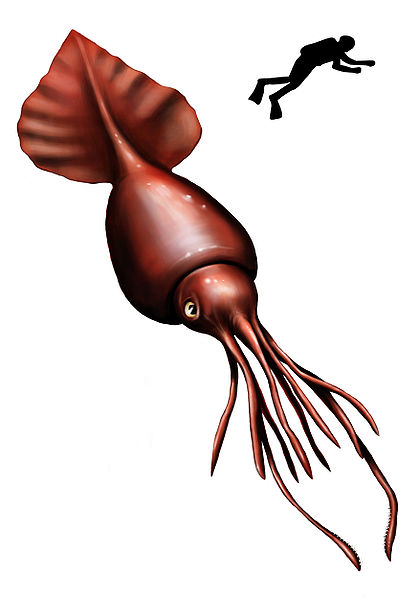
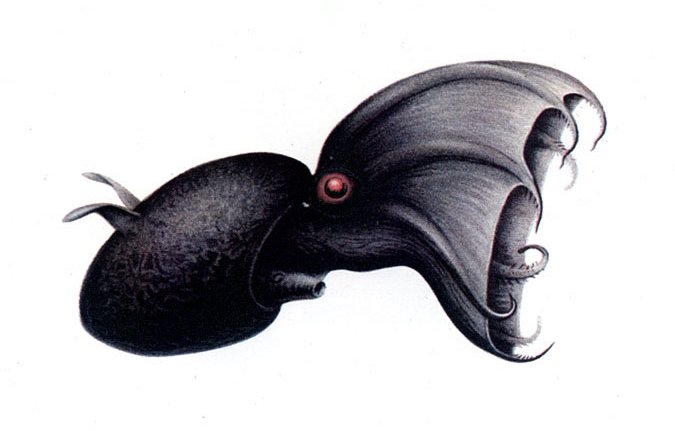
Drawing of a Vampire Squid by Carl Chun, 1911

Well it is the middle of the week, my driveway still needs to be shoveled and here I am writing a Wild Fact about a deep sea creature called the Vampire Squid.  Personally I think I made a great choice to sit down and write about this incredibly unique animal instead of braving the cold, windy, Yukon night.  In order for us to get to know the Vampire Squid a little better you may want to put on your wetsuit and grab an oxygen tank since we are heading to the deep blue sea.  Usually they can be found in temperate or tropical parts of the ocean.  So we need to choose which area we want to go swimming in.  My vote is for the tropical area.

The Vampire Squid is not a very big animal as the largest they will typically grow to is only 30 cm (1 foot) long.  Their actual jelly-like body is only about 15 cm (6″) long while their eight arms make up the rest of their length.  You may have noticed from the picture above that their arms actually have a webbing of skin attaching them together.  This webbing is pretty cool since the Vampire Squid is able to pull their arms over their body and use this web to protect themselves against attackers.  Sticking with their arms, you will find a single row of suction cups on each arm as well as soft spines which are known as cirri.  Add the cape-like webbing, soft spine structures to the fact that these squids have red eyes and you have the reason they are called Vampire Squid.  Does anyone else see the resemblance between this squid and every girls favourite vampire, Robert Pattinson?

Vampire Squid - Dorsal View - Photo from Wikicommons

Now that we are done examining the unique arms of the Vampire Squid let’s take a closer look at their body.  Their gelatinous body is covered with photophores so you know what that means, right?  Of course you do!  This means the squid is able to light up anytime they feel like.  I would like to see those “show-off” normal vampires use bio luminescence to attract prey and disorient oncoming predators.  This light show that the Vampire Squid displays is most likely their main form of defense.  Unlike other squid’s they don’t have an ink sac to help defend against the bullies of the sea.  Although, if things get really bad they can release a cloud of bio-luminescent mucus from their arms, which I am sure would help confuse their predators.  One more reason why the Vampire Squid is way cooler than the regular, ol’ vampires.

I guess that just about does it for our trip to the deep sea.  I hope you enjoyed your time swimming around with the squids.  See you tomorrow for another adventure.

Digg This
Reddit This
Stumble Now!
Buzz This
Vote on DZone
Share on Facebook
Bookmark this on Delicious
Kick It on DotNetKicks.com
Shout it
Share on LinkedIn
Bookmark this on Technorati
Post on Twitter
Google Buzz (aka. Google Reader)

Wild Fact #754 – Saturday Morning Cartoon – Glass Squid

August 3, 2010 - 12:00 am 2 Comments

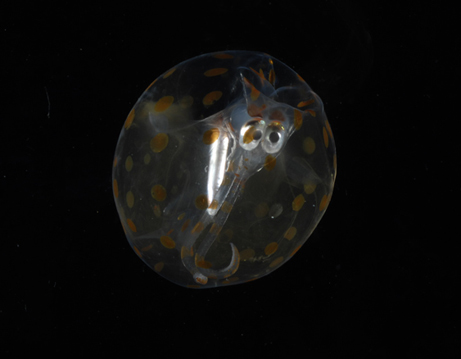
Photograph by David Shale, courtesy University of Aberdeen

During yesterday’s research on the Dumbo Octopus or “Graceful Octopus” as Agapelife so eloquently named it, I came across another interesting sea creature.  I found the cartoon appearance of the Glass Squid so amusing that I had to write a Wild Fact on them. Seriously, look at the picture.  Believe it or not that is a real animal and not some artwork you find in one of those fancy glass stores where I was never allowed to touch anything as a kid.

Glass Squid

There are actually about 60 different Glass Squid species so they don’t all look like a Saturday morning cartoon but they all have a very unique appearance.  These cool looking animals can be found in the middle depths of the ocean where the sun-lit water combined with their transparency makes a pretty good camouflage. To make this camouflage even better some species actually have a bio-luminescent light organ on the undersides of their eyes.  How does this help with camouflage you ask? Well, the light it emits will cancel out their shadow, so now you have a transparent animal swimming through the water without a shadow.  You won’t know it is there until you swim into it.  Just imagine how confused that fish would be swimming into a see-thru squid. In fact in most cases the only thing you will see is their cigar-shaped digestive gland, which acts like a liver for the squid.  Again, some species have a small light organ on the tip of their digestive gland which also cancels out any shadows.  Clever little buggers if you ask me!

Most of the Glass Squid species have a swollen body with incredibly short arms.  Each arm will have two rows of suckers, also called hooks and the third arm is usually enlarged.  To make themselves even cooler the Glass Squid will often have a large chamber filled with Ammonia.  No, they don’t use this chamber to get their white clothes even whiter. They actually use the Ammonia to assist with their buoyancy control.  Interesting little animals aren’t they?

Enjoy the rest of your day folks!

Digg This
Reddit This
Stumble Now!
Buzz This
Vote on DZone
Share on Facebook
Bookmark this on Delicious
Kick It on DotNetKicks.com
Shout it
Share on LinkedIn
Bookmark this on Technorati
Post on Twitter
Google Buzz (aka. Google Reader)