Posts Tagged ‘Turtle Facts’

Wild Fact #399 – What’s That Smell?!? – Stinkpot Turtle

December 27, 2011 - 12:00 am No Comments
Stinkpot Turtle

Photo by Laurent Lebois (Wikimedia)

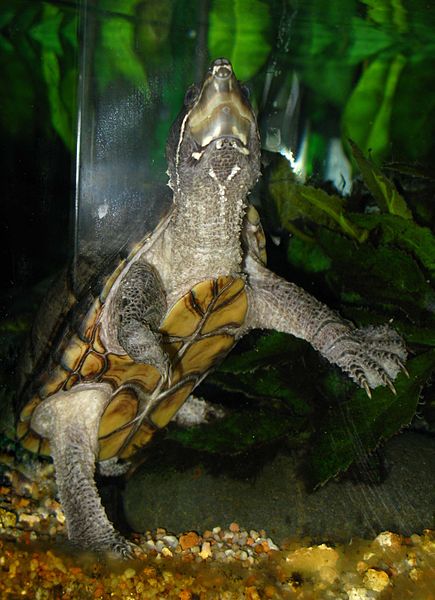
I have a hunch that today’s Wild Fact is really going to stink.Yes, that is because we are going to learn about the foul-smelling Stinkpot Turtle. It is also known as the Common Musk Turtle and can typically be found in southeastern Canada and the eastern United States. More specifically, you will find these little turtles hanging out in slow moving, shallow water bodies with a nice muddy bottom. So grab your rubber boots, a pair of nose plugs and lets go learn a little more about this smelly turtle.

Too Stinky To Eat

As you may have guessed, the Stinkpot Turtle gets their name from its ability to release a foul, musky odour. Using that definition, you could probably start calling your Dad a “Stinkpot Turtle”. The purpose of this foul smell is to encourage predators to look somewhere else for dinner. Since they are only 8 to 14 cm (3 to 5 inches) in size, this is an important feature for them. Luckily this tactic works incredibly well as the Stinkpot Turtle is hardly ever preyed on. You know you smell bad when a hungry wild animal doesn’t even want to eat you.

Stinkpot Turtle

Photo from Wikimedia

Cottage Life

As mentioned earlier, the Stinkpot Turtle spends the majority of their time in slow moving water bodies that typically have a muddy bottom. For the most part, they only venture out onto land when ti is time for the female to lay her eggs. With that said, some turtles will go out every now and again to bask in the sun. I guess even turtles can’t resist lying on the beach from time to time. Similarly,  these smelly little turtles have been known to climb up large tree branches, sometimes even higher than 2 m (6 feet) into the air. As boats drive by the turtles will often fall in and go for a nice boat ride. Suntanning and boating… it sounds like a pretty good day at the pond to me.

One Smelly Pet

Although the Stinkpot Turtle smells rotten, this doesn’t stop people from owning them as pets. Recently, the Common Musk Turtle is becoming a popular pet among households. I don’t normally condone having wild animals as pets, however, owning the Common Musk Turtle is taking the pressure off of other more endangered turtles, which is bonus. In fact, the USDA bans the sale of turtles smaller than 4 inches except for the Stinkpot Turtle, so even they are on board with them being used as pets.

That does it for today’s Wild Fact. Enjoy the rest of your day and I will see you tomorrow for another animal fact.

Digg This
Reddit This
Stumble Now!
Buzz This
Vote on DZone
Share on Facebook
Bookmark this on Delicious
Kick It on DotNetKicks.com
Shout it
Share on LinkedIn
Bookmark this on Technorati
Post on Twitter
Google Buzz (aka. Google Reader)

Wild Fact #428 – Wear Your Heart on Your….Back – Hawksbill Turtle

November 16, 2011 - 9:18 am No Comments
Hawksbill Turtle

Photo by Hoffryan (Wikimedia)

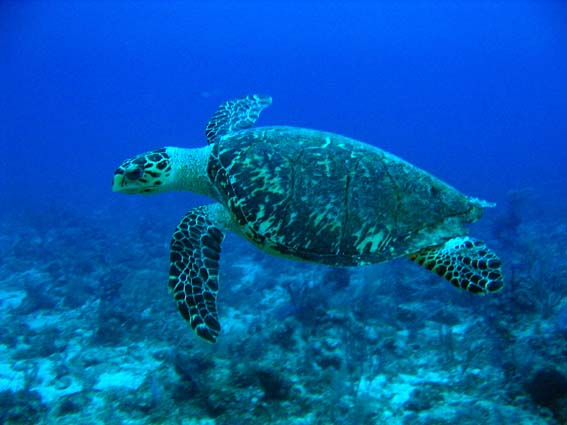
It may have took awhile to get today’s Wild Fact out, due to computer issues, however, better late than never. I promise it was worth the wait as we are heading to the ocean today to study a critically endangered sea turtle known as the Hawksbill Turtle. This particular turtle can be found throughout tropical areas in the Atlantic, Pacific and Indian Oceans, so you get to choose which area you want to explore. As well, you won’t need to go too deep since the Hawksbill Turtle prefers living along the coastlines where they are close to food and nesting sites.

One Big Heart

The Hawksbill Turtle is smaller than most other sea turtles as they only grow to about 114 cm (45″) in length and weigh up to 68 kg (150 lbs). I find it funny that a 150 lb turtle is considered to be the runt of the family. The young Hawksbill Turtles seem to have more ‘heart” compared to the adults. The juvenile turtles have a heart shaped shell, which becomes elongated as they grow older. Similarly, the shell of this particular turtle tends to be beautifully coloured, which tends to get this turtle into quite a bit of trouble.

Hawksbill Turtle

Photo by Tom Doeppner (Wikimedia)

Adopt a Turtle

As mentioned, the Hawksbill Turtle is critically endangered as a result of human influence. Although they are globally protected, people still love dining on their eggs and have no problems hunting this turtle for their flesh and amazingly beautiful shell. Similarly, the Hawksbill Turtle is also a victim to fishing as they are often accidentally caught in large fishing nets. Luckily, this turtle is getting some attention as the World Wildlife Federation (WWF) is working hard to ensure that this beautiful creature lives for a long time to come. If you would like to help out with this cause then please feel free to visit the “Adopt a Turtle” website.

The Talons of a Hawk

If you take a look at the head of the Hawksbill Turtle, you will quickly see how they received their name. Yes, their head tapers to a point, which resembles the beak of a majestic bird. Besides the beak, this Turtle also has talons like a Hawk. Okay, maybe I am exaggerating a little bit since I don’t think a pair of claws on each flipper would really constitute  as “talons” but these claws do separate the Hawksbill Turtle from most other sea turtles.

That does it for today’s adventure. Enjoy the remainder of your day and I will see you tomorrow for a new animal fact.

Digg This
Reddit This
Stumble Now!
Buzz This
Vote on DZone
Share on Facebook
Bookmark this on Delicious
Kick It on DotNetKicks.com
Shout it
Share on LinkedIn
Bookmark this on Technorati
Post on Twitter
Google Buzz (aka. Google Reader)

Wild Fact #535 – Stomp Around – Wood Turtle

June 20, 2011 - 12:00 am No Comments

Photo from Wikimedia

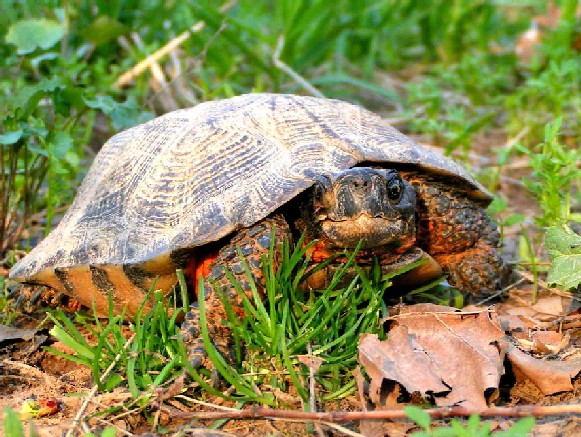
Well, we ended last week with a turtle species (remember, the Bog Turtle?) and we are going to start this fine week with another turtle.  A friend of mine from the Great White North recommended I write about the “Stomping Turtle”.  Since I like this friend, I figured I would take his recommendation.  So Wild Fact #535 will be all about the Wood Turtle, which is also referred to as the “Stomping Turtle” for reasons we will learn about shortly (but I am sure you can guess why it gets this name).  The Wood Turtle is only found in North America so it looks like our readers  across the pond will need to take a road trip for today’s fact.

Okay, so let’s start off with the most interesting behaviour of this reptile (well, it is the most interesting in my opinion). Of course, I am talking about their desire to stomp and dance around.  No, the Wood Turtle isn’t just grooving to some cool beats, they actually use their stomping to find dinner.  How, you ask?  Well, when utilizing the stomping strategy the Wood Turtle will take a few steps forward and alternate stomps between each front foot.  They typically stomp at a rate of about 1 stomp per second, which is a pretty quick rate.  The vibrations created from this dance-like behaviour causes any earthworms in the area to come to the surface.

Obviously, this is a mistake on the earthworms part since once they surface the Wood Turtle will quickly consume them. So why do the vibrations cause the worms to come to the surface? Excellent question!  It is believed that the turtles stomping imitates a similar vibration caused by the rain, and we all that the Earthworm likes the rain. And to think that I always used flashlights to find worms for fishing – Apparently, I should have been dancing around in my backyard instead.

Photo from Wikimedia

It appears that the Wood Turtle has an itch to travel as they have been known to walk long distances throughout the day.  In fact, on average, they will travel about 108 m (354′) in a day.  Now this might not sound like much to us but for a turtle that walks at speeds of 0.32 km/hr (0.20 mph), that is a lot of walking.  Apparently, Wood Turtles also have a great sense of direction and are able to find their way back home quite easily.  One study displaced a male turtle about 2.4 km (1.5 miles) away from its home and within 5 weeks the turtle was back where he originally started.  I don’t know how they do it, but I could definitely learn a thing or two from them since I get lost in the mall all the time.

Would you look at that, it appears our first Wild Fact of the week is done already.  I hope you enjoyed learning about our stomping friend and I will see you back here tomorrow for a new animal.  Enjoy the rest of your day!

Digg This
Reddit This
Stumble Now!
Buzz This
Vote on DZone
Share on Facebook
Bookmark this on Delicious
Kick It on DotNetKicks.com
Shout it
Share on LinkedIn
Bookmark this on Technorati
Post on Twitter
Google Buzz (aka. Google Reader)

Wild Fact #536 – Will Work for Food – Bog Turtle

June 17, 2011 - 12:00 am No Comments

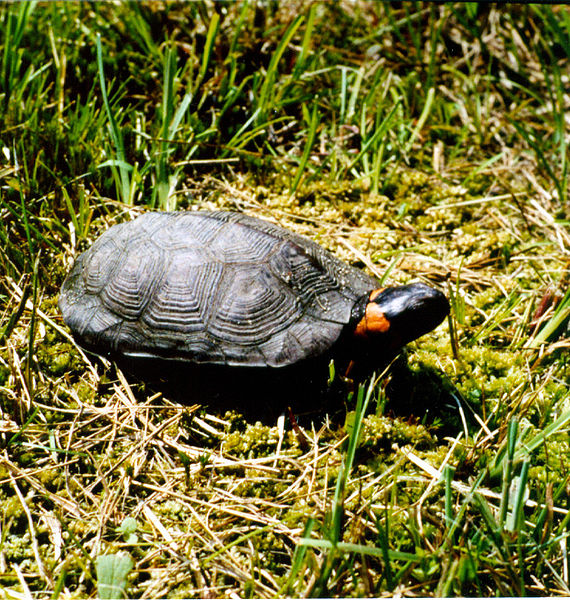
Bog Turtle - Photo from Wikimedia

Wooohoo!  We made it through another week of wild animal facts.  Since it has been so hot in Ottawa, I figured we could end the week by relaxing in a nice wetland in the Eastern United States.  It is here that we will find the smallest turtle in North America.  By now you have read the title and know I am talking about the incredibly awesome Bog Turtle.  For the record, that title really takes the suspense out of these opening paragraphs.  What are we waiting for?  Let’s grab our chest waders and head out to our local bog so we can catch a glimpse of these little turtles.

We had better hurry up and get out to the bog if we want to witness these turtles in their natural habitat.  You  see the wetlands that these turtles love are being destroyed to build new residential and commercial areas for humans.  As a result, the population of the Bog Turtle is rapidly declining but don’t worry, there are numerous conservation groups working around the clock to protect prime areas so these turtles don’t end up homeless.  Actually, right about now, i wouldn’t be surprised to see a homeless Bog Turtle sitting on the side of the street begging for aquatic vegetation.

Baby Bog Turtle (Wikimedia)

Okay, so I mentioned that these turtles are the smallest in North America.  Of course, we all want to know just how small they really are.  On average the Bog Turtle measures between 8.9 and 9.4 cm (3.5 – 3.7″) in length.  Basically, this little turtle would be able to fit in the palm of your hand, which I think is incredibly impressive.  How much habitat could such a small animal actually need?  This question will arise again when you find out that the Bog Turtle spends the majority of their time either buried in the mud (to escape the intense afternoon heat) or hibernating for the winter.  When awake, this seclusive turtle will bask in the sun to start their day before heading out to look for lunch.  What is on the menu for the Bog Turtle?  Well, the special of the day is usually insects mixed in with other invertebrates.   It may not be the most delicious meal but I bet the invertebrate diet lets the Bog Turtle keep their small shape.

Bog Turtle Fast Fact – Besides habitat destruction the Bog Turtle also needs to be on the lookout for poachers.  As you can imagine, these cute little turtles typically end up on the Black Market to be sold as pets.  Their small size makes them the perfect companion but please don’t get a pet Bog Turtle.  They are protected by the United States Endangered Species Act for a reason.

So it looks like we are at the end of another Wild Fact.  I don’t know about you but I don’t feel any cooler after playing in that wetland for the last 2 minutes.  I guess I can spend the rest of the weekend trying to stay cool.  Enjoy your Friday and have a great weekend!

Digg This
Reddit This
Stumble Now!
Buzz This
Vote on DZone
Share on Facebook
Bookmark this on Delicious
Kick It on DotNetKicks.com
Shout it
Share on LinkedIn
Bookmark this on Technorati
Post on Twitter
Google Buzz (aka. Google Reader)

Wild Fact #661 – Cowabunga – Red-Eared Slider

December 10, 2010 - 12:00 am 4 Comments

Photo by Jf268 (Wikicommons)

I am a little upset that this is the last cartoon Wild Fact. It was a ton of fun finding out the type of animals some of my favourite childhood cartoon characters were based off of. We are going to end this weeks very special edition of Cartoon Wild Facts with one of my personal favourite characters. Actually, it is four cartoon characters that go by the name of Leonardo, Donatello, Raphael and of course Michelangelo. Yep, we are headed to the sewers of New York to learn more about the Teenage Mutant Ninja Turtles. Before they were transformed into crime fighting, pizza eating heroes in a half-shell they were baby Red-Eared Sliders.

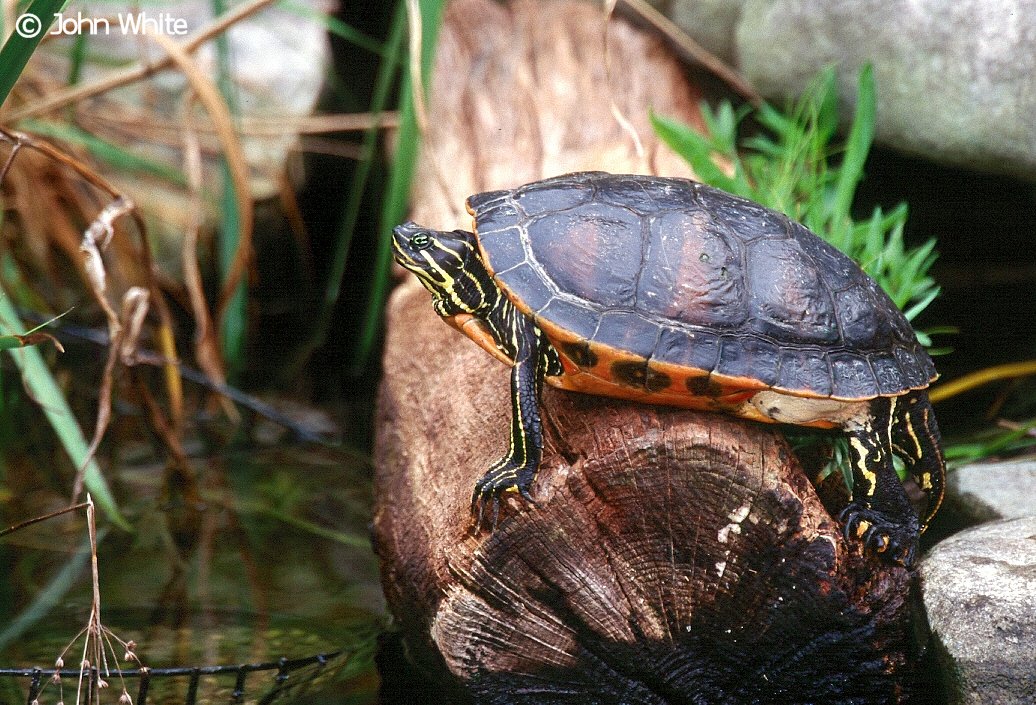
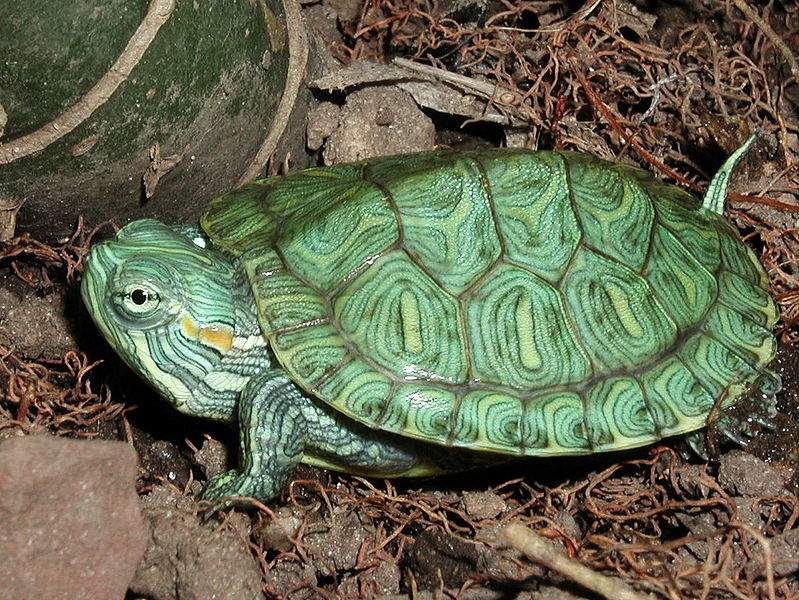
The Red-Eared Slider is a semi-aquatic turtle that was originally from the Southern United States, however, they can be found anywhere since they make great pets. Perhaps this is why Splinter wanted to hang onto them – they were just his pets.  As you can imagine they get their name from the obvious red mark around their ears.  Don’t even bother going back to the TMNT cartoon to see if you can spot it since their ears are covered up by their coloured bandannas.  Oh yeah, and the slider part is simply because they can easily and quickly slide off the rocks and logs to get back into the water (or sewer).

The Red-Eared Slider does have some traits that would help them become crime fighting ninja’s.  The real life version of the Red-Eared Slider is deceptively fast and an awesome swimmer.  Granted they don’t know how to use nunchucks but they can still use these two features to catch their prey.   So what do they use their ninja like skills to catch?  Well, other than pepperoni and anchovy pizza they feed on snails, crickets, worms, tadpoles, fish, crayfish and of course a nice healthy dose of aquatic vegetation.

Red-Eared Slider Fast Fact – A common misconception about this specific turtle is that they don’t have saliva.  Well they do but the Red-Eared Slider also has a fixed tongue and as a result can only eat in the water.

TMNT  Fast Fact – As you may have guessed the Ninja Turtles were all named after Renaissance men.  The leader of the group was named after Leonardo da Vinci, while the fun-loving comic relief Michelangelo was named after Michelangelo Buonoratti.  The other two turtles were named after the famous artist and sculptor Donatello and the very talented painter and architect Raffaelo Sanzio da Urbino, better known as Raphael.   One last side note – in real life, Leonardo da Vinci, Michelangelo and Raphael formed the traditional trinity of great masters of that period.  They also kicked the snot out of Shredder, Bebop and Rocksteady!

Unfortunately that is the last cartoon Wild Fact.  Perhaps we will start this up again in the future since it was a lot of fun.  Have a great weekend everyone.  Before I go I wanted to provide you with a YouTube link to the Ninja Turtles Opening Theme.  Unfortunately, I was unable to embed the video into the post.  Definitely check out the link though for some late 80′s memories.  Here is the link:  http://www.youtube.com/watch?v=avHVOHsN3T0

Digg This
Reddit This
Stumble Now!
Buzz This
Vote on DZone
Share on Facebook
Bookmark this on Delicious
Kick It on DotNetKicks.com
Shout it
Share on LinkedIn
Bookmark this on Technorati
Post on Twitter
Google Buzz (aka. Google Reader)

Wild Fact #793 – Heads it’s a Boy, Tails it’s a Girl – Yellow-Spotted River Turtle

June 9, 2010 - 12:00 am 9 Comments

http://commons.wikimedia.org/wiki/File:Podocnemis_unifilis.jpg

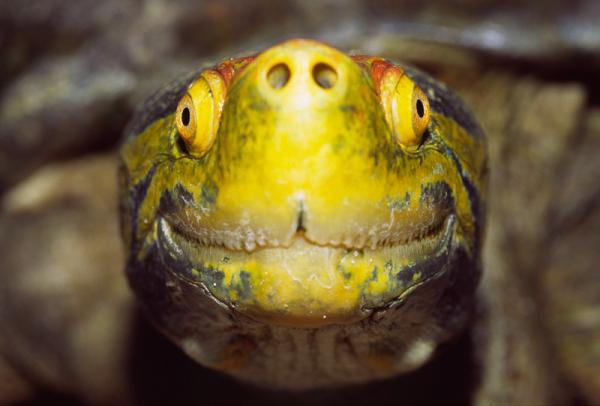
I was having a tough time deciding which animal to talk about today when it dawned on me that I haven’t talked about a turtle in a long time.  So today we get to look at the Yellow-Spotted River Turtle.  I recommend you grab your coffee (or juice in a sippy cup for our younger audience), sit back and enjoy the presence of this super cool turtle.

So what makes the Yellow-Spotted River Turtle so super cool?  Well, it is a turtle and all turtles are awesome. I also think it is pretty interesting that these turtles live in the Amazon River basin.  During the wet season though they will also venture out to hang in the flooded forest. I guess if you are a terrestrial animal like a squirrel then you would start to worry when you see the turtles moving in. For some reason, I picture an old, cranky squirrel yelling at his wife, “Martha! Martha! Pack your nuts, the Turtles are here.  We are heading for the hills!” Wow, it must have been a long day for me. I highly recommend you keep reading since I have no idea what else I might say today.

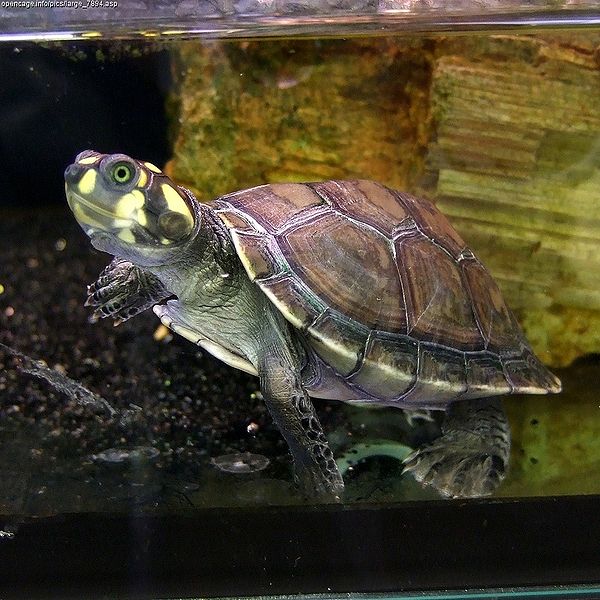
The Yellow-Spotted River Turtle is a type of side-necked turtle which can weigh up to 25 pounds.  For the record, it is the female turtle that weighs the most in this species.  I just realized that I didn’t explain what a side-necked turtle is.  Would you like to know? Of course you would.  Well, the side-necked turtles aren’t like your typical turtle.  You know the ones that pull their heads straight back to hide in their shell.  Nope, these guys simply bend their necks sideways and tuck their head under the lip of their shell.  From what I can tell from this description, the Teenage Mutant Ninja Turtles would have been your typical type of turtle.  Well, as typical as a mutant turtle can be.

Yellow-Spotted River Turtles – The sex of this particular turtle is determined during the very early stages of their life (obviously!).  Believe it or not the temperature that the eggs incubate at will actually determine if you are having a boy or a girl.  Eggs incubated below 32 degrees Celsius (90 degrees Fahrenheit) will produce male turtles.  I am sure you can guess that eggs incubated above this temperature will produce females.

Well that is all for me folks.  Have a great day!

Digg This
Reddit This
Stumble Now!
Buzz This
Vote on DZone
Share on Facebook
Bookmark this on Delicious
Kick It on DotNetKicks.com
Shout it
Share on LinkedIn
Bookmark this on Technorati
Post on Twitter
Google Buzz (aka. Google Reader)