Posts Tagged ‘Insect’

Wild Fact #861 – Ewwww! A Bug!! – Earwigs

March 5, 2010 - 12:00 am 14 Comments

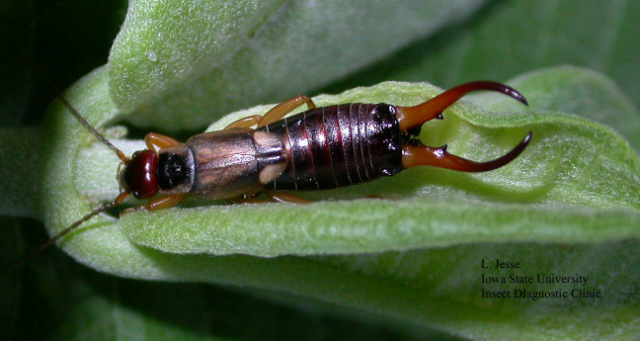
Photo by L. Jesse

I just realized that it has been awhile since we have done a post about those pesky little insects.  I am surprised by this since I am absolutely fascinated by insects and the incredible behaviours they exhibit. My goal today is to try and convince at least one person that some of the “yuckiest” insects such as the Earwig have some pretty good qualities as well. Stop squirming and continue reading to find out more about this little “pincerbug”.

I am sure a lot of us have had the pleasure to see an earwig up close and personal.  I am not sure how many of us though actually took the time to appreciate and understand this harmless little bug.  Earwigs are often blamed for destroying crops and other foliage.  Although, they do feed on this yummy plant material (well, yummy to them, not to me) they also feed on various insects which are known to cause even more damage to our beloved crops. Personally, I would take the lesser of two evils and utilize the earwigs to protect my valuable resources. I am not saying I would go out and collect 1000′s of earwigs to protect my farm, well unless it was an earwig farm of course!

I am guessing you are still not convinced that the earwig deserves a little bit of appreciation so I will keep trying.  How about this one?  Did you realize that the earwig is one of the few insects that actually cares for its eggs and will watch over the little nymphs until they reach their second molt.  You see most insects just drop their eggs and let them fend for themselves.  That would be equivalent to us dropping our newborn baby in the wild and saying, “Good Luck Little Nathan, I hope you survive”.  I guess this strategy worked for that Jungle Book guy so maybe it isn’t too bad.  Anyway, back to my point!  Yes, the female earwig is a proud mother and will take extreme measures to ensure the safety of her young ones.  If you ask me this is a pretty impressive trait for this heroic insect!

So you still haven’t rushed out to buy the latest Earwig T-Shirt? (could you imagine if they actually had these)  Maybe you will be a little less scared of the earwig after I clear up the myth that they crawl into your ear and bore into your brain.  I can tell you right now that they have better things to do such as caring for their young!

You have to admit that the maternal instinct of the earwig is pretty impressive and unique.  I think they deserve and a little appreciation and I hope you see that now too.

Have a great weekend everyone!!

Digg This
Reddit This
Stumble Now!
Buzz This
Vote on DZone
Share on Facebook
Bookmark this on Delicious
Kick It on DotNetKicks.com
Shout it
Share on LinkedIn
Bookmark this on Technorati
Post on Twitter
Google Buzz (aka. Google Reader)

Wild Fact #924 – Check Out These Chompers – Dobsonfly

December 7, 2009 - 12:00 am 7 Comments
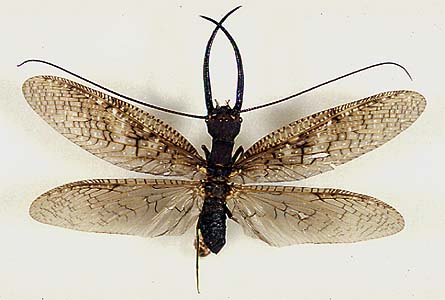
Photograph by Atilano Contreras-Ramos

Photograph by Atilano Contreras-Ramos

Well, I hope everyone enjoyed their weekend as much as I did.  I really do love this time of year! It has been awhile since I did a fact about an insect so I thought I would devote today’s Wild Fact to the Dobsonfly.

If you look at the picture, this looks like the most vicious insect in the world.  They are a large insect that can reach up to 12.5 cm (5″) in length. For the record, that is almost half a foot! Even crazier is the fact that the male dobsonfly will grow tusks (or mandibles) that can reach about 1″ in length. The females also have mandibles but they are substantially smaller than the males. Like a lot of insects, the adult version (pictured above) do not actually feed and are fairly short lived. They spend most of their life in the aquatic larvae form where they can live up to 3 years and are very predacious.

So if the adult dobsonfly does not feed then what the heck is the purpose of the huge mandibles.  Obviously, they are used to scare people into thinking they are the most deadly insect on the face of the earth.  Actually, they are used to impress the ladies.  That’s right, the dobsonfly studs will show off their impressive tusks to their mating partner.  They are also used to hold the female during copulation.  I wanted to write about this insect to illustrate that mating adaptations are common throughout the animal kingdom.  Not only with mammals or reptiles but with the more primitive animals such as crustaceans and insects.  Mating plays such an important role in evolution since it can decide the fate of an entire species.  You may have noticed that most of the adaptations presented so far have to do with self defense or mating. If it is the survival of the fittest then these are the strategies that need to be perfected in order for a species to make it to the next generation.

Dobsonfly Fast Fact: The mandibles on the male dobsonfly are so large that they are actually incapable of biting a human. They are not able to get enough leverage to do any harm.  The female dobsonfly, on the other hand can use her pincers to inflict a painful bite.

Digg This
Reddit This
Stumble Now!
Buzz This
Vote on DZone
Share on Facebook
Bookmark this on Delicious
Kick It on DotNetKicks.com
Shout it
Share on LinkedIn
Bookmark this on Technorati
Post on Twitter
Google Buzz (aka. Google Reader)

Wild Fact #941 – This is one Party you Never Want to Host – Twisted Wing Parasites

November 12, 2009 - 12:00 am 14 Comments

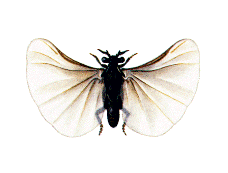
Photo compliments of http://www.cals.ncsu.edu

Photo compliments of http://www.cals.ncsu.edu

Yesterday we learned that you can’t judge a book by it’s cover.  Today we are going to learn that the insect world is filled with weird insects that have strange behaviours. One of the wierdest has to be the life history strategies of the twisted wing parasite.  You know it is messed up when even biologists named them “twisted”.

The twisted wing parasite actually has a complex life style. Only the males have wings, legs and are free living.  The females never leave the host that they are living in (except in the Mengenillidae family). The females don’t have legs or wings.  Let me back up a bit and tell you the interesting life cycle of the twisted wing parasites.  It all starts with the little larvae (the immature stage of the insect).  The larvae will climb onto some pretty flowers and wait for other insects to come and pollinate those flowers.  When an insect like a bee lands on the flower the twisted wing larvae will jump aboard the insect and burrow into their body. At this point they will change into another stage of larvae and feed off the blood and organs of the poor unsuspecting host.  At this point a male twisted wing parasite will emerge in order to find a mate.  The male insect does not eat and only lives for about 5 hours.  Their only goal is to find a female and mate. As mentioned, the female twisted wing parasite remains in their host so they will produce pheromones in order to attract their short lived mate.  Only the head and thorax (body) of the female are sticking out of the host insect so once the male finds the female he will penetrate the area between the head and the thorax depositing his sperm directly into the abdominal cavity.  The eggs will hatch and the larvae will move on looking for their very own host to take advantage of.  At this point the whole cycle starts over again.  Now if this does not weird you out then their is something wrong with you.  I am just glad that the human life cycle is completely different then that of the twisted wing parasite.

Twisted Wing Parasite Fast Fact: In some species the female is able to reproduce without actually mating with a male. Oh and one more thing! These insects don’t just live in some remote, tropical area.  We have them in USA and Canada.

Enjoy the rest of your day!

Reference:

Twisted-Wing Parasites: Strepsiptera – Behavior And Reproduction

Digg This
Reddit This
Stumble Now!
Buzz This
Vote on DZone
Share on Facebook
Bookmark this on Delicious
Kick It on DotNetKicks.com
Shout it
Share on LinkedIn
Bookmark this on Technorati
Post on Twitter
Google Buzz (aka. Google Reader)

Wild Fact #954 – How the Desert Locust Changes from Dr. Jekyll into Mr. Hyde

October 26, 2009 - 12:05 am 6 Comments

1087798

Well, I am back from British Columbia and well rested so let’s dive right into Monday’s Wild Fact.  While, I was sitting in my hotel last week, I saw a commercial about an upcoming movie called 2012 which predicted the end of the world in the year of the title. It got me thinking about deadly plagues and I remembered that one of the 10 plagues of Egypt mentioned that locusts would come in and out with the wind.  In a weird, round about way, that movie preview inspired today’s fact about locusts. So what exactly is a locust? We probably know they can be devastating to agriculture as they eat everything in sight but what causes this insect to be so destructive.

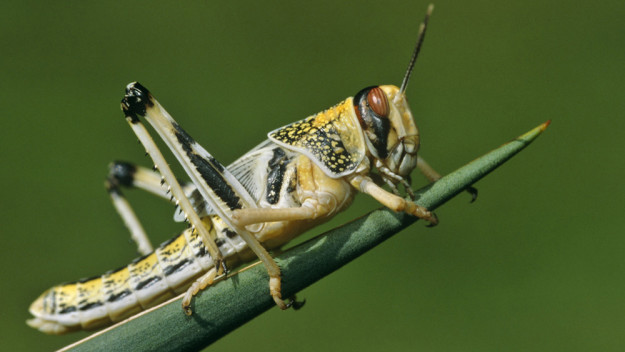
Firstly I want to let you know that a locust is basically a large grasshopper.  I bet the majority of us have played with grasshoppers and they didn’t seem that destructive.  For the most part this is true, but let’s take the desert locust for example.  When there is plenty of food and the population of desert locusts is in check they are fairly harmless insects.  Although, once the population starts to increase and the food runs out these small, friendly locusts become similar to Dr. Jekyll and Mr. Hyde.  As the population grows there will be much more stimulation on the hind legs of the locust.  So big deal, right?  Wow, their legs are getting bumped due to overcrowding.  I have seen similar things with humans in large cities so what is the big deal.  I know, it may seem trivial but as these locusts legs constantly get touched it will release serotonin.  Just so you know serotonin is known to play a role in regulating mood, appetite and muscle contraction.  So are you starting to see the importance of Dr. Jekyll’s legs constantly getting bumped?  As this serotonin level increases the friendly desert locusts will begin to molt until they produce one final generation of locust.  This last generation, however, will be in the Mr. Hyde form.  Instead of being a solitary animal they will turn gregarious and form gangs with other locusts.  They become larger, change colours, consume more food and breed easier.  This gregarious form is the typical locust swarm that we all picture.  These swarms can become very large containing billions of locusts. Yes, BILLIONS! You can imagine what these hungry little insects will do to crops everywhere.  Now that scientists realize it is an increase in serotonin levels that cause the gregarious form of locusts, they are working on a pesticide that will change them back into their harmless, solitary form.  To date, I don’t believe this chemical exists but I am sure they are working hard on it. So, remember, the next time you are playing with a friendly grasshopper, make sure you don’t constantly touch the back legs :) .

Desert Locust Fast Fact – Desert locusts fly with the wind and can cover up to 100-200 kilometers/day.  They will not fly higher that 2000 meters above sea level so tall mountain ranges will provide some very important barriers to this insect.

After I wrote today’s post I went searching for a great video that shows what a locust swarm looks like.  I came across a video done by National Geographic that basically explains this Wild Fact.  Check it out in the post below to see how devastating these swarms of locusts can be.

Literature Cited:

http://www.world-science.net/othernews/090130_locust.htm

Digg This
Reddit This
Stumble Now!
Buzz This
Vote on DZone
Share on Facebook
Bookmark this on Delicious
Kick It on DotNetKicks.com
Shout it
Share on LinkedIn
Bookmark this on Technorati
Post on Twitter
Google Buzz (aka. Google Reader)

Wild Video – Why Desert Locusts Swarm

October 26, 2009 - 12:00 am 4 Comments

Check out the following video that explains how the Desert Locusts swarm and the potential devastation they can cause.

Digg This
Reddit This
Stumble Now!
Buzz This
Vote on DZone
Share on Facebook
Bookmark this on Delicious
Kick It on DotNetKicks.com
Shout it
Share on LinkedIn
Bookmark this on Technorati
Post on Twitter
Google Buzz (aka. Google Reader)