
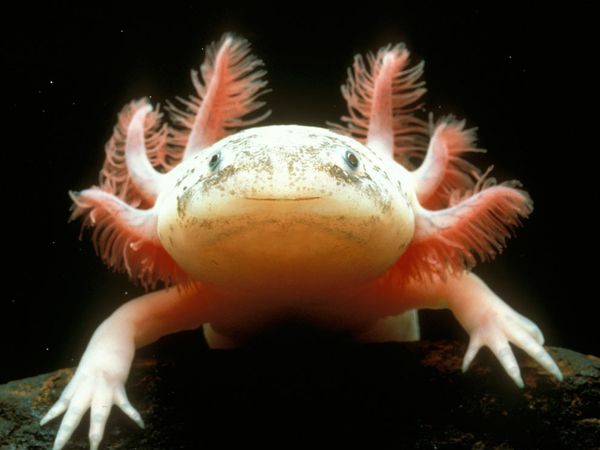
Yesterday we had the opportunity to learn about the largest land-dwelling salamander, the Tiger Salamander. Today we are going to look at one of their close relatives, the Axolotls (pronounced ACK-suh-LAH-tuhl) which spends its adult life in the aquatic form.
The Axolotl is one of the few salamanders that retains its larval features throughout their adult life. That’s right these adult salamanders actually keep their tadpole-like fin as well as their external gills. Honestly, how cool is it that these little guys remain forever young? I guess I can’t really call them “little” since some individuals will grow up to a foot long (30 cm), however, the majority remain around the 6″ (15 cm) mark. Either way they get fairly large for a salamander.
If your curiosity is piqued and you want to check out these aquatic salamanders than we need to take a trip to the lake complex of Xochimilco (pronounced SO-chee-MILL-koh) near Mexico City. It is in this complex that you will discover a different salamander that spends its entire life in the water. Well, I guess this isn’t always true since in a few rare cases the Axolotl has been known to mature into the land-dwelling salamander leaving its watery home. But for the most part the Axolotl is more than happy to hang out on the bottom of this lake complex.

One of the traits they share with their land-dwelling cousin, the Tiger Salamander, is their longevity. The Axolotl has been known to live up to 15 years in the wild. Throughout this time they will feed on a variety of aquatic animals such as worms, mollusks, insect larvae and other various crustaceans. Unfortunately the population of the Axolotl is beginning to dwindle as large fish are introduced into their lakes knocking them off the top of the food chain. As you can imagine there are problems living so close to a highly populated center such as Mexico City. As a result of this increasing human population the Xochimilco lake complex is being drained and what isn’t drained is contaminated. To make matters worse the Axolotl is a favourite among the pet trade and roasted Axolotl is considered a delicacy in Mexico. One population estimate has the number of wild Axolotl around 700-1200 which is down considerably from the 6000 that were estimated in 1998. It is a very possible reality that the Axolotl will become extinct in the wild if something is not done soon.
If you would like to find out more about the Axolotl or what you can do to help than I suggest checking out EDGE – The Evolutionarily Distinct and Globally Endangered website for ways that you can make a difference.
Thanks and have a great day!


Thanks for this great post on the Axolotl! I actually blogged about them myself a couple of years ago (not on Sparkle’s blog, on a personal Typepad blog I haven’t updated in forever). They are fascinating (not-so) little guys. I will pass your post around.
Hi Janiss!
Thanks for passing on the Wild Fact post. I have always found the Axolotl to be very interesting. I was actually surprised when I realized that I hadn’t blogged about them yet. I would love to track down your old blog post and see what you had to say about the cute “little” buggers.
Thanks for stopping by!
@Nathan, here you go:
http://janiss.typepad.com/stuff_n_nonsense/2008/11/my-fave-endangered-creature-the-axolotl.html
thanks for these facts i needed them for my speech
for next week i apperciate you doing that
This is cool! I love the pic, and this post is awesome! I needed this for a OneWorld Science project, and this helped so much!
Nice one ;)!
this is very cool and helpful. I had a group project for school and I had to search for facts of animals for the desert biome. This completely helped complete my food chain and food web. A very helpful website and a very factual post. Once again, thank you for all the help!