
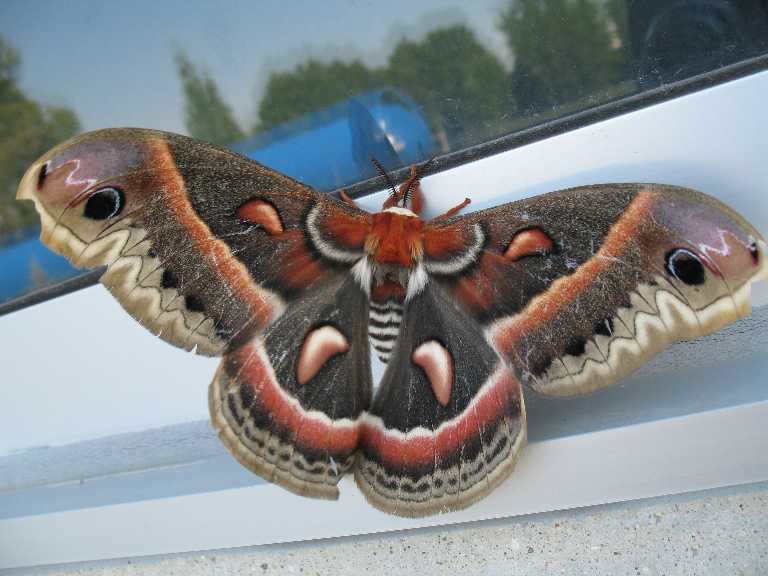
As promised we are going to end the week of Wild Facts with another interesting insect. Today we are going to discover North America’s largest, native moth known as the Cercopia Moth, which is a member of the Giant Silk Moth family. This particular insect can be found as far west as the Rocky Mountains and as far north as the Atlantic provinces in Canada. Basically, they can be found throughout much of the United States and the southern portion of Canada, so if you happen to live in this area, keep an eye out for these impressive moths….adults and larvae, alike.
Stunning Colours
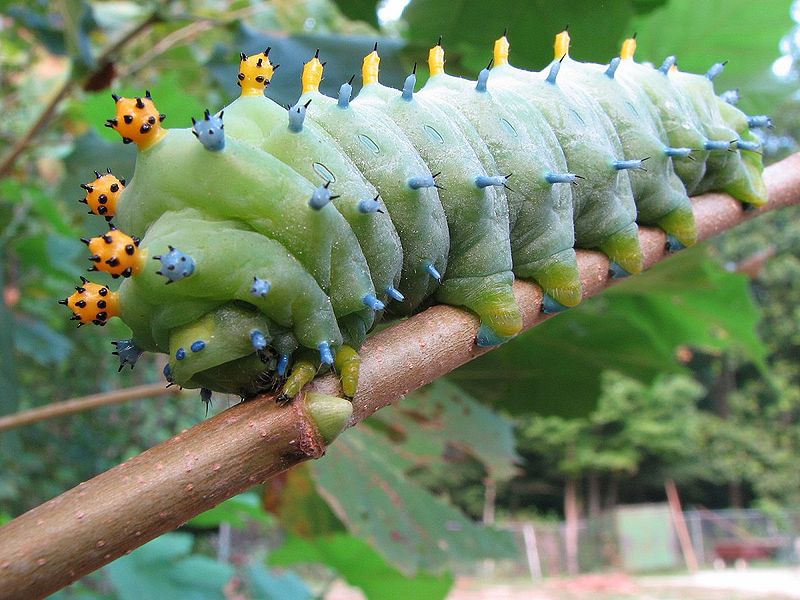
Personally, I like the larvae of the Cercopia Moth is by far the coolest aspect of this beautiful insect. Much like other silk moths, the adult will lay eggs which give rise to caterpillars. The “baby” moths will go through several changes, called in-stars, before turning into the adult form. These in-stars are pretty impressive stages as they start out being bright green/yellow with tiny, orange spines that are topped with a little blue knob. As the caterpillar continues going through their life stages their colour will dull but they get much larger – around 4 inches in length.
Apparently Parasites are Bad!
One of the main things the Cercopia Moth needs to worry about are dangerous parasitoids such as parasitic wasps. These mean old parasites will lay their eggs in or on the awesome looking moth larvae. Basically, these parasites will control the larvae (yep, they keep them alive) until they are ready to pupate into the adult form. Unfortunately, when the larvae goes through the final stage to become a beautiful moth, the parasite will kill their host and transform into an adult themselves. Then the entire cycle starts all over again. If it isn’t parasites, the Cercopia Moth needs to look out for those pesky squirrels which apparently love feasting on the pupate stage (this is when the caterpillar is hanging out in their cocoon).
Pruning Your Trees are also Bad!
Interestingly enough, one other threat of the Cercopia Moth are those pesky humans that love to prune their trees. The next time you are trimming your tree, take a look around to see if there are any cocoons in the area…if so, you may want to wait for a little while before snipping that branch. I am sure the Cercopia Moth will appreciate if, if you wait until they transform into their adult form.


hi Nathan! it’s been a while since I visited your blog…
this moth catches my attention from my blog feeds ahahaha! and
I searched for how the stages of its metamorphosis looks like.
and I stumble upon this site..
http://www.wormspit.com/cecropia.htm
in the end it has a beautiful result ^_^
Hey kanjiruminamoto!
That is a great website. I highly recommend everyone check out http://www.wormspit.com/cecropia.htm to get a great ideal of what each stage of this moths development looks like.
Thank you for posting this link. It is a great resource!!
@Nathan, I am Glad that you liked it..
thanks to the Owner of the site, I Looked around and
he is Michael Cook ^_^
the site is for Silk work, so, all about silk is in there 😀
Very informative site
Happy posting Nathan! 😀