Archive for the ‘Parasites’ Category

Wild Fact #748 – Law of Attraction – Green-Banded Broodsac

August 11, 2010 - 12:00 am No Comments

You may be relieved to learn that today is the last of our Parasitic Wild Facts.  I know you will be disappointed to see an end of these weird little worms and crustaceans that mess with their hosts.  Today’s parasite is just as interesting and unique as the rest.  We are going to learn about the Green-Banded Broodsac which, much like the Liver Fluke we learned about last week, likes to use snails as their intermediate host or middle-man if you will.  Everyone seems to be out to get those poor little snails.  They are going to develop a complex.

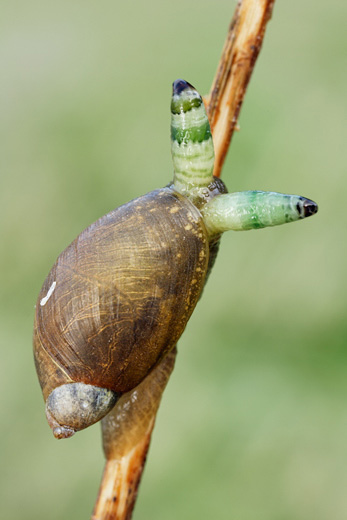
Snail - Notice the large green, pulsating tentacles

Occasionally an Amber Snail will have giant extended eye stalks that seem to have green, moving lateral stripes.  As you may have guessed this is a result of our friendly little Green-Banded Broodsac parasites.  The journey of this parasite begins as eggs in the droppings of birds (again, assuming the journey starts with the eggs).  The clueless snail thinks he has just struck gold and begins to feed on the bird droppings.  Naturally, the parasite then begins to hatch inside of the snail and infects their main digestive gland.  While in this gland the parasite will change into something called cercaries and will begin to produce sporocytes which are simply long tubes composed of hundreds of these cercaries. These sporocytes will extend into the snails tentacles and will begin to pulsate.  So why do these parasites go through all of this trouble?  Generally in nature bright green, pulsating movement is not necessarily the best camouflage.  That’s right my friends this parasite is actually trying to attract the attention of a bird.  As they should the bird will see this snail sticking out like a sore thumb and swoop down to eat.  It sort of reminds me of an alien calling for their mother ship.   Once the parasite is in the birds digestive tract they will change from cercaries to adults, lay eggs and the whole process starts over again.  I still find it absolutely incredible how manipulative parasites can be.

I hope you enjoyed our unique theme of Wild Facts.  We will be back to normal broadcasting tomorrow.  Have a great day!

Digg This
Reddit This
Stumble Now!
Buzz This
Vote on DZone
Share on Facebook
Bookmark this on Delicious
Kick It on DotNetKicks.com
Shout it
Share on LinkedIn
Bookmark this on Technorati
Post on Twitter
Google Buzz (aka. Google Reader)

Wild Fact #749 – Tongue-In-Cheek – Tongue-Eating Louse

August 10, 2010 - 12:00 am No Comments

The title of this Wild Fact should have been enough to keep you reading but I have to tell you up front that this post will highlight some of the most bizarre behaviour I have ever witnessed.  You are all in for a treat as we discover the Tongue-Eating Louse.  We might think this is incredibly interesting but I can guarantee you that the Rose Snapper, a type of fish, does not agree with us.

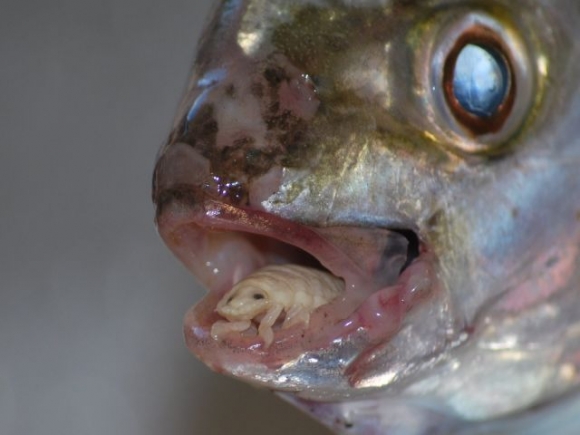
This parasite is a crustacean that tends to be about 3-4 cm (1.2-1.6″) long and is the only known parasite that actually replaces an organ.  Yes, that is correct, I said “replaces an organ”.  You can probably guess from their name which organ they replace.  When this parasite finds a Rose Snapper that they like they will attach themselves to the base of the fishes tongue.  At this point the parasitic crustacean will clamp down on the tongue and start drawing blood away from it using their claws.  Eventually the tongue will just wither away since it is being deprived of blood.

Tongue-Eating Louse

Once the pesky fish tongue is out of the way the parasitic louse will attach itself to the remaining tongue muscles and the fish can actually use the louse as a functioning tongue. Come on!  Tell me you are not impressed with this little parasite right now?  This has to be the most bizarre but fascinating thing I have heard of in a very long time.  This parasite will live out the rest of their life as the tongue of a fish where they will feed on the host’s blood or on the fish mucus.  I know, I too was hoping that the tongue would eat the same prey items as the fish.  Imagine how confused the fish would be if its tongue was stealing all of its food? This really sounds like it has the makings for a B-Rated horror movie.

That is the end of another parasitic Wild Fact which means tomorrow will be the last one dedicated to these weird little animals.

Digg This
Reddit This
Stumble Now!
Buzz This
Vote on DZone
Share on Facebook
Bookmark this on Delicious
Kick It on DotNetKicks.com
Shout it
Share on LinkedIn
Bookmark this on Technorati
Post on Twitter
Google Buzz (aka. Google Reader)

Wild Fact #750 – Now Wonder They are Crabby – Sacculina carcini

August 9, 2010 - 12:00 am No Comments

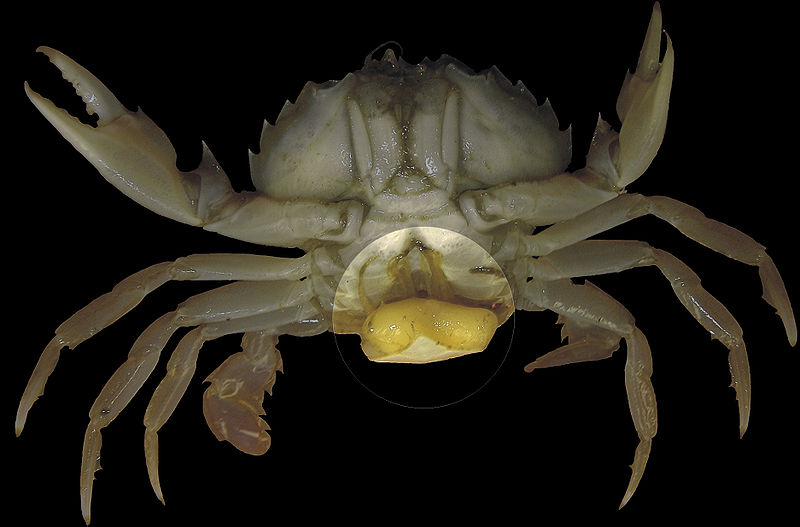
The parasite is highlighted in the circle. Photo by Hans Hillewaert

I hope all of you had a great weekend and managed to enjoy the fleeting days of summer (or winter if you live in the southern hemisphere).  In case you forgot, this weeks Wild Facts will be dedicated to parasites.  The previous two that we looked at were more of your typical “worm-like” parasites.  Today we are going to discover a barnacle that infects crabs.  Yes, you read that right.  A barnacle like the ones you see on the side of a big ship.  Unfortunately, this parasite looks nothing like the barnacles you find on a ship though (see picture below for proof).  They are classed as barnacles since they have similar larval forms as other barnacles. This particular one doesn’t even have a common name (as far as I can tell) and is referred to by their scientific name, Sacculina carcini. For the purpose of this Wild Fact, I am going to call it a Barnaclesite.

This Barnaclesite will just hang out in the water until they catch the scent of a wandering crab.  At this point they will ride the water until they land on the armour of the poor unsuspecting crab.  After successfully landing on the crab the Barnaclesite will crawl around until it finds a hole in their armour.  This spot is usually on their arm where the hair of the crab protrudes from.  Now that they found a chink in the armor the parasite will inject a long, hollow tube into the crab and deposit a blob-like substance comprised of a few cells.  The barnacle will then shed most of their body and will spend out the rest of their life in the form of a microscopic slug.

Microscopic view of the "Barnaclesite"

This slug which I will now refer to as a “Slugasite” will settle down in the crab’s underside where it forms a large bulb in the crab’s shell. As the parasite grows the bulb will also grow and can now be considered a knob like structure on the underbelly of the crab. Poor little crab! Interestingly enough each female parasite will usually carry two males along with her so they will constantly breed and produce new baby parasites.  Yuck!

This is the really fascinating part.  The crab becomes a mindless zombie and will stop growing as well as moulting. All of this energy is directed to the parasite. This next part is genius on the parasites part.  Remember that knob that the slugasite formed?  Well it just so happens to be sitting in the exact same location as a healthy crab’s brood pouch.  Normally the crab would keep their babies in this pouch and would constantly groom them so algae and fungi couldn’t grow (because having those parasites would be gross!).  An infected crab though treats this parasitic knob like it’s baby.  They will groom it and even help disperse the parasitic larvae by waving its claws to send the parasites through the water column.  How depressing and messed up is this for the poor crab?  By the way, that larvae she helped disperse will hang out and start the whole process over on another unsuspecting crab.

Well that just about does it for today’s Parasitic Wild Fact.  Stay tuned for another interesting fact tomorrow.

Digg This
Reddit This
Stumble Now!
Buzz This
Vote on DZone
Share on Facebook
Bookmark this on Delicious
Kick It on DotNetKicks.com
Shout it
Share on LinkedIn
Bookmark this on Technorati
Post on Twitter
Google Buzz (aka. Google Reader)

Wild Fact #751 – Party Crasher – Liver Fluke

August 6, 2010 - 12:00 am No Comments

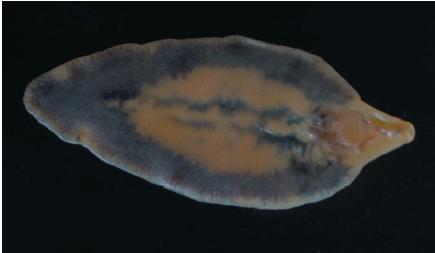
First of all I want to thank all of you for coming back to witness another interesting parasite.  On this beautiful Friday (I know it is beautiful since I will be on vacation fishing in Northern Ontario) we are going to look at the Liver Fluke.  These diverse little parasites like live in snails, ants and mammals such as cattle and sheep.

Liver Fluke Life Cycle

That stuff is all interesting but I want to talk about the impact these little parasites have on one of the most intriguing insects (in my opinion), ants. You see these little guys can completely disrupt the social structure of many ant colonies.  I guess I should slow down and tell you how the Liver Fluke, Ants and Mammals are all connected in this chain.  Well it starts when the eggs are swept out of the mammal host (I guess we could have the “chicken or the egg” argument here but to save time we will say it starts with the eggs) through their feces.  At this point a free-swimming parasite emerges and penetrates the tissues of a suitable snail.  Man, one more animal is impacted by these little guys.  The snail is just an intermediate host to allow the parasite to multiply.  This is not the type of messenger job I would apply for.  At this point a more developed stage of the parasite exits the snail and rests on aquatic vegetation.  This vegetation will be consumed by grazing herbivores and the whole process starts over.  Now you are probably wondering where the Ants play in all of this.  Well the slime that  an infected snail leaves behind is full of these developed parasites.  Ants will collect this slime and bring it home for everyone to eat.  Who knew that ants will eat the slime of a snail…ewwwww!

The fun begins once the ants ingest the parasite.  I am actually going to keep you in suspense with this.  I want you to watch the National Geographic video below as it beautifully describes how this parasite manipulates the ants for their own benefit.  I know it seems like I am just shirking my responsibility but who wants to read another paragraph on a Friday anyways.  Enjoy the clip and have a great weekend!

Digg This
Reddit This
Stumble Now!
Buzz This
Vote on DZone
Share on Facebook
Bookmark this on Delicious
Kick It on DotNetKicks.com
Shout it
Share on LinkedIn
Bookmark this on Technorati
Post on Twitter
Google Buzz (aka. Google Reader)

Wild Fact #752 – Bad Company – Nematomorpha

August 5, 2010 - 12:00 am No Comments

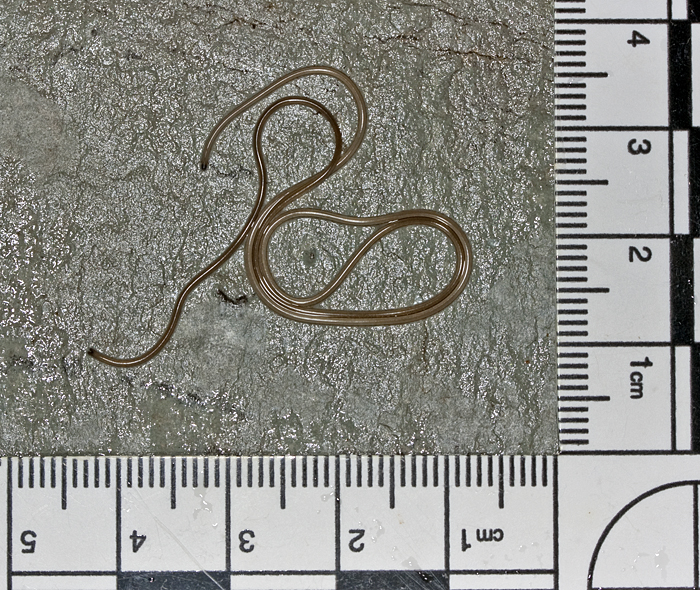
As you are reading this I am most likely on a plane heading to Ontario for a few days.  As you may know, when I am away I like to create a theme for Wild Facts so from now until next Thursday we are going to be looking at Parasites.  I know, I know, ewwwwww!  I am not going to lie to you there will be some gross animals in the next week but I will promise you that they are all very fascinating.  My favourite aspect of parasites is the impact they have on the host which is why I wanted to start out with the Nematomorpha, also known as Horsehair Worms, which really mess with their gracious hosts life.

Horsehair Worms range in size but the majority are about 50 to 100 cm (20-39″) long.  In some crazy cases this parasite has been able to get as long as 2 m (6′) which just boggles my mind. You can usually find the Horsehair Worms in puddles, watering troughs, streams and other damp areas.  We don’t need to worry about this particular parasite since they usually attach themselves to cockroaches, beetles, grasshoppers and even crustaceans. Only the larvae (juvenile stage) are parasitic while the adult worms are free living.

I mentioned that they cause their host to do some crazy things and I meant it.  A study conducted determined that the Horsehair worm will manipulate their grasshopper host into thinking it is a good idea for them to jump in the water.  This parasitic worm will develop inside of the land-dwelling grasshopper and when it becomes time for the larvae to emerge as an adult it will “brainwash” the grasshopper into committing suicide by jumping into a stream or other water body.  Around this time the long Horsehair Worm will exit its host and just leave the grasshopper there to die.  Talk about ungracious company!  I would hate to entertain these guys. They could have at least stuck around to help clean up the mess.  Below is a short clip which shows this process.  A poor helpless cricket falls victim to the deadly Horsehair Worm.

That does it for Day 1 of Parasite Week.  Check back tomorrow for a parasite that can create slaves!

Here is that video:

Digg This
Reddit This
Stumble Now!
Buzz This
Vote on DZone
Share on Facebook
Bookmark this on Delicious
Kick It on DotNetKicks.com
Shout it
Share on LinkedIn
Bookmark this on Technorati
Post on Twitter
Google Buzz (aka. Google Reader)